%20Redacto%20logo_New.png)


What Is DPO as a Service?


Most companies do not ask about DPO as a service because they suddenly care about job titles.
They ask because privacy work has started leaking across teams. Legal owns the notice. Security owns the breach process. Product ships new data flows. Support receives Data Principal requests. Procurement signs processors. The board wants to know who is accountable when all of this is questioned.
That is the real problem DPO as a service is meant to solve.
DPO as a service is an external or fractional Data Protection Officer function that helps an organisation run privacy governance, monitor compliance, advise leadership, coordinate rights and breach workflows, and maintain evidence.
Under the Digital Personal Data Protection Act, 2023, the statutory DPO obligation is narrower than many generic pages suggest: Section 10(2)(a) requires a Significant Data Fiduciary to appoint a Data Protection Officer who represents it under the Act, is based in India, is responsible to the board or similar governing body, and acts as the grievance redressal contact.
Our Redacto view is simple: do not buy a DPO-as-a-service retainer as a compliance costume. Buy it only if the provider can help your organisation make better privacy decisions and prove those decisions later.
Quick Verdict: The DPO Is a Decision Function, Not a Name on a Page
For Indian enterprises, DPO as a service makes sense when the company needs senior privacy judgment before it can justify or hire a full-time DPO.
It is most useful when:
- You are, or may become, a Significant Data Fiduciary under Section 10 of the Digital Personal Data Protection Act, 2023.
- Your board needs one accountable privacy line of sight across consent, DSARs, breach response, DPIAs, ROPA, vendors, and training.
- Privacy work is active enough to need a monthly operating rhythm, but not yet mature enough for a full internal DPO office.
- You need an India-based individual or specialist function that understands the DPDP Act rather than a generic global template.
It is the wrong buy when the provider is only selling legal review hours, a policy pack, or a name to publish in your privacy notice.
The data fiduciary still owns the risk. Section 33 of the DPDP Act, 2023 read with the Schedule allows penalties up to ₹250 crore for failure to take reasonable security safeguards under Section 8(5), and up to ₹150 crore for breach of Significant Data Fiduciary obligations under Section 10.
An external DPO can advise, monitor, escalate, and evidence. It cannot transfer board accountability away from the company.
The Founder Lens: Start With the Breakpoint, Not the Job Title
If I were advising a founder, CISO, or compliance head, I would not start with: “Do we need a DPO?”
I would start with five sharper questions:
- Who can explain every major personal data flow in the business?
- Who decides whether a new product feature needs a DPIA?
- Who receives, routes, and evidences Data Principal requests?
- Who briefs the board when a processor breach affects customers?
- Who can show the regulator a timestamped trail instead of a spreadsheet assembled after the fact?
If those answers are unclear, the company has a DPO problem even before the title is formally required.
This is where many DPO-as-a-service purchases go wrong. Teams buy the role before defining the decisions the role must own. The result is a polite monthly call, a few templates, and no real change in how privacy work moves through the company.
A useful DPO-as-a-service model should create operating pressure. It should force owners, deadlines, evidence, escalation paths, and board visibility.
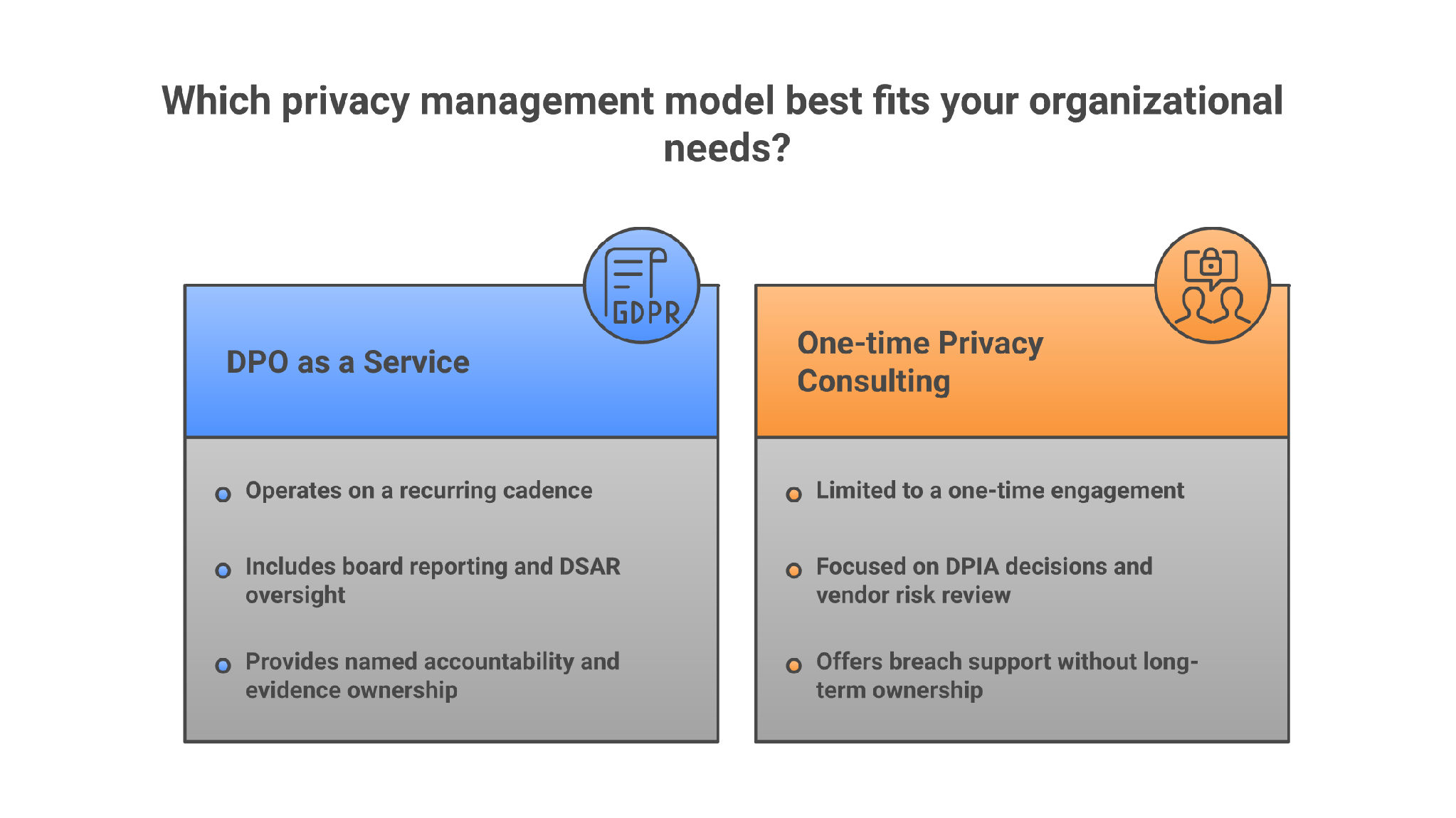
Who Actually Needs a DPO Under the DPDP Act?
Not every Indian company needs a statutory DPO under the Digital Personal Data Protection Act, 2023.
Section 10(1) says the Central Government may notify a Data Fiduciary, or class of Data Fiduciaries, as a Significant Data Fiduciary based on factors such as volume and sensitivity of personal data, risk to Data Principal rights, sovereignty and integrity of India, electoral democracy, security of the State, and public order.
Once a company is notified as a Significant Data Fiduciary, Section 10(2)(a) requires it to appoint a Data Protection Officer. The MeitY text of the Digital Personal Data Protection Act, 2023 says that the DPO must:
- Represent the Significant Data Fiduciary under the Act.
- Be based in India.
- Be an individual responsible to the board of directors or similar governing body.
- Be the point of contact for the grievance redressal mechanism under the Act.
Section 8(9) of the DPDP Act, 2023 also requires every Data Fiduciary to publish business contact information of the DPO, if applicable, or another person who can answer Data Principal questions about personal data processing.
That last point matters. Even when the statutory DPO trigger has not arrived, the operating requirement often has. Someone must still answer the Data Principal, coordinate internal facts, and make the organisation responsive.
Current DPDP Rules Status in 2026
As of 4 July 2026, the DPDP Rules are not merely a draft. The Government notified the Digital Personal Data Protection Rules, 2025 in November 2025.
The PIB release on the notified DPDP Rules describes an 18-month phased compliance timeline. The MeitY commencement notification brings Rules 1, 2, and 17 to 21 into force on Gazette publication, brings Rule 4 one year after publication, and brings Rules 3, 5 to 16, 22, and 23 eighteen months after publication. The notified Digital Personal Data Protection Rules, 2025 also make the DPO discussion more operational through rights handling, safeguards, breach notice, retention, and Significant Data Fiduciary obligations.
For DPO planning, the practical message is this:
- Do not wait for the last month of the phase-in period to decide who owns privacy governance.
- Do not assume every company needs a statutory DPO today.
- Do verify Significant Data Fiduciary status and thresholds against current MeitY or Gazette notifications, not a vendor roundup.
- Do build the evidence workflows now, because they take longer than appointing a person.
For BFSI, healthcare, pharma, telecom, ecommerce, and adtech teams, this is not a paperwork exercise. These businesses often process high-volume, sensitive, behavioural, financial, or health-linked data. The operational load arrives before the perfect legal certainty does.
What a Good DPO-as-a-Service Provider Should Actually Do
A good provider should not behave like a remote lawyer waiting for questions.
It should act like a privacy operating function.
1. Build the data map before giving opinions
The DPO function needs to know what personal data enters the company, why it is collected, where it is stored, who can access it, which processors touch it, and when it should be erased.
For a bank, that means KYC data, transaction records, mobile app events, call-centre recordings, loan workflows, collections, marketing lists, and processor access. For a hospital chain, it means patient records, diagnostics, insurance claims, appointment systems, lab integrations, and pharmacy records.
Without this map, every DSAR, breach review, PIA, and vendor assessment starts with guesswork.
2. Connect notice and consent to the real product workflow
Section 5 of the DPDP Act, 2023 requires notice to accompany or precede a consent request, including the personal data and purpose for processing. Section 6 governs consent and withdrawal.
The DPO-as-a-service provider should therefore check whether the notice matches the actual product, marketing, HR, analytics, support, and vendor workflows.
This is where the shallow fix breaks. A privacy notice in the footer is not a consent system. If withdrawal does not reach downstream systems, the evidence trail is already weak.
3. Run Data Principal rights as a workflow, not an inbox
Sections 11 to 14 of the DPDP Act, 2023 cover access to information, correction, completion, updating, erasure, grievance redressal, and nomination.
A DPO service should define:
- Intake channels.
- Identity verification.
- Internal routing.
- Response ownership.
- Exception handling.
- Approval gates.
- Evidence retention.
If all rights requests land in a shared mailbox with no queue, SLA, or audit trail, the company does not have a DPO function. It has a place where requests can disappear.
4. Coordinate breach readiness with security, not instead of security
Section 8(5) of the DPDP Act, 2023 requires reasonable security safeguards to prevent personal data breaches. Section 8(6) requires the Data Fiduciary to give notice of a personal data breach to the Board and each affected Data Principal in the prescribed form and manner.
The DPO does not replace the CISO. The DPO asks the privacy questions the incident channel often misses:
- Is personal data involved?
- Which Data Principals are affected?
- Which processors are in scope?
- What notice must be sent?
- What evidence must be preserved?
- What did the board know, and when?
That last question is why a DPO-as-a-service model must include escalation rights. A provider with no ability to reach leadership during a serious event is advisory decoration.
5. Turn DPIA, ROPA, and vendor risk into recurring governance
For Significant Data Fiduciaries, Section 10(2)(b) and Section 10(2)(c) of the DPDP Act, 2023 require an independent data auditor and periodic Data Protection Impact Assessment. Rule 13 of the Digital Personal Data Protection Rules, 2025 adds annual DPIA and audit expectations for Significant Data Fiduciaries.
The DPO service should help decide when a DPIA is triggered, what product and engineering teams must answer, which vendors need deeper review, and what records go to the board.
The point is not the document. The point is whether the workflow produces evidence before someone asks for it.
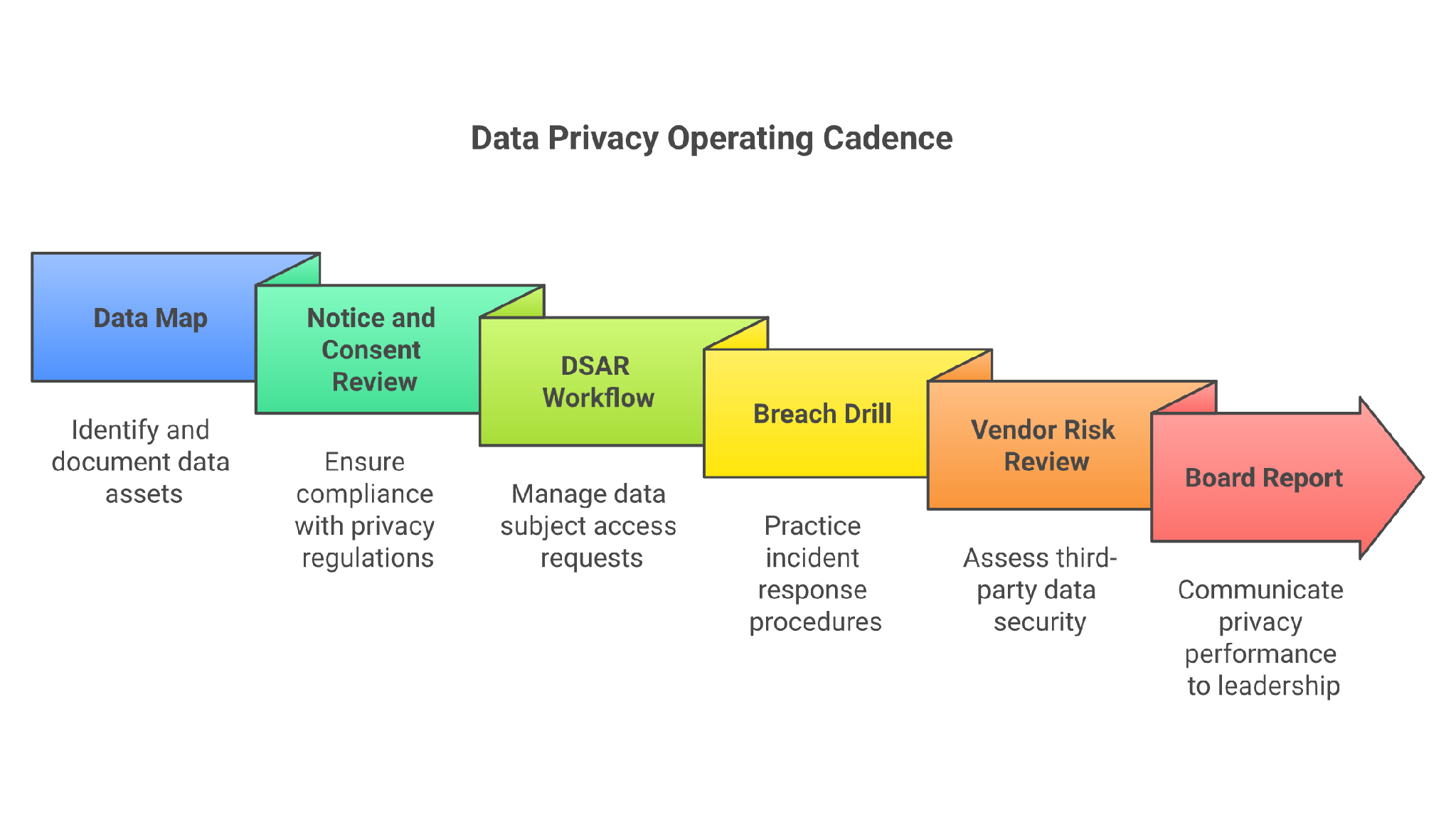
DPO as a Service vs In-House DPO vs Hybrid Model
The better question is not whether external is better than internal.
The better question is: where does privacy judgment need to sit for your risk level?
For Significant Data Fiduciaries, the reporting point cannot be hand-waved. Section 10(2)(a)(iii) of the DPDP Act, 2023 says the DPO must be an individual responsible to the board of directors or similar governing body.
That is where many outsourced models fail. They sell access to expertise, but they do not define the reporting line, escalation power, breach availability, internal system access, or evidence cadence.
What Does DPO as a Service Cost in India?
Public pricing is uneven, and buyers should treat visible numbers as directional.
One India-focused DPO service page lists indicative quarterly pricing of ₹80,000 to ₹1,50,000 for an advisory retainer, ₹2,50,000 to ₹5,00,000 for a dedicated DPO model, and ₹6,00,000+ per quarter for enterprise or global support, as shown on the DPO India service cost page reviewed on 4 July 2026.
The better pricing question is: what decisions and evidence are included?
Ask whether the retainer covers:
- Named DPO appointment or only advisory support.
- DPDP-only coverage or multi-jurisdictional advice.
- DSAR execution or only oversight.
- Breach response availability.
- DPIA review and drafting.
- Vendor contract and processor review.
- Board reporting.
- Training.
- Regulatory correspondence.
- Tool implementation and evidence management.
The cheapest DPO retainer can become expensive when every serious workflow is outside scope.
For Redacto, pricing is not public. Redacto uses a license-based; contact Redacto model. Buyers should separate two budgets: expert oversight and the compliance operating system used to produce consent logs, DSAR records, DPIA evidence, ROPA entries, vendor risk outputs, and audit reports.
Where Redacto Fits: The DPO Needs an Evidence Layer
Our product POV is direct: a DPO without evidence becomes a coordinator of promises.
Redacto is India’s DPDPA compliance platform for consent, data governance, vendor risk, PIA, ROPA, and DSAR automation. For a DPO function, the relevant Redacto capabilities include Unified Consent Manager, Automated DSAR Management, Privacy Impact Assessment Automation, AI-Driven Data Discovery & Mapping, Vendor Risk Management, Audit & Reporting, and Unified Privacy & Security Trust Center.
Redacto does not replace the DPO. It gives the DPO a system of record for the work that otherwise sits across email, spreadsheets, product docs, ticketing tools, and vendor folders.
That evidence layer matters because the DPO needs to answer questions like:
- Which consent record supports this processing purpose?
- Did withdrawal propagate to the right systems?
- Which DSARs are open, overdue, rejected, or completed?
- Which product changes triggered a PIA?
- Which vendors process which categories of personal data?
- What report can the board inspect this quarter?
Who should not choose Redacto? If the primary need is a global multi-regulation privacy suite with deep GDPR, CCPA, LGPD, and regional templates out of the box, a global incumbent may be the better first fit. Redacto is India/DPDPA-first by design.
A competitor-wins scenario is clear: a multinational privacy office already standardised on OneTrust globally may prefer extending that stack. An Indian BFSI, healthcare, pharma, telecom, ecommerce, or adtech team preparing for DPDP evidence may want a focused DPDPA operating layer.
What Most DPO-as-a-Service Pages Miss
Generic DPO-as-a-service pages usually explain outsourcing, cost saving, and access to expertise. That answers the top-of-funnel question, but it does not help an Indian buyer decide what to build.
The missing layer is operational:
- DPDP Act Section 10 is not the same as the GDPR DPO appointment model.
- DPO appointment is tied to Significant Data Fiduciary status, not every company by default.
- Section 8(9) still creates a contact-and-response pressure even before statutory DPO appointment.
- Board responsibility is part of the DPO design, not an afterthought.
- DPIA, DSAR, breach, consent, vendor, and ROPA workflows need evidence trails.
- A DPO provider without system access can advise, but may not be able to verify.
That is the Redacto POV: the market talks too much about who wears the DPO title and too little about whether the company can prove the privacy work happened.
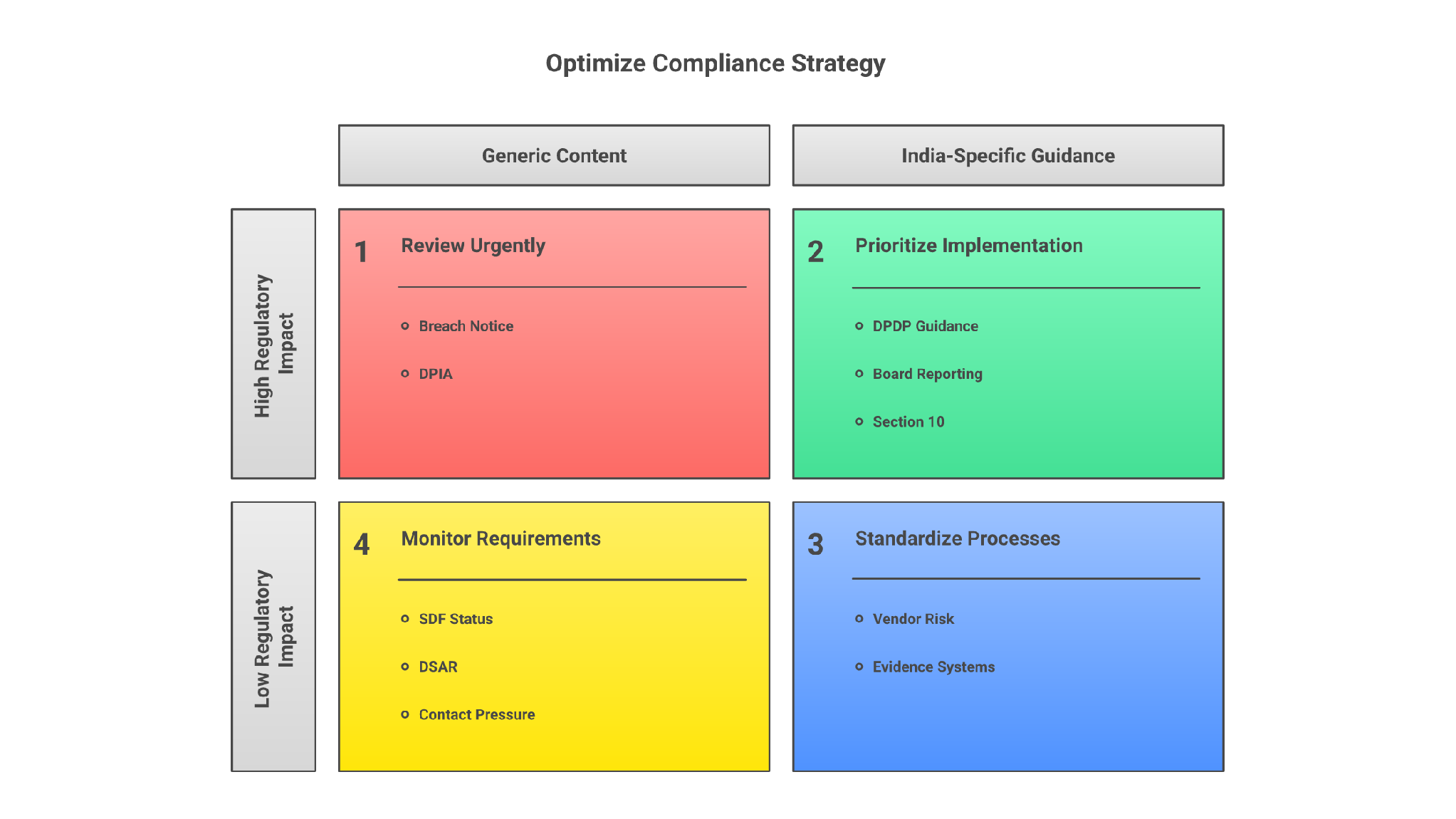
How to Choose a DPO-as-a-Service Provider
Use this checklist before signing a retainer.
1. Ask what exact role they are playing
Are they the named DPO for a Section 10 use case, a privacy advisor, a DSAR operator, a breach coordinator, a DPIA reviewer, or a compliance program manager?
Those are related roles. They are not the same contract.
2. Test the Section 10 fit
If you are or may become a Significant Data Fiduciary, ask:
- Who is the named individual?
- Are they based in India?
- Will they be responsible to the board or similar governing body?
- Will they be the grievance redressal contact?
- What internal access and escalation rights will they have?
If the answer is a rotating helpdesk, it is not enough for a serious Section 10 use case.
3. Check independence and conflicts
Do not appoint someone as DPO if they also make the decisions the DPO is supposed to monitor.
A provider that designs your adtech targeting logic, decides retention rules, or owns the disputed processing purpose may not be independent enough to monitor that same work.
4. Demand artefacts, not only advice
Ask for sample outputs:
- Board report format.
- DPIA decision record.
- DSAR workflow.
- Breach response checklist.
- Vendor risk questionnaire.
- Data map or ROPA structure.
- Monthly compliance calendar.
If the provider cannot show how advice becomes evidence, the service may become expensive commentary.
5. Match cadence to risk
A low-volume B2B SaaS company may need quarterly review and DSAR readiness.
A healthtech platform processing patient data, a fintech handling KYC and transaction data, or an ecommerce platform with high-volume behavioural data needs a deeper cadence: more frequent reviews, breach drills, vendor checks, product intake, and board reporting.
6. Write exclusions into the contract
Clarify whether breach support, DSAR execution, DPIA drafting, vendor contract review, employee training, regulatory correspondence, product review, and tool implementation are included.
The retainer should say what happens when the company is under pressure, not only what happens in a quiet month.
Common Mistakes When Buying DPO as a Service
The first mistake is buying the title before mapping the decisions.
If you do not know which teams the DPO can challenge, which risks reach the board, and which records must be maintained, the service will drift into generic advice.
The second mistake is treating the provider as a liability shield. The DPO can monitor, advise, report, and escalate. The Data Fiduciary still determines the purpose and means of processing, and the board still owns the risk.
The third mistake is ignoring internal ownership. Even with an external DPO, legal, security, product, HR, support, procurement, and operations must still execute their parts of the workflow.
The fourth mistake is running privacy from documents alone. Policies matter, but the harder question is whether consent, DSARs, PIAs, vendors, and breach response produce evidence.
The fifth mistake is waiting for formal Significant Data Fiduciary notification before building readiness. If your business model already points toward high-volume or high-sensitivity processing, use the phase-in period to build the operating model now.
Final Answer: Should You Use DPO as a Service?
Use DPO as a service if you need senior privacy judgment, Section 10 readiness, and a repeatable DPDP operating model, but cannot yet build a full in-house DPO office.
Do not use it as a substitute for accountability.
The model I would want to see inside an Indian enterprise is:
- An internal business owner for privacy execution.
- A DPO or external privacy expert for independent judgment and escalation.
- A DPDPA compliance system for evidence, workflow, and audit reporting.
That structure turns privacy from a policy folder into an operating system a CISO, DPO, CTO, founder, or board member can inspect.
Monday morning next step: create a one-page DPO readiness register. List your major data flows, whether you may qualify as a Significant Data Fiduciary under Section 10(1) of the DPDP Act, 2023, who currently answers Data Principal questions under Section 8(9), who would brief the board after a breach, and which systems hold evidence for consent, DSARs, DPIAs, ROPA, and vendor risk. If any row says “unclear,” that is where the DPO-as-a-service conversation should start.