Table of contents

What is the Role of Consent Manager in the DPDP Act?

By
sheik
Last Updated on:
May 5, 2026

Most websites today just show you an “Accept All” button.

You click it without really knowing what you agreed to and later, if you want to take that consent back, you usually can’t find where to do it.

That’s the problem the Digital Personal Data Protection Act, 2023 is trying to fix.

Instead of leaving you stuck with unclear permissions, it introduces something new called a Consent Manager.

It is a way for you to actually stay in control of your data, without chasing settings across different apps and websites.

In this guide, you’ll learn:

  • What a Consent Manager actually does
  • Why it exists in the first place
  • And how it helps both you and the companies handling your data

TL;DR

A Consent Manager is a registered platform that helps users control their consent. It lets users give, review, and withdraw consent in one place. It acts on behalf of the user (not the company). It makes consent clear, trackable, and easy to manage

What is the Role of a Consent Manager in the DPDP Act?

A Consent Manager is a system that helps you control how your personal data is used under the Digital Personal Data Protection Act, 2023.
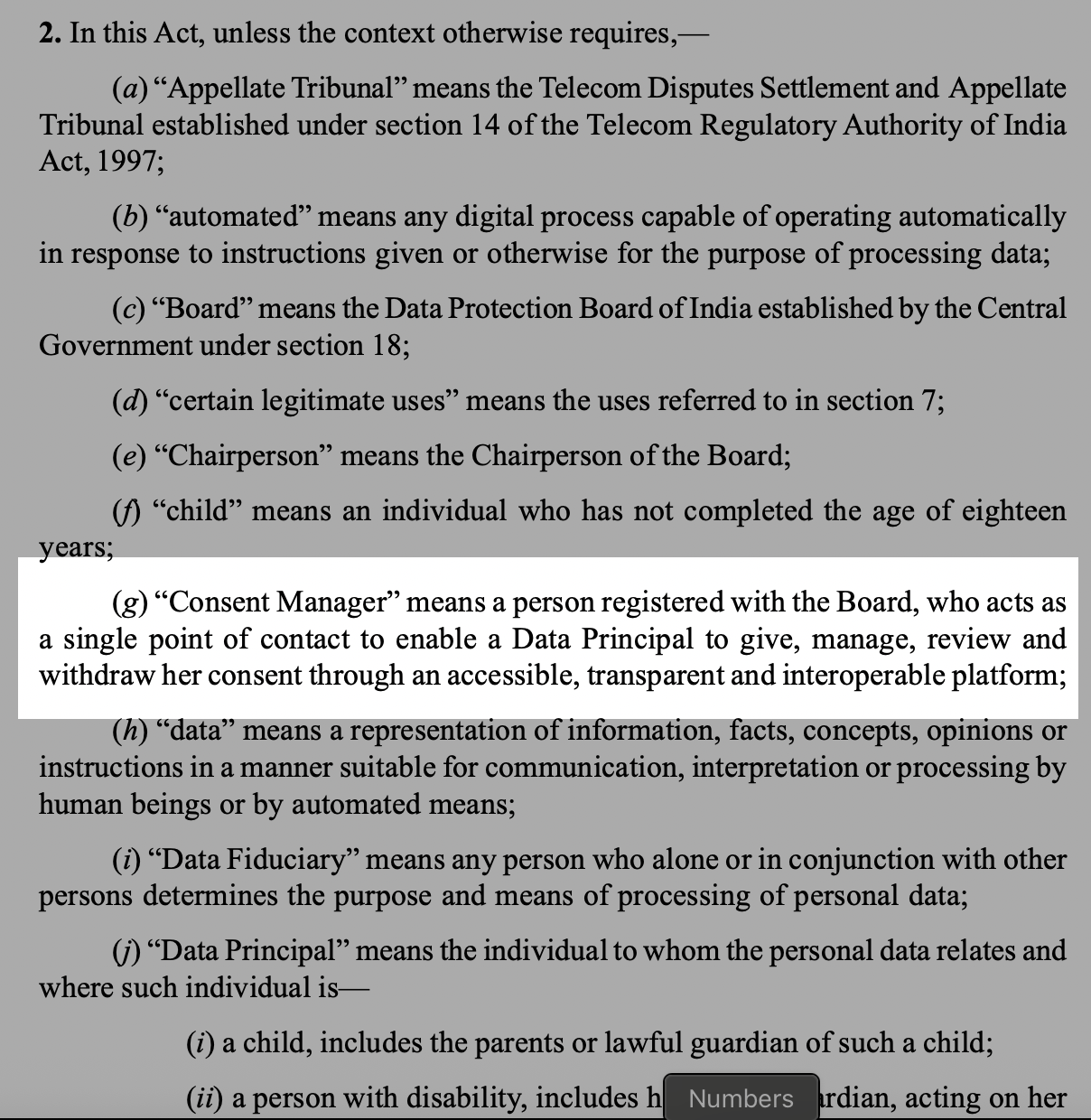
Definition of consent manager in DPDP Act
This image shows the Definition of consent manager in DPDP Act

Instead of dealing with consent on every website or app separately, it gives you one place to manage everything.

A Consent Manager helps you:

  • Give permission to companies to use your data
  • See what you’ve already agreed to
  • Take that permission back anytime

You don’t have to search through settings or emails anymore. Everything is handled in one place.

It is a user control layer between you and companies using your data.

Why Consent Managers Exist

Before the Digital Personal Data Protection Act, 2023, consent was messy.

Before DPDP

  • Every app had its own consent system
  • You clicked “Accept” without knowing the full impact
  • Your permissions were scattered across platforms
  • And if you wanted to withdraw consent, it was almost impossible

You didn’t really control your data. You just agreed and moved on.

What DPDP Changed

DPDP made consent stricter and more user-focused.

Now, consent must be:

  • Clear
  • Informed
  • Specific
  • Easy to withdraw

This means companies can’t rely on vague or hidden permissions anymore.

Where Consent Managers Fit

Consent Manager makes these rules practical in real life by:

  • Giving you one place to manage consent
  • Making withdrawal simple
  • Keeping a clear record of your choices

How a Consent Manager Works?
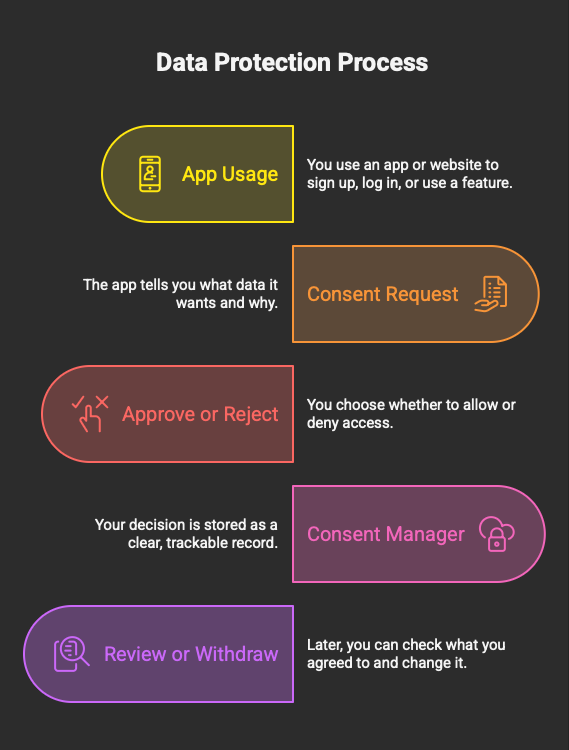
Data protection process of Consent Managers
This image shows the Data protection process of Consent Managers

Here’s how it works in real life under the Digital Personal Data Protection Act, 2023:

  1. You use an app or website: You sign up, log in, or try to use a feature.
  1. You see a clear consent request: The app tells you what data it wants and why.
  1. You approve or reject it: You choose whether to allow or deny access.
  1. The Consent Manager records your choice: Your decision is stored as a clear, trackable record.
  1. You can review or withdraw anytime: Later, you can check what you agreed to and change it in one place.

Behind the scenes, this runs on secure systems (APIs, encryption) so your choices are safely recorded and shared without exposing your data.

Key Features of a Consent Manager

Here are the key features you should expect:

  • You get one dashboard for all your consents, so you can see and manage permissions across different apps in one place
  • You can withdraw consent anytime without digging through settings
  • You can clearly see what you agreed to and when
  • Your consent is handled securely, without exposing your actual data
  • You can manage everything across multiple apps without jumping between platforms

Who Should Care About Consent Managers?

For you (as a user / Data Principal)

  • You want clear control over how your personal data is used
  • You don’t want to deal with hidden tracking or unclear permissions
  • You want an easy way to check and withdraw consent anytime

For businesses (Data Fiduciaries)

  • You need to prove that consent was taken properly
  • You want to avoid compliance risks and penalties
  • You need clean, trackable consent records across systems

For Example

You use a banking app, a shopping app, and a health app. Normally, each one has its own settings, so you end up managing your consent separately in all three places.

With a Consent Manager:

  • You see all your consents in one dashboard
  • You can check what each app is allowed to access
  • You can withdraw consent from any app in a few clicks

Instead of switching between apps, you manage everything from one place.

Do Businesses Need a Consent Manager?

A Consent Manager is not mandatory in every case under the Digital Personal Data Protection Act, 2023.

But it becomes very useful when:

  • You handle user data at scale and need a structured way to manage consent
  • You need audit-proof records to show that consent was taken properly
  • You operate across multiple systems, apps, or vendors where consent can get fragmented

In simple terms, you can manage without it at a small scale, but as your data grows, a Consent Manager makes compliance much easier and more reliable.

lHow to Choose Between Different Types of Consent Management Solutions

Consent Manager vs Regular Consent Tools (CMPs)

Feature Consent Manager Basic CMP
Legal recognition Yes (under the Digital Personal Data Protection Act, 2023) No
User control High, you manage everything in one place Limited, tied to one site
Withdrawal Easy, you can revoke anytime from a dashboard Often complex, buried in settings
Scope Cross-platform, works across apps/services Single website or app only

As your systems grow, consent is no longer just a checkbox, it becomes something you need to track, prove, and manage continuously.

That’s usually the point where teams move away from manual tracking or basic tools.

Some teams handle this by using platforms like Redacto that bring these pieces together in one place, instead of managing them separately.
Redacto.ai Homepage
This image shows the Redacto.ai Homepage

This approach is usually more practical when dealing with multiple systems and higher volumes of user data.

8 Best Consent Management Platforms for Indian Enterprises (DPDPA-Compliant 2026)

Conclusion

Consent managers turn consent from a confusing checkbox into something that individuals (data principals) can actually control.

For businesses that collect and use personal data, they make it easier to track, manage, and prove consent properly.

For individuals whose data is being used, they make it easy to see what they agreed to and withdraw consent anytime.

As DPDP implementation moves forward, managing consent manually will become harder, especially as data flows across multiple systems and vendors.

In those cases, exploring structured platforms like Redacto can help teams manage consent and related compliance workflows in a more organized way, instead of relying on scattered tools or manual tracking.

Compliance

What is the Role of Consent Manager in the DPDP Act?

sheik
Defender of data

Most websites today just show you an “Accept All” button.

You click it without really knowing what you agreed to and later, if you want to take that consent back, you usually can’t find where to do it.

That’s the problem the Digital Personal Data Protection Act, 2023 is trying to fix.

Instead of leaving you stuck with unclear permissions, it introduces something new called a Consent Manager.

It is a way for you to actually stay in control of your data, without chasing settings across different apps and websites.

In this guide, you’ll learn:

  • What a Consent Manager actually does
  • Why it exists in the first place
  • And how it helps both you and the companies handling your data

TL;DR

A Consent Manager is a registered platform that helps users control their consent. It lets users give, review, and withdraw consent in one place. It acts on behalf of the user (not the company). It makes consent clear, trackable, and easy to manage

What is the Role of a Consent Manager in the DPDP Act?

A Consent Manager is a system that helps you control how your personal data is used under the Digital Personal Data Protection Act, 2023.

Definition of consent manager in DPDP Act
This image shows the Definition of consent manager in DPDP Act

Instead of dealing with consent on every website or app separately, it gives you one place to manage everything.

A Consent Manager helps you:

  • Give permission to companies to use your data
  • See what you’ve already agreed to
  • Take that permission back anytime

You don’t have to search through settings or emails anymore. Everything is handled in one place.

It is a user control layer between you and companies using your data.

Why Consent Managers Exist

Before the Digital Personal Data Protection Act, 2023, consent was messy.

Before DPDP

  • Every app had its own consent system
  • You clicked “Accept” without knowing the full impact
  • Your permissions were scattered across platforms
  • And if you wanted to withdraw consent, it was almost impossible

You didn’t really control your data. You just agreed and moved on.

What DPDP Changed

DPDP made consent stricter and more user-focused.

Now, consent must be:

  • Clear
  • Informed
  • Specific
  • Easy to withdraw

This means companies can’t rely on vague or hidden permissions anymore.

Where Consent Managers Fit

Consent Manager makes these rules practical in real life by:

  • Giving you one place to manage consent
  • Making withdrawal simple
  • Keeping a clear record of your choices

How a Consent Manager Works?

Data protection process of Consent Managers
This image shows the Data protection process of Consent Managers

Here’s how it works in real life under the Digital Personal Data Protection Act, 2023:

  1. You use an app or website: You sign up, log in, or try to use a feature.
  1. You see a clear consent request: The app tells you what data it wants and why.
  1. You approve or reject it: You choose whether to allow or deny access.
  1. The Consent Manager records your choice: Your decision is stored as a clear, trackable record.
  1. You can review or withdraw anytime: Later, you can check what you agreed to and change it in one place.

Behind the scenes, this runs on secure systems (APIs, encryption) so your choices are safely recorded and shared without exposing your data.

Key Features of a Consent Manager

Here are the key features you should expect:

  • You get one dashboard for all your consents, so you can see and manage permissions across different apps in one place
  • You can withdraw consent anytime without digging through settings
  • You can clearly see what you agreed to and when
  • Your consent is handled securely, without exposing your actual data
  • You can manage everything across multiple apps without jumping between platforms

Who Should Care About Consent Managers?

For you (as a user / Data Principal)

  • You want clear control over how your personal data is used
  • You don’t want to deal with hidden tracking or unclear permissions
  • You want an easy way to check and withdraw consent anytime

For businesses (Data Fiduciaries)

  • You need to prove that consent was taken properly
  • You want to avoid compliance risks and penalties
  • You need clean, trackable consent records across systems

For Example

You use a banking app, a shopping app, and a health app. Normally, each one has its own settings, so you end up managing your consent separately in all three places.

With a Consent Manager:

  • You see all your consents in one dashboard
  • You can check what each app is allowed to access
  • You can withdraw consent from any app in a few clicks

Instead of switching between apps, you manage everything from one place.

Do Businesses Need a Consent Manager?

A Consent Manager is not mandatory in every case under the Digital Personal Data Protection Act, 2023.

But it becomes very useful when:

  • You handle user data at scale and need a structured way to manage consent
  • You need audit-proof records to show that consent was taken properly
  • You operate across multiple systems, apps, or vendors where consent can get fragmented

In simple terms, you can manage without it at a small scale, but as your data grows, a Consent Manager makes compliance much easier and more reliable.

lHow to Choose Between Different Types of Consent Management Solutions

Consent Manager vs Regular Consent Tools (CMPs)

Feature Consent Manager Basic CMP
Legal recognition Yes (under the Digital Personal Data Protection Act, 2023) No
User control High, you manage everything in one place Limited, tied to one site
Withdrawal Easy, you can revoke anytime from a dashboard Often complex, buried in settings
Scope Cross-platform, works across apps/services Single website or app only

As your systems grow, consent is no longer just a checkbox, it becomes something you need to track, prove, and manage continuously.

That’s usually the point where teams move away from manual tracking or basic tools.

Some teams handle this by using platforms like Redacto that bring these pieces together in one place, instead of managing them separately.

Redacto.ai Homepage
This image shows the Redacto.ai Homepage

This approach is usually more practical when dealing with multiple systems and higher volumes of user data.

8 Best Consent Management Platforms for Indian Enterprises (DPDPA-Compliant 2026)

Conclusion

Consent managers turn consent from a confusing checkbox into something that individuals (data principals) can actually control.

For businesses that collect and use personal data, they make it easier to track, manage, and prove consent properly.

For individuals whose data is being used, they make it easy to see what they agreed to and withdraw consent anytime.

As DPDP implementation moves forward, managing consent manually will become harder, especially as data flows across multiple systems and vendors.

In those cases, exploring structured platforms like Redacto can help teams manage consent and related compliance workflows in a more organized way, instead of relying on scattered tools or manual tracking.

Frequently asked  questions

sheik
Security Engineer
Before we patch the system, we break it—in thought.

Contact Us

Thank you! Your submission has been received!
Oops! Something went wrong while submitting the form.

Your Trusted partner