%20Redacto%20logo_New.png)


14 Best DPDPA Compliance Consulting Services and Software for Indian Businesses (2026 Guide)


DPDPA compliance looks straightforward on paper. Then you try to actually do it.
On a recent call, a compliance lead stated, “We collect consent everywhere… but if someone asks for proof, we don’t know where it is.”
That’s not a rare case. It’s the default.
Most teams are dealing with:
- Data scattered across tools
- Consent collected but not centrally tracked
- Vendor risks sitting in spreadsheets
- No clear system for handling user requests
We’ve also seen teams say the same thing in different ways that compliance becomes a manual, never-ending task that no one fully owns.
That’s the real problem.
DPDPA compliance is not just about ticking the checklist. It’s about building a system that can handle consent, data, vendors, and user requests continuously without breaking.
In this guide, you’ll find the best DPDPA compliance consulting services and softwares in India, so you can choose a solution that actually works in practice, not just on paper.
TL;DR
Here’s a quick breakdown of which DPDPA compliance software or consulting service makes sense based on what you’re trying to solve:
- Redacto works best if you want an all-in-one India-focused DPDPA platform for consent, DSAR, DPIA, vendor risk, and data governance.
- KPMG is a better fit if you need expert-led consulting, readiness assessment, governance design, and implementation support.
- Netrika makes sense if you want DPDP gap assessment, policy setup, DPO support, and risk-based consulting before choosing software.
- KavachOne is useful if you want DPDP compliance tools along with cybersecurity, GRC, SOC 2, and PCI DSS support.
- Illume Intelligence fits better if your priority is security testing, audit preparation, and vulnerability assessment before compliance rollout.
- DPDP Consultants is a good option if you want consulting plus built-in tools for consent, DPIA, DSAR, and vendor risk.
- Securze works best if you need cybersecurity-led DPDP consulting with VAPT, red teaming, managed SOC, and audit readiness.
- BigID is best for large enterprises that need deep data discovery, classification, and visibility across complex data environments.
- TrustArc is worth considering if you need privacy software plus consulting support to build a structured enterprise privacy program.
- Securiti.ai fits large teams that need strong automation across data discovery, DSAR, vendor risk, privacy, and multi-cloud governance.
- Lightbeam works well if your main goal is real-time visibility into sensitive data and automated data classification.
- Privado AI is best for engineering-led teams that need code, app, web, cookie, SDK, and data-flow scanning.
- Privy by IDfy makes sense if you want an India-first consent and governance platform backed by IDfy’s trust infrastructure.
- PrivEzi fits teams that want a modular, India-first privacy platform covering consent, DSAR, data discovery, vendor risk, and breach workflows.
How We Evaluated These DPDPA Consulting Services & Softwares
This comparison is based on publicly available product and service information at the time of review. It is written to help businesses shortlist DPDPA consulting services and software, not to provide legal advice or make definitive claims about any provider. Please verify the latest capabilities, service scope, certifications, support, and pricing directly with each provider before making a decision.
To make this list useful, we evaluated tools based on what actually matters in real-world compliance.
1. Compliance Coverage
Does the tool cover core requirements like consent, DSAR, DPIA, and vendor risk, or just one part of it?
2. Automation Level
Can it reduce manual work, or does it still rely on teams to manage workflows?
3. Integrations
Can it connect with your existing stack (CRM, apps, databases), or does it create more silos?
4. Pricing (India-Focused)
Is it practical for Indian businesses, or only built for global enterprises?
5. Ease of Use
Can legal, tech, and operations teams actually use it without heavy training?
6. Industry Adoption
Is it proven in sectors like BFSI, healthcare, or e-commerce where compliance is critical?
This ensures the list is not just feature-based, but practical, realistic, and decision-focused.
14 DPDPA Compliance Consulting Services and Softwares
This comparison is based on public positioning and typical use cases. Feature depth, deployment model, and DPDP-specific coverage should be validated with each vendor.
1. Redacto (Best All-in-One DPDPA Platform for Indian Businesses)
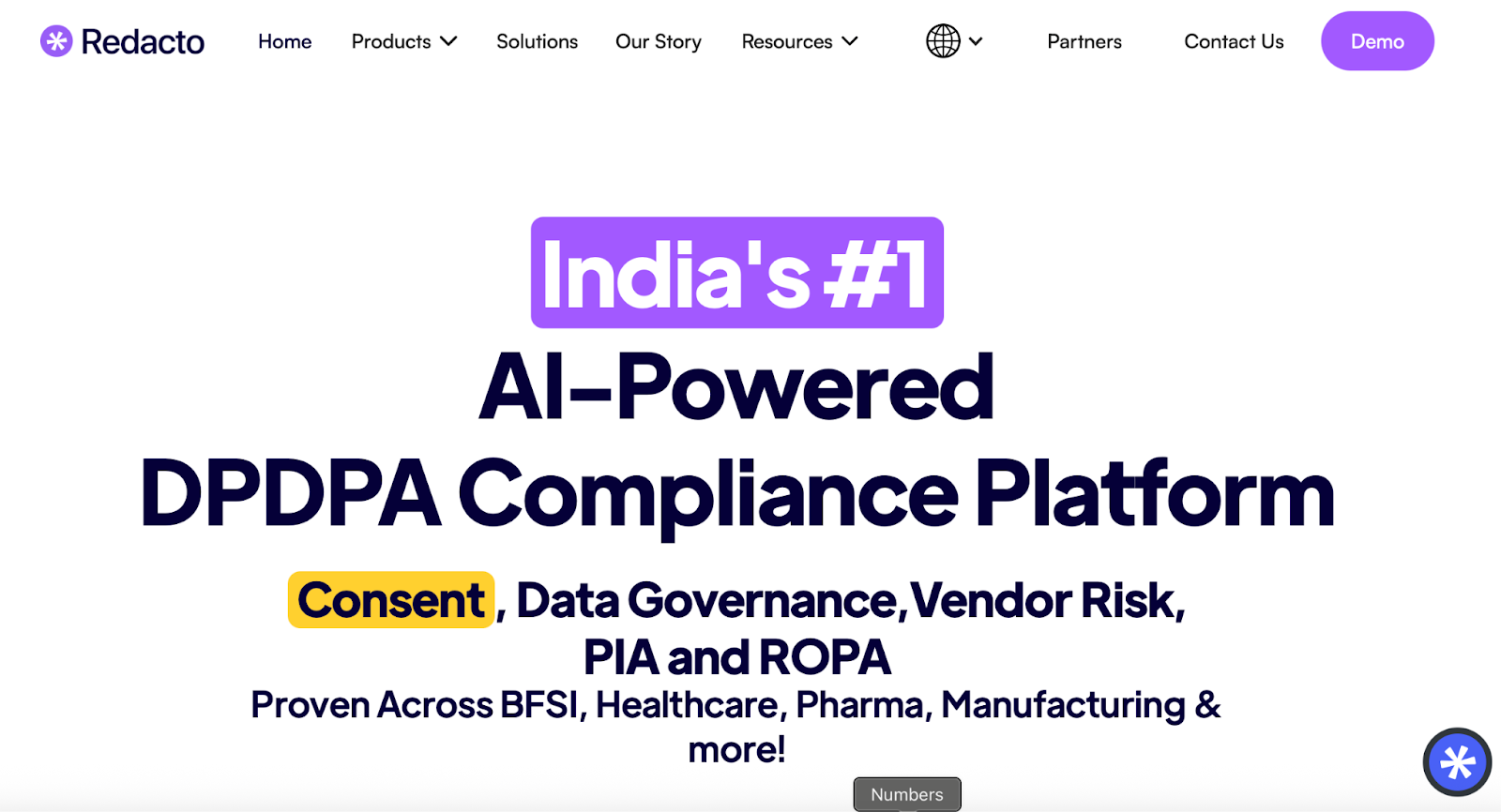
Redacto is an AI DPDPA compliance platform built specifically for Indian businesses.
It combines consent, data governance, vendor risk, and compliance workflows into one unified system instead of spreading them across multiple tools.
What Makes It Different
Redacto focuses on solving the real execution gap in compliance.
Instead of offering separate modules, it brings everything into one platform, consent management, DSAR, DPIA, and vendor risk.
It also stands out with:
- 7000+ integrations to connect with existing systems
- AI-powered automation, including ~98.5% accuracy in Privacy Impact Assessments
- Fast deployment compared to traditional enterprise tools
The platform is designed to reduce manual effort across compliance workflows, especially in high-data environments.
Key Features
- Unified consent management with multilingual support
- Data discovery and mapping across systems
- Automated vendor risk assessments
- DSAR workflow automation
- Breach notification and compliance dashboards
Pros
- Built specifically for Indian compliance (DPDPA-ready)
- Strong automation reduces manual workload
- Faster implementation compared to legacy tools
- Works across industries like BFSI, healthcare, and e-commerce
Cons
- Pricing may be high for smaller teams or early-stage startups
Best For
Mid-to-large businesses in BFSI, healthcare, pharma, and data-heavy industries that need a scalable, all-in-one compliance system rather than fragmented tools.
2. KPMG (Best for DPDPA Consulting & Implementation Support)
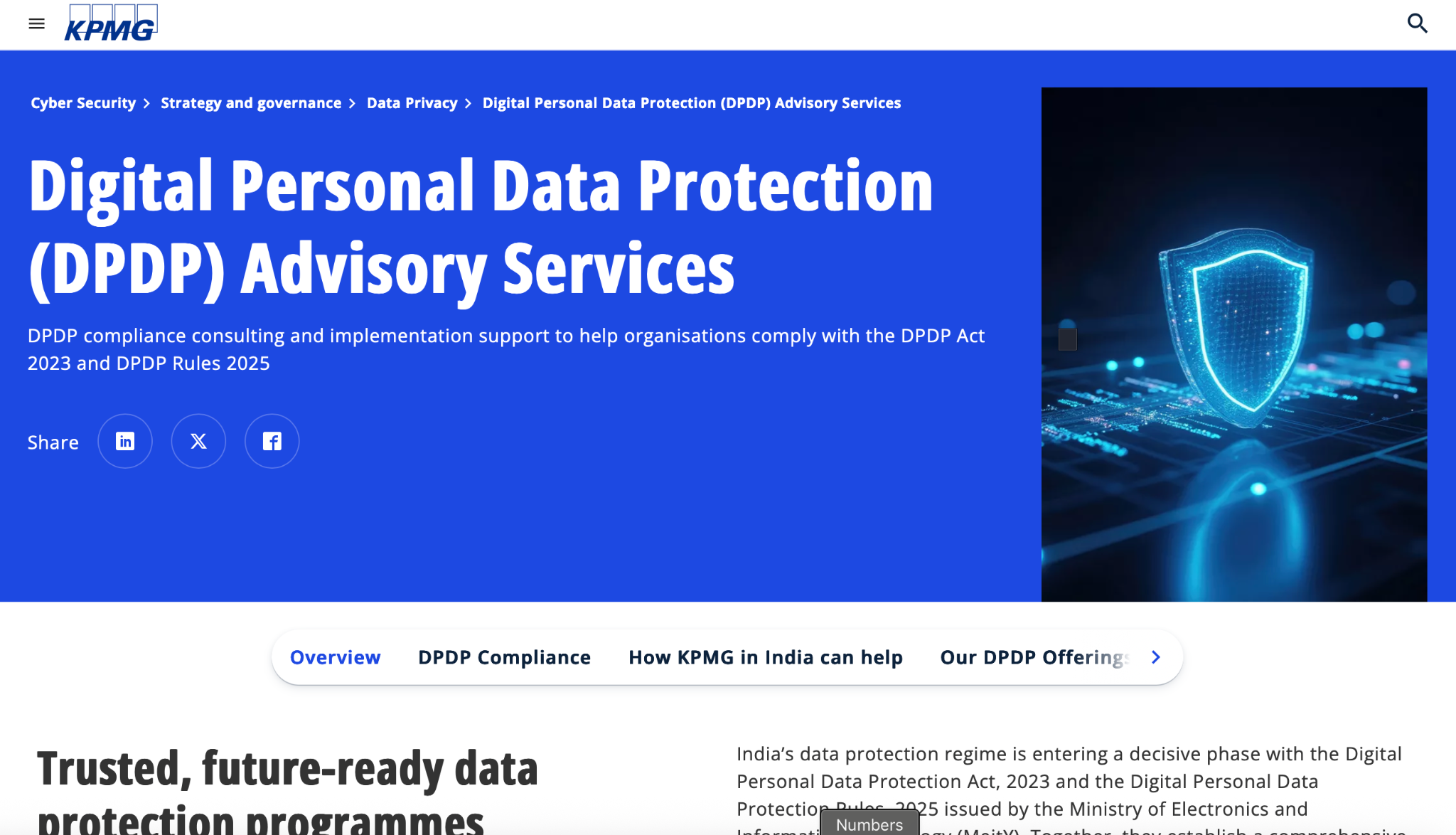
KPMG is a global consulting firm that offers DPDP advisory and implementation services to help organizations design, assess, and operationalize privacy programs.
Instead of software, it focuses on building a complete compliance framework tailored to your business.
What Makes It Different
KPMG is not a tool, it’s a consulting-led approach to compliance.
Key differentiators:
- End-to-end DPDP advisory (strategy → implementation → operations)
- Strong focus on privacy operating models and governance design
- Combines legal, risk, and technology expertise
- Helps build privacy-by-design systems, not just documentation
It is ideal for companies that need guidance on how to actually implement DPDPA, not just track it.
Pros
- Highly experienced consultants with strong domain expertise in privacy and cybersecurity
- Helps design complete privacy programs, not just tools or workflows
- Strong support for audits, readiness assessments, and compliance roadmaps
- Useful for building governance structures and privacy operating models
- Delivers structured insights and practical implementation guidance
- Trusted by large enterprises for complex compliance transformations
Cons
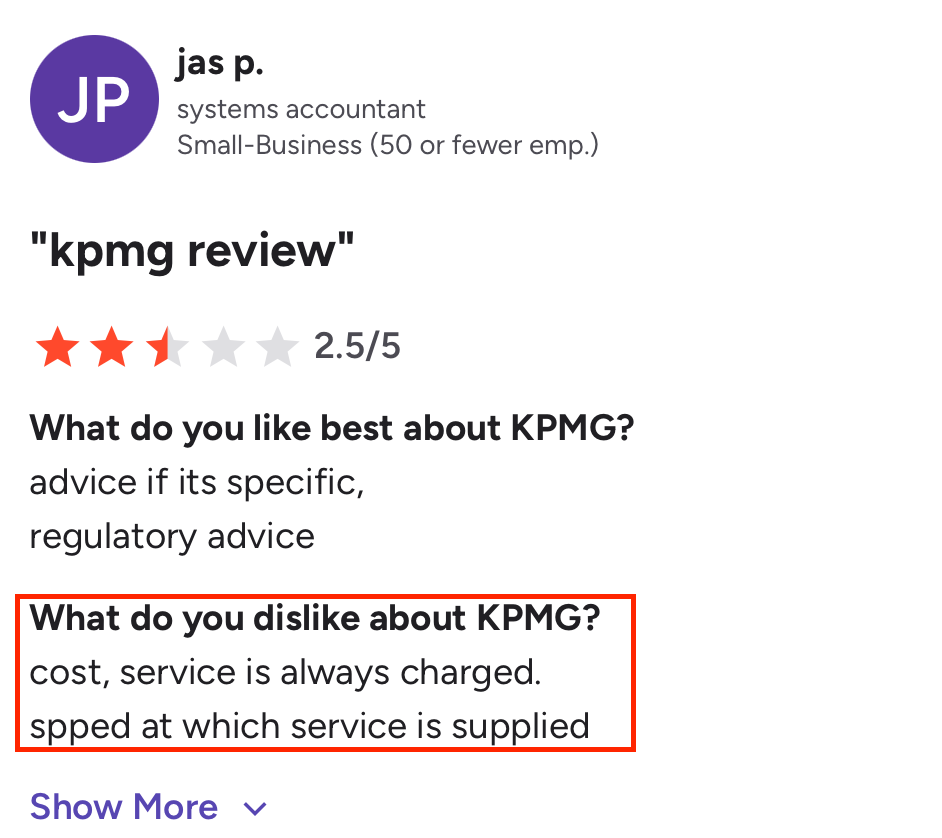
- High cost compared to most tools and consulting alternatives
- Engagements can be time-consuming depending on scope
- Ongoing support and changes may increase overall cost
- Requires internal teams to execute recommendations post-consulting
- Not a software solution, so needs to be paired with tools for execution
Best For
Large enterprises or regulated organizations that need expert-led DPDPA strategy, audits, and implementation support before adopting a compliance platform.
3. Netrika (Best for DPDP Gap Assessment & Risk-Based Consulting)
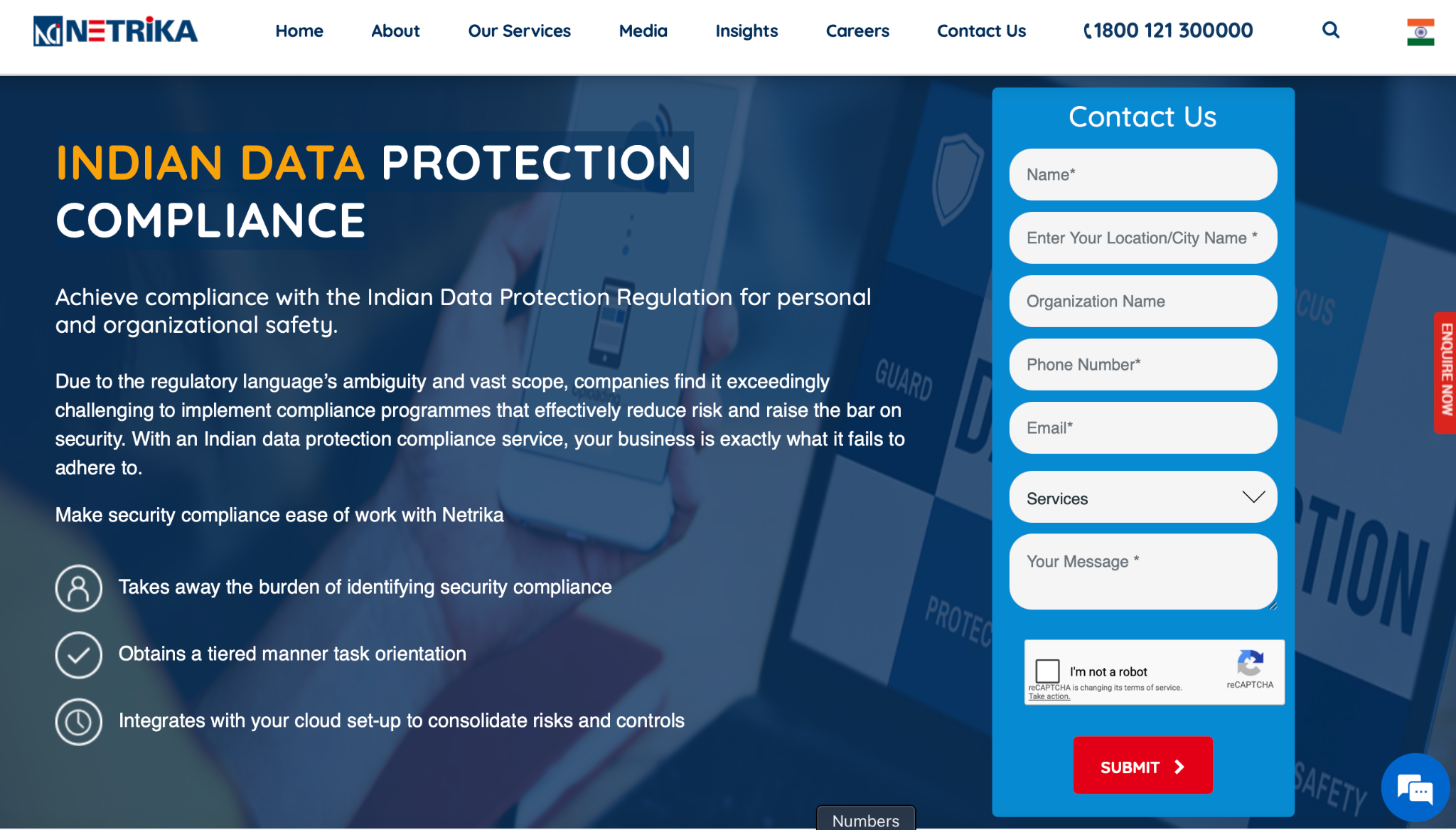
Netrika is a consulting-led data protection and cybersecurity firm that helps organizations achieve DPDP compliance through assessments, policy design, and risk management frameworks.
What Makes It Different
Netrika focuses on risk-first compliance, helping businesses understand where they are non-compliant before implementing solutions.
Key differentiators:
- Strong focus on DPDP gap assessment and readiness evaluation
- Helps design policies, procedures, and governance frameworks
- Offers DPO-as-a-Service for ongoing compliance support
- Combines privacy compliance with cybersecurity and risk management
It is more about building the foundation of compliance, not running it through software.
Pros
- Strong expertise in DPDP gap assessment and compliance readiness
- Helps identify and classify personal data across workflows
- Provides structured compliance roadmap and risk prioritization
- Offers DPO-as-a-Service for ongoing privacy management
- Good fit for organizations needing policy and governance setup
- Combines data privacy with cybersecurity and risk consulting
- Helps translate regulatory requirements into actionable steps
Cons
- Not a software platform, requires tools for ongoing execution
- Implementation can be time-consuming depending on scope
- Requires internal teams to act on recommendations
- Limited automation compared to compliance platforms
- Primarily consulting-led, not ideal for continuous workflow management
- May require additional vendors for full compliance stack
Best For
Organizations starting their DPDPA journey that need gap assessment, policy setup, and risk-based consulting before adopting a compliance platform.
4. KavachOne (Best for DPDP + Security-Led Compliance Stack)
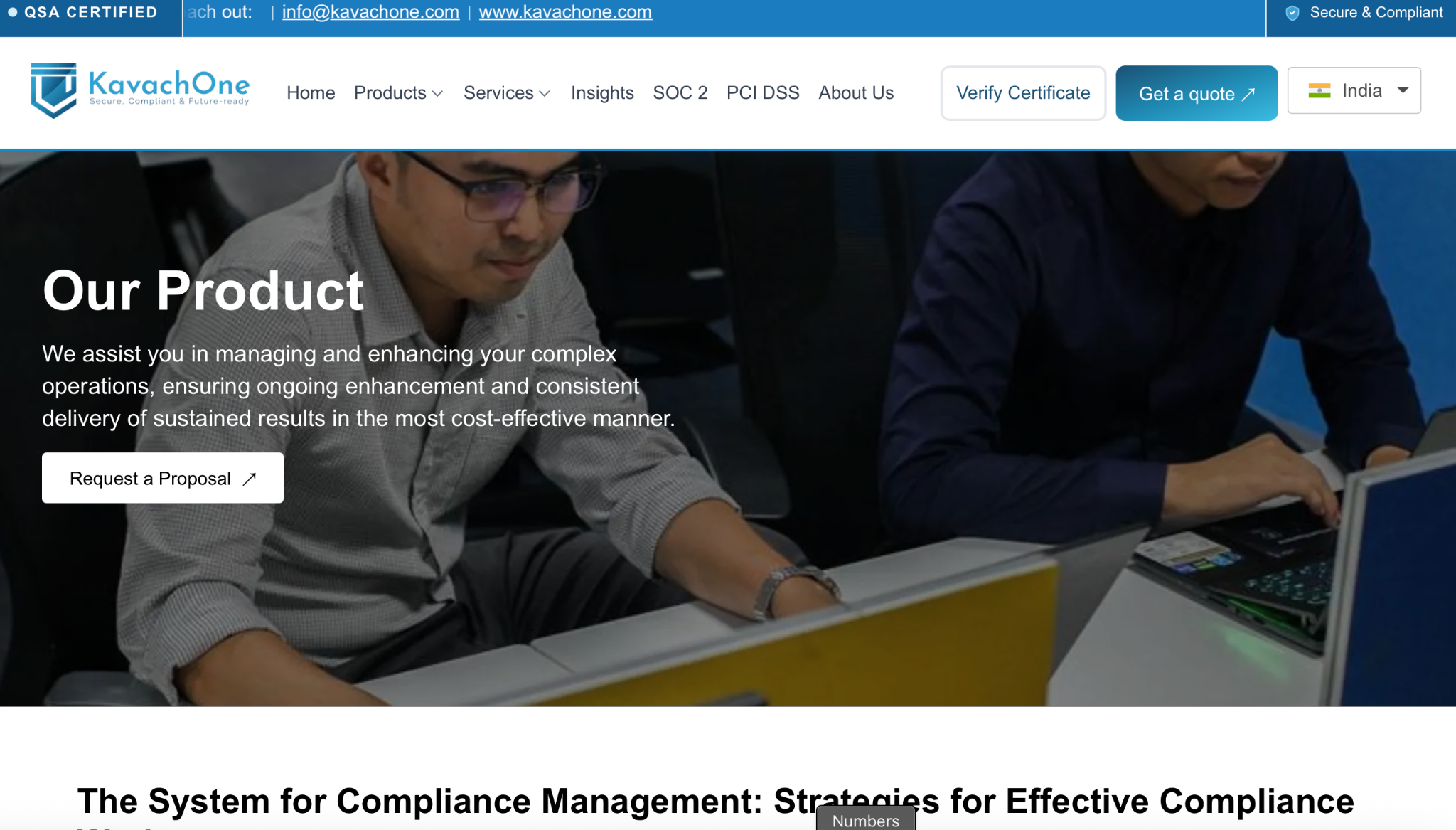
KavachOne offers a mix of DPDP compliance tools + cybersecurity solutions, combining consent management, DPIA automation, and PII scanning in one ecosystem.
What Makes It Different
KavachOne blends privacy compliance with security certifications (SOC 2, PCI DSS), making it useful if your goal is both compliance + audit readiness.
Key differentiators:
- Built-in DPDP consent platform (ConsentiQo)
- PII scanners to detect sensitive data automatically
- DPIA lifecycle automation tools
- Strong focus on GRC (Governance, Risk, Compliance)
- Backed by security certifications expertise (SOC 2, PCI DSS)
It’s more of a compliance + security stack, not just a privacy tool.
Pros
- Offers end-to-end DPDP modules including consent, DPIA, and PII scanning
- Strong focus on data security alongside privacy compliance
- Includes GRC tools for risk and compliance management
- Useful for SOC 2, PCI DSS, and multi-framework compliance
- Provides automated due diligence and risk workflows
- Flexible delivery with both tools and consulting support
- Good fit for organizations needing compliance + security together
Cons
- Platform experience may feel fragmented across multiple tools
- Less mature ecosystem compared to global privacy platforms
- Requires setup effort across different modules
- May be more security-heavy than privacy-focused for some teams
- Limited visibility into pricing and scalability
- Not as specialized in privacy workflows as dedicated tools
Best For
Companies that want DPDP compliance along with cybersecurity, audit readiness, and GRC workflows in one stack, especially in regulated industries.
5. Illume Intelligence (Best for Security-First DPDP Compliance Support)

Illume Intelligence is primarily a cybersecurity and audit-focused firm that supports DPDP compliance through security assessments, testing, and risk analysis.
What Makes It Different
Illume is not a typical compliance software. It focuses on “secure first, then comply”.
Key differentiators:
- Strong focus on VAPT, penetration testing, and security audits
- Helps identify real vulnerabilities before compliance mapping
- Offers DPDP audit prep and cybersecurity consulting
- Covers application, network, and infrastructure security
- Useful for organizations handling sensitive or regulated data
It’s more of a security backbone for compliance, not a workflow automation tool.
Pros
- Strong expertise in penetration testing and vulnerability assessments
- Helps identify real security gaps before compliance implementation
- Covers application, network, and infrastructure security
- Useful for DPDP audit preparation and risk assessments
- Offers customized security consulting based on business needs
- Good fit for high-risk industries like BFSI and healthcare
- Focuses on proactive threat detection and prevention
Cons
- Not a dedicated DPDP compliance software platform
- No built-in workflows for DSAR, DPIA, or consent management
- Requires combining with other tools for full compliance coverage
- More security-focused than privacy workflow-focused
- Limited automation compared to modern compliance platforms
- Engagement is consulting-heavy rather than product-led
Best For
Organizations that need strong cybersecurity and risk assessment as a foundation for DPDP compliance, especially before implementing a full compliance platform.
6. DPDP Consultants (Best for End-to-End DPDP Consulting + Built-in Tools)
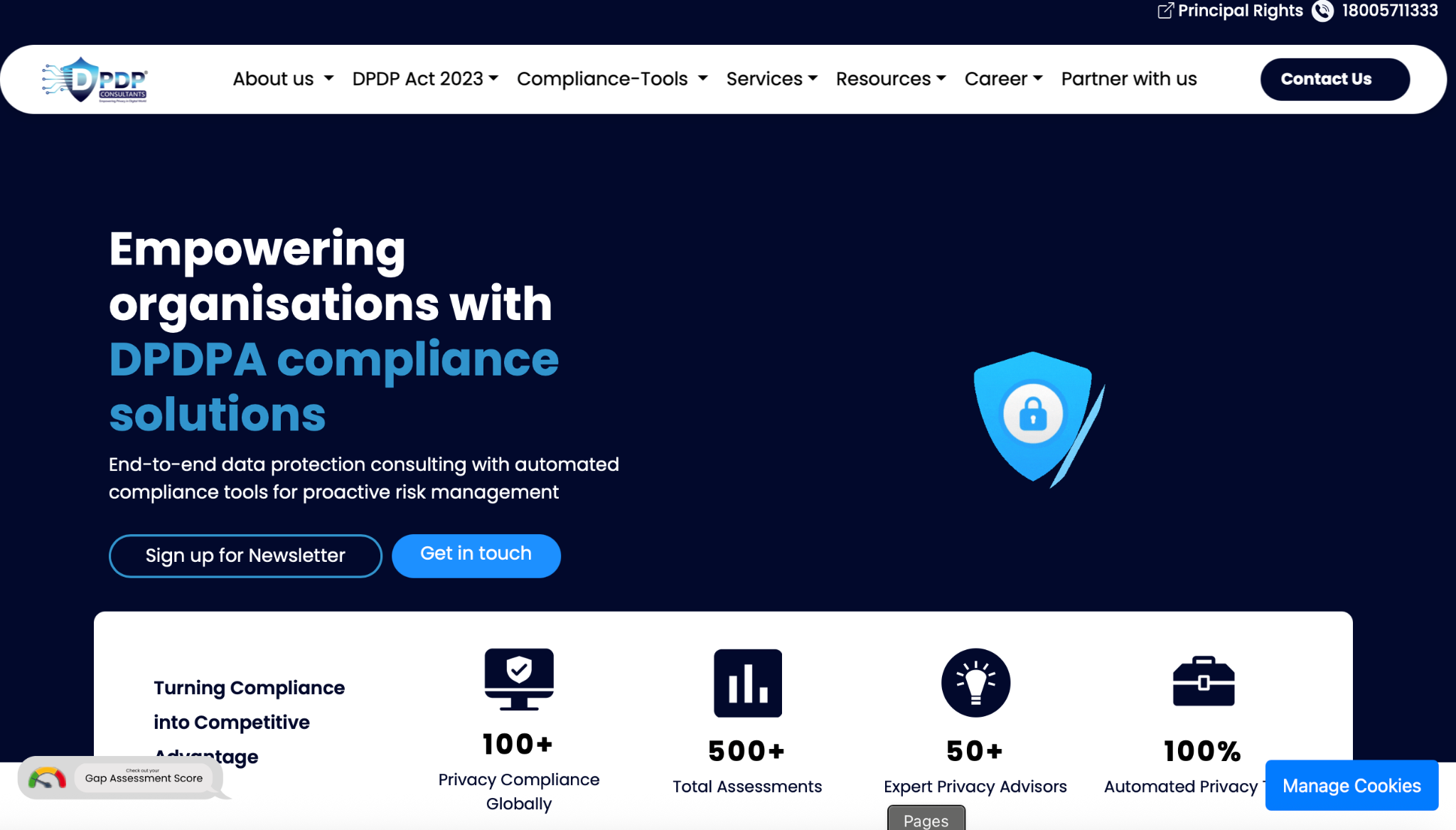
DPDP Consultants combines consulting + proprietary compliance tools, making it a hybrid option between agencies and software platforms.
What Makes It Different
Unlike pure consultants, DPDP Consultants also offers in-house automation tools.
Key differentiators:
- Built-in tools for consent, DPIA, DSAR, and vendor risk
- Offers DPO-as-a-Service for ongoing compliance
- Strong focus on DPDP-specific workflows
- Combines legal, technical, and operational support
- Helps manage both legacy and live consent data
It sits between manual consulting and full SaaS platforms.
Pros
- Provides end-to-end DPDP consulting with implementation support
- Offers proprietary tools for consent, DPIA, and DSAR workflows
- Strong focus on Indian DPDP requirements
- Supports legacy data and multi-channel consent management
- Includes DPO-as-a-Service for ongoing compliance
- Combines legal, technical, and operational expertise
- Good visibility across data flows, risks, and compliance status
Cons
- Still consulting-heavy compared to pure SaaS platforms
- Automation may not be as deep as modern AI-first tools
- Requires ongoing engagement for full value
- Customization can increase complexity and cost
- Less plug-and-play compared to lightweight tools
- Scalability depends on implementation approach
Best For
Organizations that want a guided DPDP compliance journey with both consulting support and built-in tools, especially if they’re moving from manual processes to structured systems.
7. Securze (Best for Security-Led DPDP Compliance + Managed Protection)
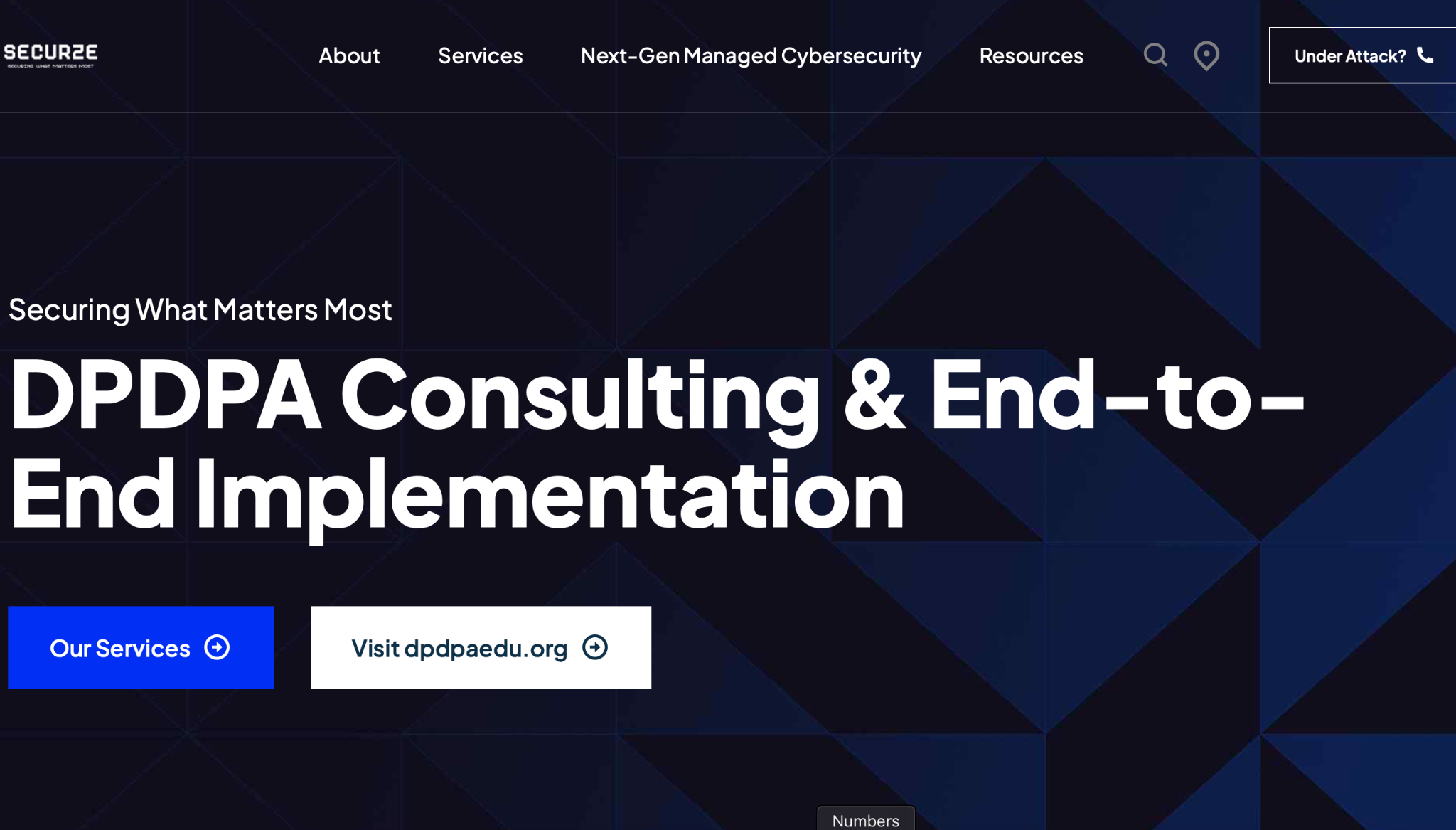
Securze is a cybersecurity-first consulting firm that supports DPDP compliance through audits, risk assessments, and continuous security monitoring.
What Makes It Different
Securze approaches DPDP from a “defend first, comply second” mindset.
Key differentiators:
- Strong focus on VAPT, red teaming, and SOC monitoring
- Offers DPDP consulting + implementation support
- Covers multiple frameworks (ISO 27001, SOC 2, GDPR, PCI DSS)
- Provides 24/7 managed security services
- Community-driven DPDP awareness initiatives
It’s more of a security + compliance partner, not a SaaS tool.
Pros
- Strong expertise in penetration testing and real-world attack simulation
- Offers end-to-end DPDP consulting and implementation support
- Provides managed SOC for continuous threat monitoring
- Covers multiple compliance frameworks beyond DPDP
- Detailed reporting that helps engineering teams fix issues faster
- Cost-effective compared to large consulting firms
- Good for proactive risk detection before compliance audits
Cons
- Not a dedicated compliance software platform
- No built-in automation for DSAR, DPIA, or consent workflows
- Requires combining with tools for full DPDP coverage
- More security-focused than privacy workflow-focused
- Implementation depends heavily on consulting engagement
- Limited scalability compared to SaaS platforms
Best For
Organizations that want strong cybersecurity + DPDP compliance support together, especially those prioritizing risk detection, threat prevention, and audit readiness.
8. BigID (Best for Data Discovery at Scale)
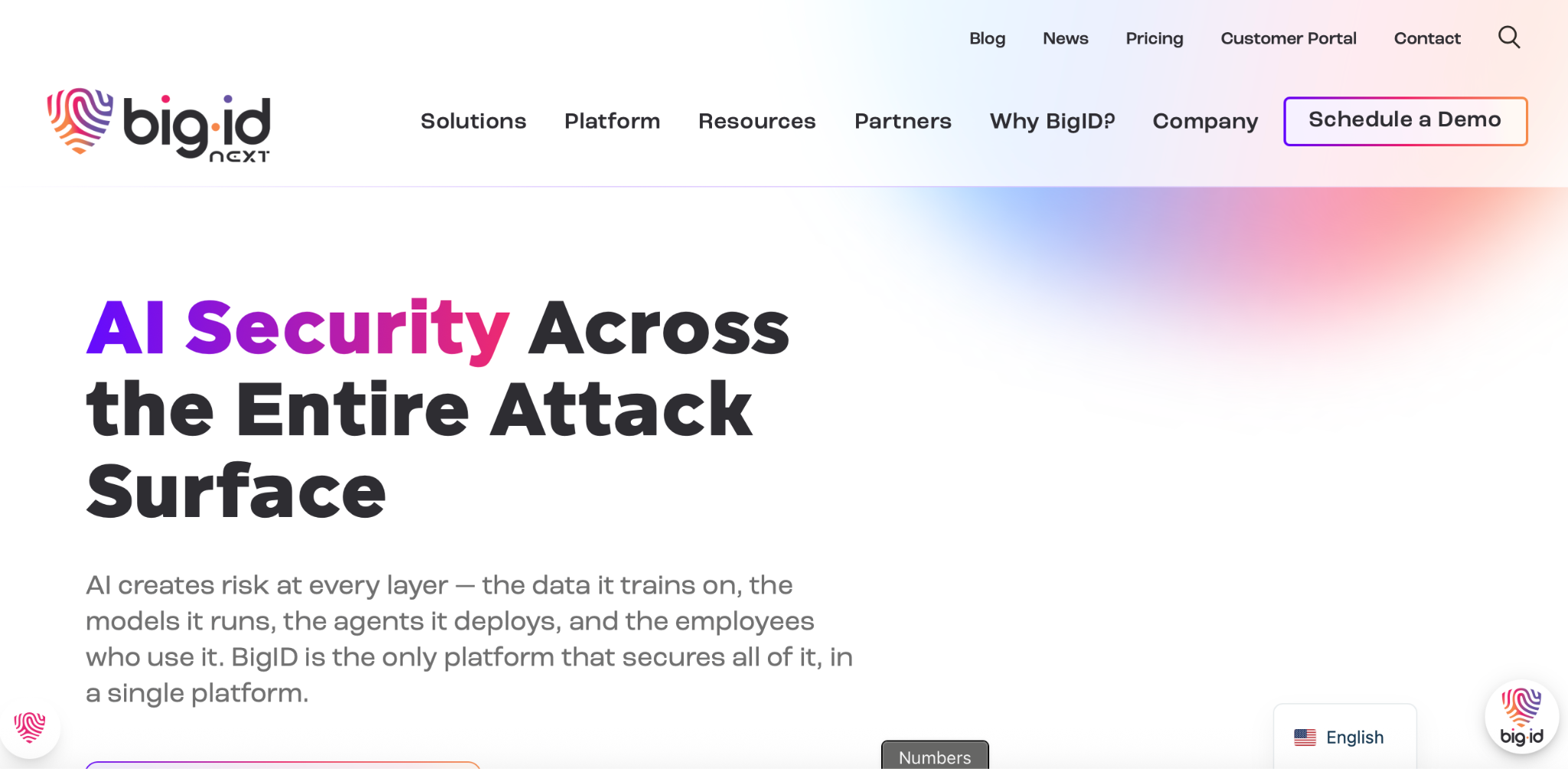
BigID is an enterprise-grade data security and privacy platform focused on data discovery, classification, and protection at scale.
It is widely used by large organizations to understand where sensitive data exists across cloud, SaaS, and on-prem systems.
What Makes It Different
BigID stands out for its deep data intelligence layer. While most compliance tools focus on workflows, BigID focuses on finding, classifying, and controlling data itself.
Key differentiators:
- Advanced AI-based data classification across structured and unstructured data
- Coverage across hundreds of data sources (cloud, SaaS, databases)
- Strong focus on AI and data security governance
- Agentless, cloud-native deployment for faster scalability
It is particularly strong in environments where data is fragmented and hard to track.
Pros
- Strong data discovery and classification across structured and unstructured data
- AI platform for data security, privacy, and compliance
- Works well across cloud environments and large data ecosystems
- Provides clear visibility into sensitive data and access controls
Cons
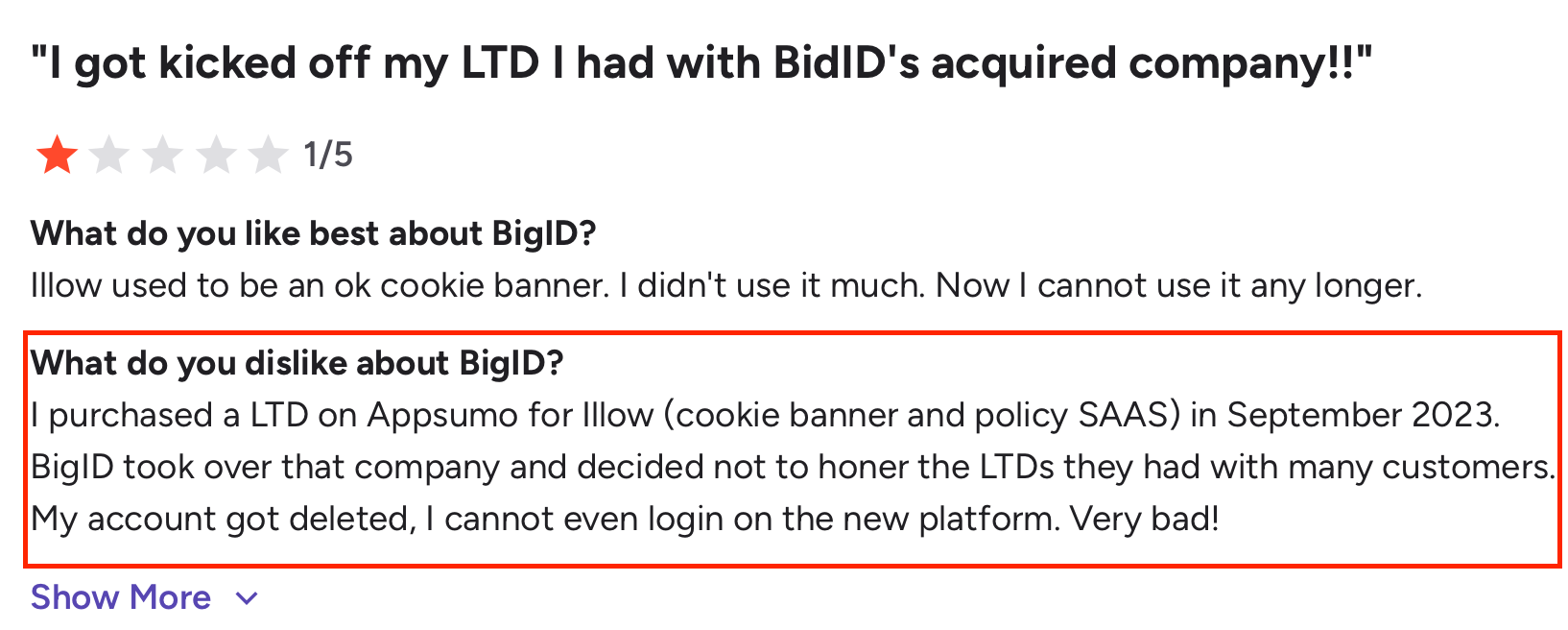
- High pricing makes it difficult for mid-sized companies to adopt
- Platform can feel slow or have latency issues in some cases
- Bug fixes and issue resolution can take time (especially for newer features)
- Limited ability to drill down into granular data details easily
- Some workflows require exporting data to fully view or analyze it
- Product transitions (like acquisitions) can disrupt user access or continuity
- More optimized for large-scale enterprise use than smaller teams
Best For
Large enterprises with massive, distributed data environments that need deep visibility into data for compliance, security, and AI governance rather than just workflow automation.
9. TrustArc (Best for Privacy Governance + Consulting)
TrustArc is a mature privacy management platform that combines compliance software with consulting and assurance services.
It helps organizations operationalize privacy programs through automation, standardized workflows, and regulatory intelligence.
What Makes It Different
TrustArc focuses on turning privacy into an operational system, not just a compliance task.
Key differentiators:
- Strong privacy program management + consulting support
- Centralized platform for DSAR, DPIA, vendor risk, and data mapping
- Access to 800+ regulatory templates and legal insights
- Built-in AI assistance (e.g., Nymity AI) for guidance and reporting
It is widely used by enterprises that want both technology + advisory support.
Pros
- Centralized platform to manage DSAR, DPIA, vendor risk, and data mapping
- Strong workflow standardization makes compliance repeatable and scalable
- Automation reduces reliance on spreadsheets and manual processes
- Useful AI features for regulatory guidance and reporting
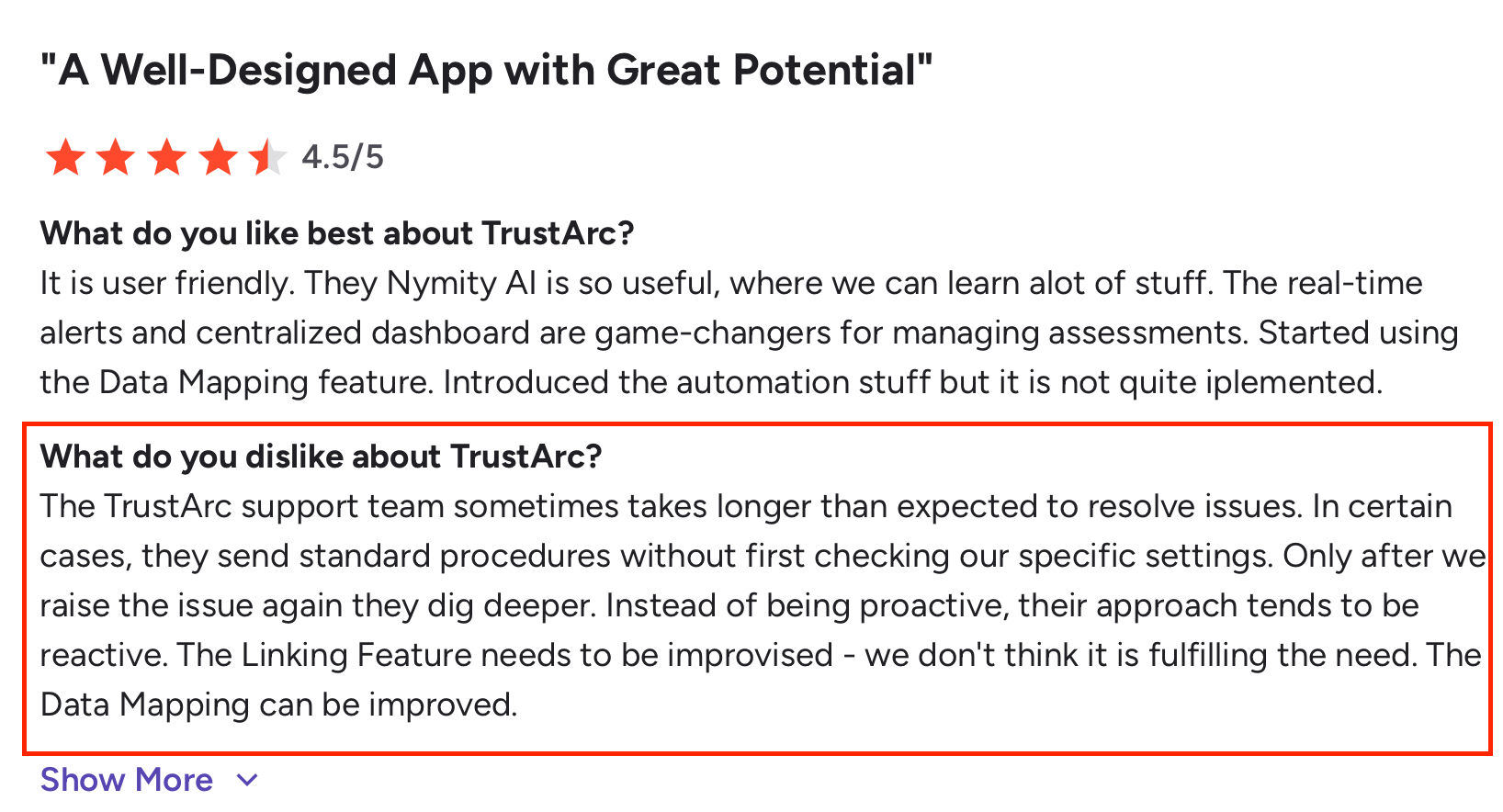
- Clean dashboards with real-time alerts for compliance tracking
- Strong customer support and consulting services
- Effective cookie consent and preference management tools
Cons
- Initial setup and configuration can take time, especially for complex use cases
- Pricing can be high, especially when adding more modules
- Some features (like data mapping or linking) need improvement
- Not fully self-service in some areas, requiring support involvement
- UI and certain modules can feel complex for new users
- Support can sometimes be reactive instead of proactive
- Limited localization (e.g., language support) for global teams
Best For
Enterprises that need a structured privacy program with both software and consulting support, especially in regulated industries like healthcare, finance, and global SaaS.
10. Securiti.ai (Best for Automation + Enterprise Workflows)
Securiti.ai is a unified data privacy, security, and governance platform built for large enterprises managing complex, multi-cloud environments.
It brings data discovery, compliance, AI governance, and risk management into a single “Data Command Center.”
What Makes It Different
Securiti focuses on data-first compliance with strong automation.
Instead of just workflows, it provides deep visibility into data across systems and connects it directly to compliance actions.
Key differentiators:
- Unified platform for data security, privacy, and AI governance
- Strong data discovery and classification across hybrid environments
- Automated workflows integrated with tools like ServiceNow
- Highly customizable with deep enterprise integrations (AWS, SAP, Salesforce)
Pros
- Powerful automation workflows (DSAR, vendor risk, assessments) reduce manual effort
- Deep integrations with tools like AWS, Salesforce, SAP, and ServiceNow
- Highly customizable to fit complex enterprise needs
- Smooth integration and onboarding with strong support teams
- Provides clear visibility into data risks and vulnerabilities
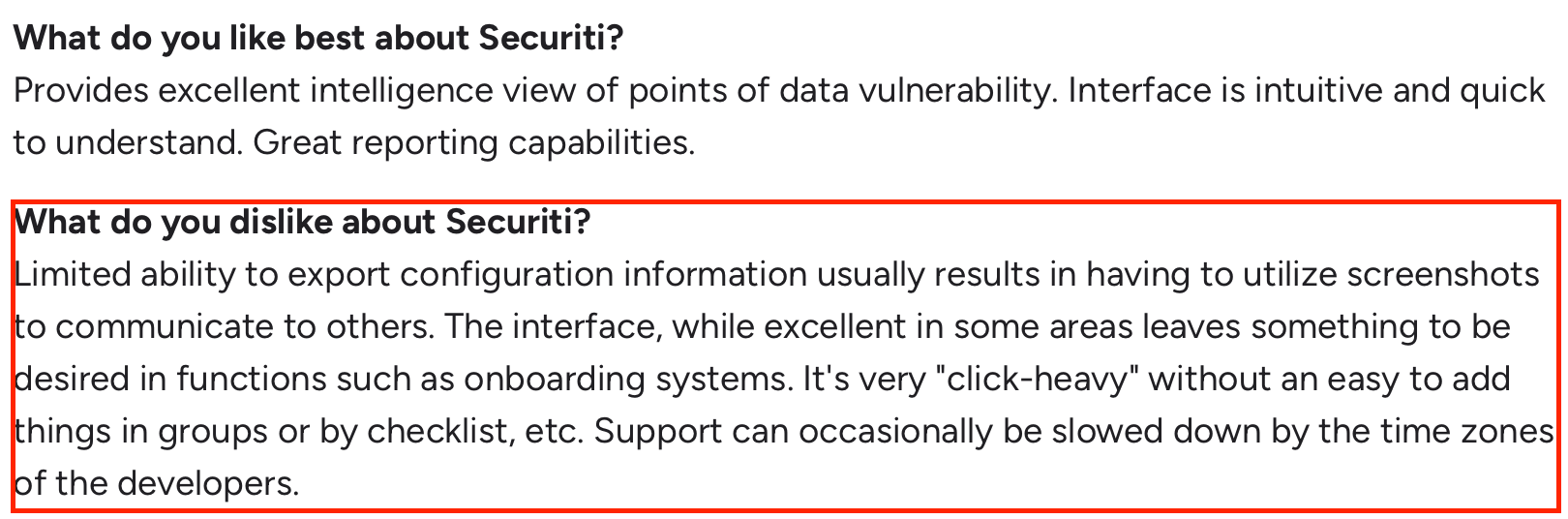
Cons
- UI can be slow or inefficient for large-scale deployments
- Bulk actions and large dataset onboarding require manual effort or API workarounds
- Customization and advanced setup can take time to fully configure
- Data remediation capabilities are still evolving compared to discovery
- Dashboard customization and reporting flexibility can be improved
- Some workflows (like data mapping or linking assets) still require manual input
- Performance optimization needed for very large-scale environments
Best For
Large enterprises handling multi-cloud data, complex workflows, and high-volume compliance operations, especially those needing strong automation and deep data visibility.
11. Lightbeam.ai (Best for Real-Time Data Visibility)
Lightbeam.ai is a data privacy automation platform focused on data discovery, classification, and real-time visibility.
It helps organizations understand where sensitive data exists and automate compliance and security workflows.
What Makes It Different
Lightbeam stands out for its ability to provide a 360-degree view of data sprawl across systems.
It focuses heavily on automated data classification and privacy controls, making it easier to identify and secure sensitive data.
Key differentiators:
- AI-driven data classification and privacy automation
- Real-time visibility into sensitive data across systems
- Easy-to-use interface compared to complex enterprise tools
- Strong focus on data discovery + risk identification
Pros
- Provides a clear 360-degree view of sensitive data across systems
- Strong data discovery and auto-classification capabilities
- Automates privacy compliance and security workflows effectively
- User-friendly interface, easy to navigate even for non-technical users
- Helps identify data ownership and sensitive data relevance
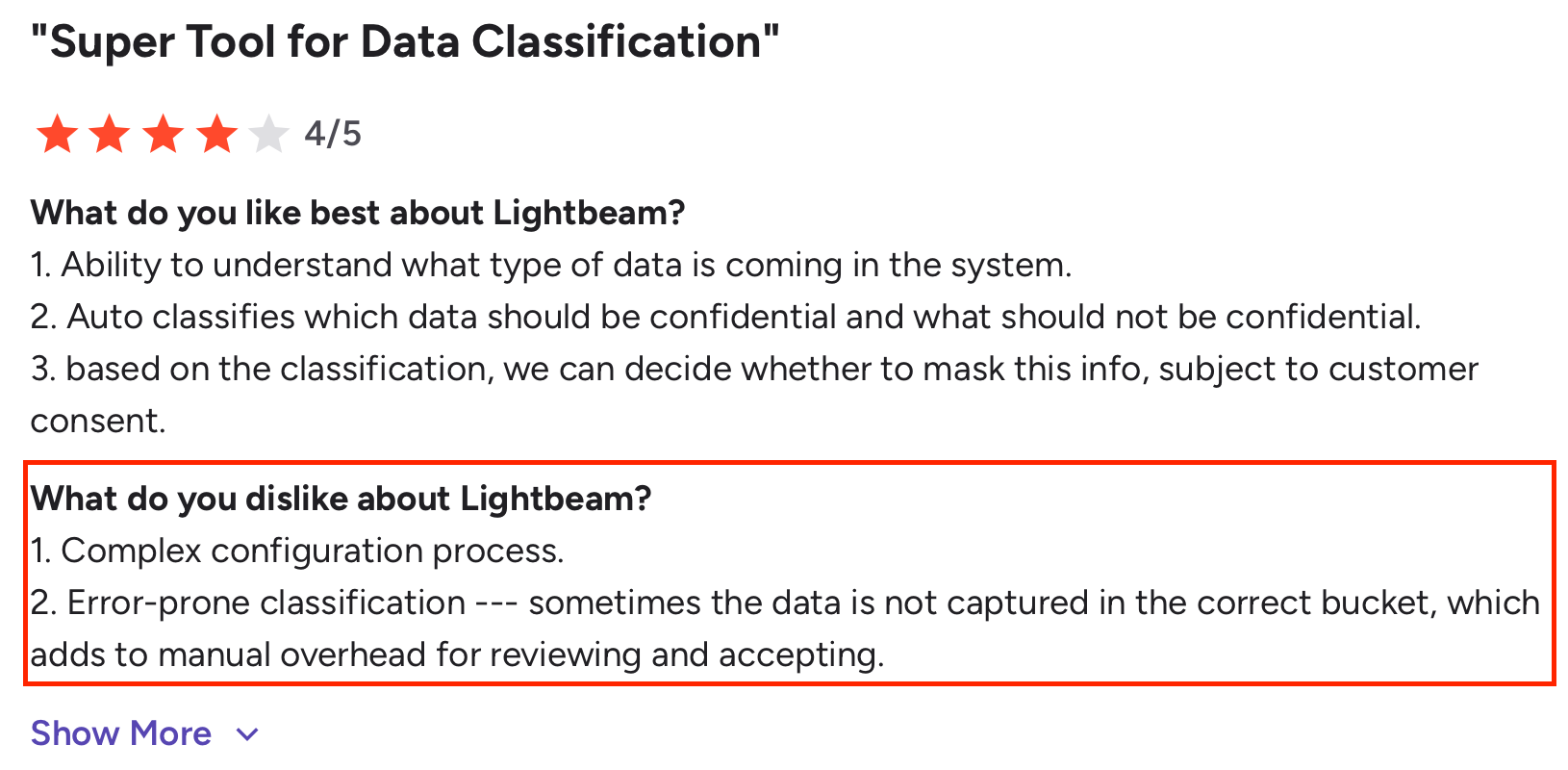
Cons
- Platform capabilities can be overwhelming without proper guidance
- Initial setup and configuration can be complex and time-consuming
- Data classification may sometimes be inaccurate, requiring manual review
- Requires technical expertise and investment for full implementation
- Minor performance issues or slowness reported in some cases
- Limited training resources or documentation for new users
Best For
Mid-to-large organizations that need strong data visibility, classification, and automation, especially teams looking to understand and control data sprawl across systems.
12. Privado AI (Best for Engineering-Led Teams)
Privado AI is a privacy platform built for modern product and engineering teams that need real visibility into how personal data moves across code, apps, websites, and third-party tools.
Instead of relying on questionnaires and manual reviews, it uses scanning and AI agents to surface privacy risks directly from technical systems.
What Makes It Different
Privado’s biggest strength is its engineering-first approach.
It helps legal and privacy teams work with developers using live data maps, code scanning, and automated assessments instead of spreadsheets.
Key differentiators:
- Code, web, and app scanning to identify privacy risks in real time
- Dynamic data maps that update as systems change
- AI agents that pre-fill PIAs, DPIAs, and RoPAs from technical docs
- Strong support for cookie, pixel, SDK, and consent auditing
It is especially useful for teams that want privacy to become part of the product development cycle, not just a legal review at the end.
Pros
- Strong visibility into sensitive data flows across products and systems
- Dynamic data mapping reduces guesswork during privacy reviews
- Code, web, and app scanning help catch privacy issues early
- AI agents can pre-fill assessments using technical documents
- Useful for validating CMP setups, cookies, pixels, tags, and SDKs
Cons
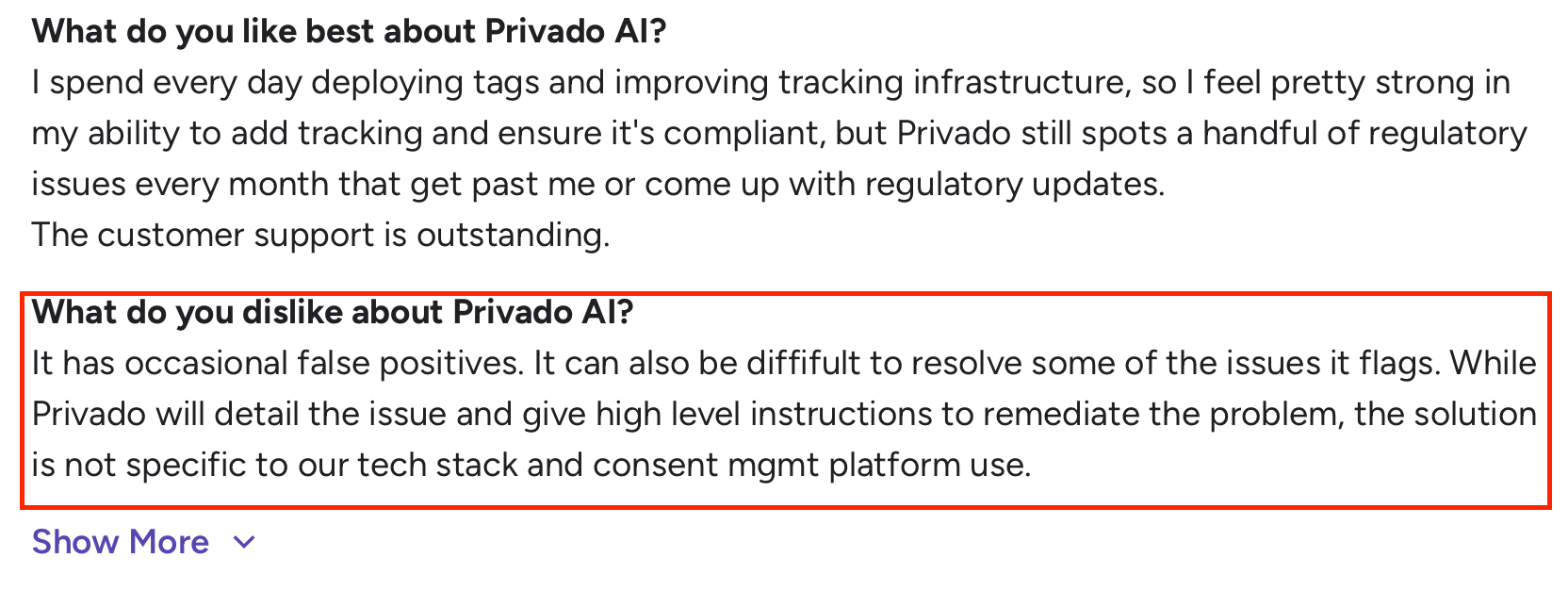
- False positives in scans and alerts can create extra triage work
- Learning curve can be steep for teams new to privacy concepts
- Some alerts need better prioritization between critical and informational issues
- Requires engineering effort for implementation and integration
- Lacks some execution features legal teams may expect, like built-in deletion tools
- Issue remediation guidance may not always be specific enough for each tech stack
Best For
Product, engineering, and privacy teams that want real-time data visibility, code-level privacy checks, and automated assessments without relying on manual questionnaires.
13. Privy by IDfy (Best Indian Compliance + Verification Stack)
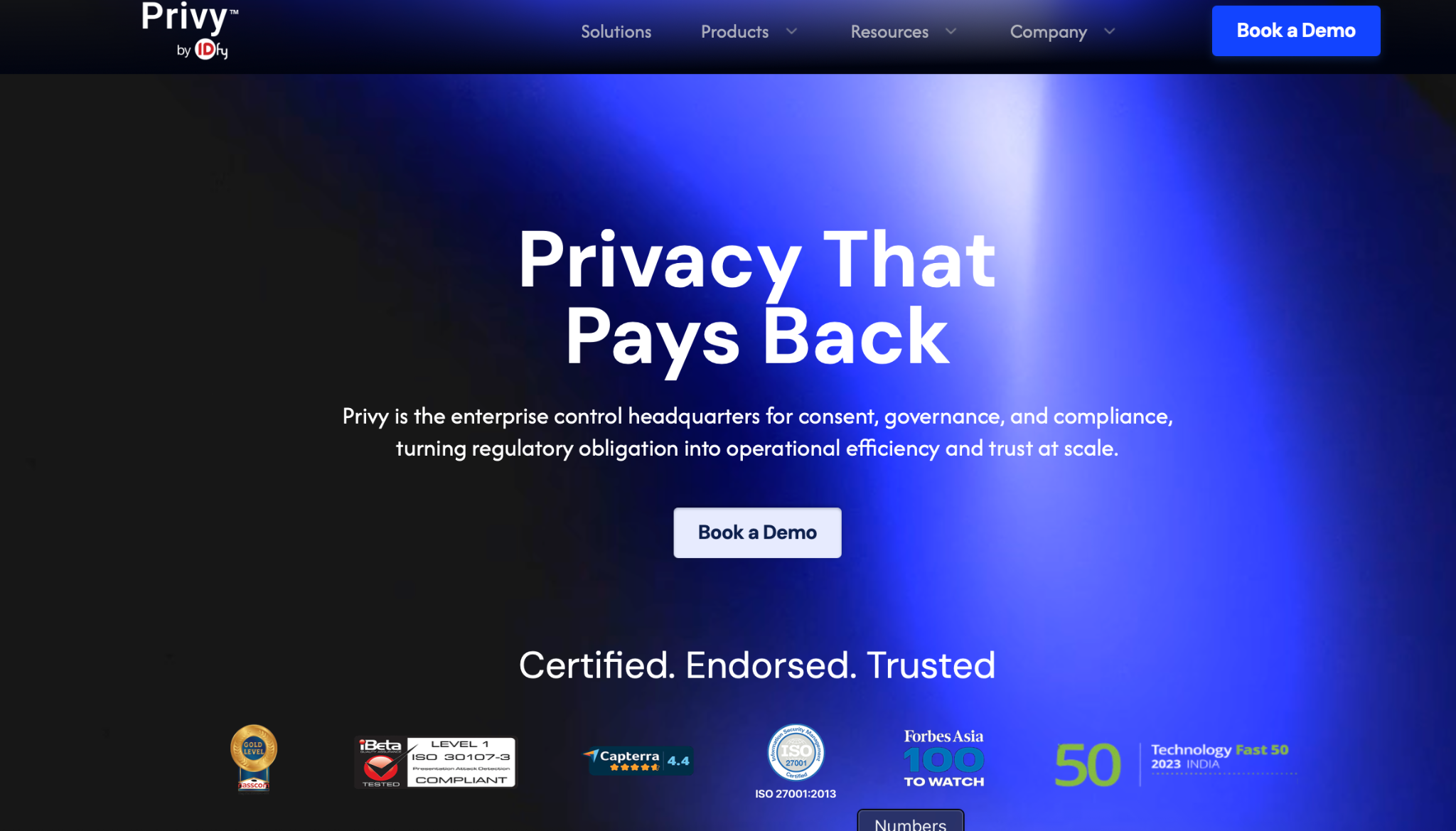
Privy by IDfy is an India-focused privacy and compliance platform designed to help enterprises manage consent, data governance, and DPDPA compliance in one system.
It is built on IDfy’s broader trust and identity infrastructure and is recognized by MeitY for consent management.
Must Read: Privy by IDfy Review: Is It Worth Data Privacy & Compliance Solution?
What Makes It Different
Privy is built specifically for the Indian regulatory ecosystem, making it more aligned with DPDPA requirements compared to global tools.
Key differentiators:
- Strong consent lifecycle management (multi-lingual, audit-ready)
- Deep alignment with Indian regulators (RBI, SEBI, IRDAI use cases)
- Integrated data discovery, governance, and risk management
- AI-powered privacy assistant (Inspect AI) for monitoring and insights
It focuses on turning compliance into an operational system, not just documentation.
Pros
- Strong consent lifecycle management with audit-ready records
- Built specifically for Indian regulations like DPDPA
- Centralized platform for consent, DSAR, and governance workflows
- Good fit for regulated industries like BFSI and fintech
- Backed by IDfy’s established identity and compliance infrastructure

Cons
- Less mature globally compared to tools like OneTrust or BigID
- May require customization depending on organization workflows
- Enterprise-focused pricing may not suit smaller teams
- Limited public clarity on advanced automation depth
- Heavily focused on Indian ecosystem (less useful for global compliance)
- Implementation may require partner or onboarding support
Best For
Indian enterprises, especially in BFSI, fintech, and regulated sectors, need a DPDPA-aligned, consent-first compliance platform with strong local relevance.
14. PrivEzi (Best Emerging Full-Stack Privacy Platform)
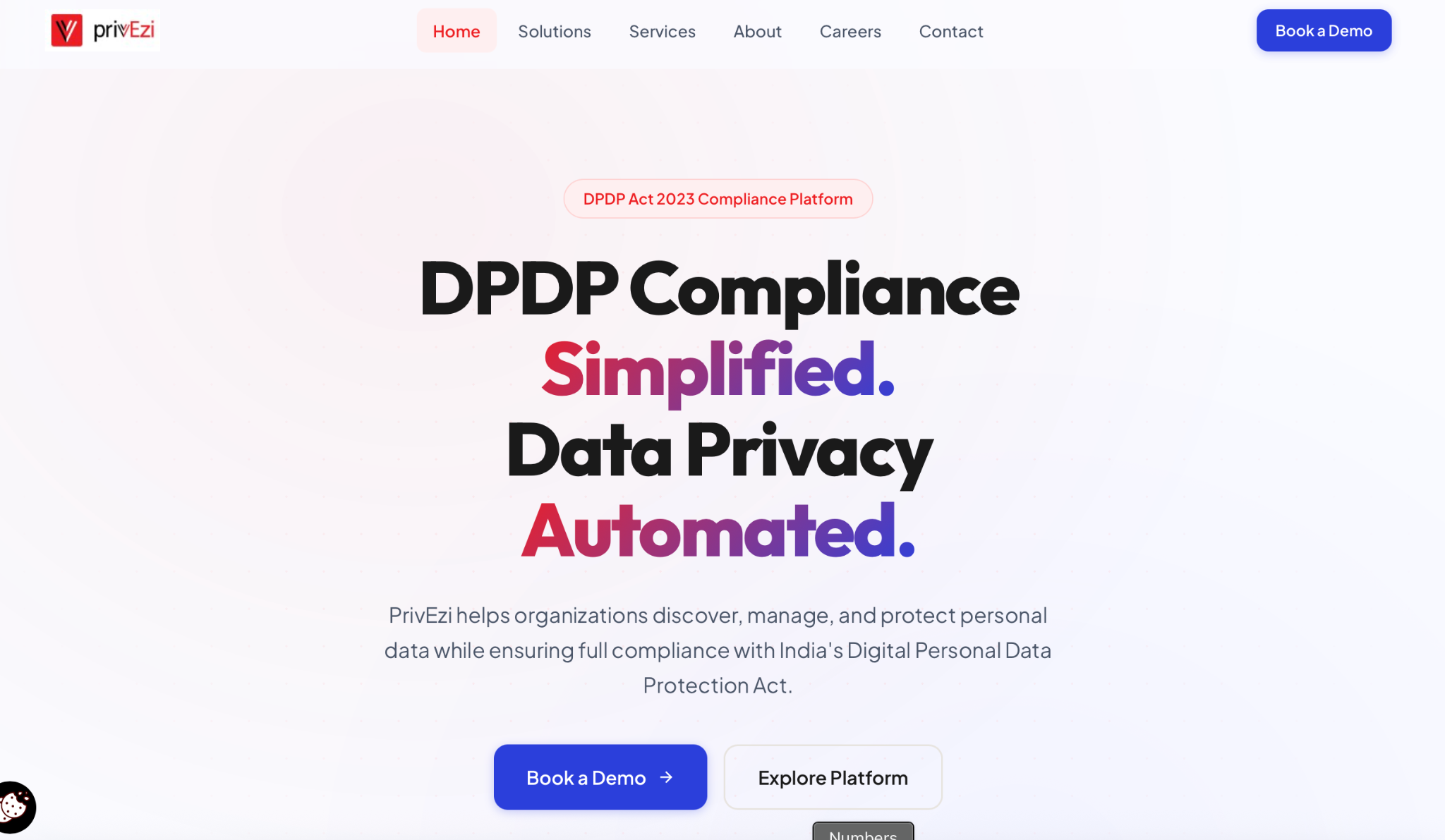
PrivEzi is a full-stack data privacy and DPDPA compliance platform designed to help organizations discover, manage, and protect personal data through a modular system.
It covers everything from consent and data discovery to breach management in one unified platform.
What Makes It Different
PrivEzi positions itself as a complete privacy operating system, not just a consent tool.
Key differentiators:
- 8 interconnected privacy modules (consent, data discovery, DSAR, vendor risk, breach, RoPA)
- Strong India-first design with DPDP alignment and local data residency
- Flexible deployment (SaaS, private cloud, on-prem)
- Automation-first approach with AI-driven data classification
It allows teams to deploy only the modules they need and scale over time.
Pros
- End-to-end platform covering consent, DSAR, data discovery, vendor risk, and breach management
- Modular architecture allows flexible deployment and scaling
- Supports SaaS, on-prem, and private cloud environments
- Built specifically for DPDP with support for global standards like GDPR
- Automates workflows like DSAR handling and risk assessments
Cons
- Limited publicly available user reviews and validation
- May require customization based on organization workflows
- Ecosystem and integrations not as extensive as larger platforms
- Feature depth may vary across modules
Best For
Organizations looking for a modern, modular privacy platform with strong DPDP alignment, especially teams that want flexibility in deployment and a full-stack approach without relying on multiple tools.
DPDPA Compliance Software vs Consulting: What Should You Choose?
Most companies don’t struggle with what DPDPA requires. They struggle with how to implement it.
That’s where this decision comes in.
Choose Software if:
- You need ongoing compliance, not a one-time setup
- You want to automate consent, DSAR, vendor risk, and data mapping
- Your data is spread across tools and keeps changing
Choose Consulting if:
- You are just getting started with DPDPA
- You need help with policies, audits, or gap assessment
- You don’t have an internal privacy or legal team
What most companies actually do:
They use both.
Consultants help you design the compliance framework.
Software helps you run it every day without manual effort.
If you only use consulting, compliance becomes a one-time document.
If you only use software without a strategy, you risk misconfigurations.
Is DPDPA Compliance Software Worth It?
Yes, but only if you handle real user data, you don’t really have a choice.
Most teams try to manage compliance with spreadsheets, internal docs, and manual workflows. That works at a small scale. But as soon as data grows, things break.
- Consent is not tracked properly
- Data mapping becomes outdated
- User requests take too long
- Vendor risks are missed
Now compare that with the downside.
The cost of non-compliance (up to ₹250 crore penalties, reputational damage, and operational risk) is far higher than the cost of using the right system.
That’s the real tradeoff.
DPDPA tools are not just about “compliance.”
They reduce manual effort, create audit trails, and help teams respond faster without chaos.
If your data is growing, manual systems won’t keep up.
Conclusion
DPDPA compliance is no longer optional, it’s operational.
You can try to manage it with spreadsheets and scattered tools. But that approach doesn’t scale when your data, vendors, and user requests increase.
At some point, compliance stops being a task and becomes a system.
That’s where automation matters.
The right platform helps you move from reactive work to structured, repeatable processes, without relying on manual tracking.
If your team is moving from spreadsheets to a more structured compliance system, platforms like Redacto are worth evaluating.