%20Redacto%20logo_New.png)


7 Best Risk Assessment Tools For Pharma Companies in India


A pharma company does not manage one type of risk.
Quality teams assess deviations, CAPA, change controls, OOS/OOT results, FMEA records, supplier quality and batch-related failures. Privacy and legal teams assess patient data, employee records, pharmacovigilance data, CROs, processors, consent, PIAs and DPDPA evidence.
Enterprise teams track internal audit, controls, cyber risk, plant risk, procurement, business continuity and executive reporting.
These workflows may all be called risk assessment, but they do not belong in one software category. A quality-risk platform should support ICH Q9-style assessment methods, mitigation, review and links to regulated QMS records.
A privacy-risk platform should connect data categories, processing purposes, vendors, PIAs, consent, DSARs and breach evidence. An enterprise GRC platform should consolidate controls, audit findings and operational risk for leadership.
For Indian pharma companies, the DPDPA layer matters because Section 8 of the Digital Personal Data Protection Act, 2023 places obligations on Data Fiduciaries, including reasonable security safeguards and breach notice obligations.
The Act’s Schedule lists ₹250 crore as the maximum penalty for failing to maintain reasonable security safeguards. The Digital Personal Data Protection Rules, 2025 add operating detail for notices, safeguards, breach reporting, contact points, DPIA/audit obligations for Significant Data Fiduciaries and Data Principal rights workflows.
This guide compares risk assessment tools for pharma companies in India by the record your team needs to produce. It does not name one universal winner, because no single product is automatically best across GMP quality risk, DPDPA privacy risk and enterprise operational risk.
Quick Answer: 7 Best Risk Assessment Tools For Pharma By Risk Category
- Redacto - Best for India-first DPDPA, PIA and processor risk.
- MasterControl - Best for enterprise pharmaceutical quality risk.
- Veeva Vault QMS - Best for global biopharma quality operations.
- TrackWise Digital - Best for high-volume deviations, CAPA and quality events.
- MetricStream - Best for enterprise GRC, audit and operational risk.
- AmpleLogic - Best for ICH Q9-oriented digital QRM workflows.
- Scilife - Best for growing life-sciences quality teams.
The right choice depends on whether your primary evidence record is a deviation, CAPA, FMEA, supplier qualification, PIA, vendor processor assessment, DSAR log, enterprise risk register or internal audit issue.
What Does A Pharma Risk Assessment Tool Actually Manage?
Before comparing tools, I would separate pharma risk into three operating categories.
1) Quality and GMP risk
This is the risk language quality teams already use: Quality Risk Management or QRM, ICH Q9(R1), FMEA/FMECA, HACCP, HAZOP where process safety applies, Risk Priority Number or RPN, deviations, OOS/OOT investigations, CAPA effectiveness checks, change-control risk, supplier qualification, GxP validation, audit trails, 21 CFR Part 11 and EU GMP Annex 11.
The record usually lives close to the QMS. The workflow starts from a quality event or planned change, routes through risk scoring and review, links mitigation to CAPA or change control, and keeps evidence for inspection.
2) Privacy and third-party data risk
This is where pharma companies handle patient support data, pharmacovigilance reports, employee records, healthcare professional data, trial-related operational data, CROs, CDMOs, SaaS processors and consent evidence.
Under Rule 6 of the Digital Personal Data Protection Rules, 2025, security safeguards include measures such as encryption, masking, access controls, logs, monitoring, backups and safeguards in processor contracts.
Under Rule 14 of the Digital Personal Data Protection Rules, 2025, Data Principals need clear means to exercise rights and provide identifying particulars. Those rules turn privacy risk into an intake, verification, routing, decision and evidence workflow.
3) Enterprise and operational risk
This category sits above individual quality or privacy records. It covers risk registers, internal audit findings, controls, cyber risk, procurement risk, plant risk, business continuity and management reporting.
Enterprise GRC matters when leadership needs a common view across plants, suppliers, audits, IT and compliance. It is not usually deep enough to replace a specialist QMS for deviation/CAPA risk or a DPDPA operating layer for consent, PIAs and DSAR evidence.
How I Evaluated The Tools
I evaluated these tools from the point of view of an Indian pharma company that has to choose the right system for the risk workflow, not just buy a generic assessment form. This is not a numerical ranking of one product against every risk category. The products are shortlisted by the type of risk workflow they handle best.
- Pharma quality-risk functionality - 30%: Does the tool support QRM methods such as FMEA, risk scoring, residual-risk review, deviations, CAPA, OOS/OOT, change control and supplier quality?
- Auditability and evidence trails - 20%: Can the team show who assessed the risk, what changed, who approved it, what mitigation was assigned and which record proves closure?
- Regulatory and validation fit - 15%: Does the tool fit ICH Q9(R1), GxP validation expectations, audit trails, electronic records and regulated quality operations?
- Supplier/vendor risk - 15%: Can the tool assess CROs, CDMOs, processors, material suppliers, outsourced labs and other third parties with reassessment and ownership logic?
- India and DPDPA fit - 10%: Can the tool support personal data, PIAs, consent, DSARs, processor contracts and DPDPA evidence for Indian operations?
- Implementation and buying friction - 10%: Is pricing understandable, is scope clear, and will implementation match the maturity of the buyer’s quality, privacy or GRC team?
7 Best Risk Assessment Tools For Pharma Companies
Advanced does not mean interchangeable. MasterControl, Veeva, TrackWise, AmpleLogic and Scilife are closer to QMS/QRM records. Redacto is closer to DPDPA privacy, processor and PIA records. MetricStream is closer to enterprise GRC, audit and control records.
1. Redacto - Best For India-First DPDPA, PIA And Processor Risk
Best For
Redacto is best for Indian pharma privacy, legal and security teams that need to assess patient data, employee data, pharmacovigilance records, CRO/CDMO processors, PIAs, consent, DSARs and DPDPA evidence.
Why It Made The List
Redacto belongs in this guide because pharma risk in India is no longer only a GMP/QMS issue. Pharma companies also need to prove how personal data moves through vendors, systems, purposes and response workflows.
That is where Redacto is strongest. It is not trying to be a batch-quality QMS. It helps teams run and evidence DPDPA workflows through modules such as Unified Consent Manager, Automated DSAR Management, Privacy Impact Assessment (PIA) Automation, AI-Driven Data Discovery & Mapping, Vendor Risk Management and Audit & Reporting.
Risk Workflows Supported
- PIA workflow for privacy risk before new processes, products or vendors go live.
- Vendor and processor risk assessment for CROs, CDMOs, labs, SaaS tools and support providers.
- Consent capture, withdrawal and lifecycle tracking.
- Data discovery and mapping by purpose, category and owner.
- DSAR intake, verification, routing, response and evidence.
- Audit exports for privacy and security review.
Pharma And Regulatory Fit
Redacto fits the DPDPA side of pharma risk. Section 10 of the Digital Personal Data Protection Act, 2023 requires Significant Data Fiduciaries to appoint a Data Protection Officer, appoint an independent data auditor and undertake periodic Data Protection Impact Assessments.
Rule 13 of the Digital Personal Data Protection Rules, 2025 adds periodic DPIA and audit obligations for Significant Data Fiduciaries and reporting of significant observations to the Board.
For a pharma company handling patient support data, pharmacovigilance records or large processor networks, the important record is not only a policy. It is a traceable PIA, processor assessment, consent ledger, DSAR log, breach timeline and audit trail.
Automation can prepare the assessment, route approvals and surface missing records. DPO, legal, security and quality leaders still own interpretation, risk acceptance and regulator-facing accountability.
Features
- Unified Consent Manager for consent capture, withdrawal and lifecycle records.
- Privacy Impact Assessment (PIA) Automation for privacy-risk review.
- Vendor Risk Management for processor assessment and reassessment.
- AI-Driven Data Discovery & Mapping for personal data visibility.
- Automated DSAR Management for Data Principal request workflows.
- Audit & Reporting for evidence exports.
- Anonymization & Pseudonymization for exposure reduction where identifiable data is not required.
Pricing
License-based; contact Redacto. Redacto does not publish public pricing as of July 20, 2026.
Pros
- Strong India-first fit for DPDPA privacy and processor-risk workflows.
- Useful when pharma teams need to connect data categories, processing purposes, vendors, PIAs and audit evidence.
- Good match for privacy, legal, security and compliance teams that need a DPDPA operating layer.
- Better fit than QMS tools when the primary record is a PIA, DSAR log, consent ledger or vendor processor assessment.
- Current product capabilities line up with DPDPA evidence work rather than generic privacy documentation.
Cons
- It is not a GMP/QMS platform for deviations, CAPA, OOS/OOT, batch quality or controlled manufacturing records.
- No public pricing means budget comparison requires a sales conversation.
- Redacto is India/DPDPA-first, so a multinational that needs deep global GDPR, HIPAA, CCPA and multi-jurisdiction privacy operations may prefer a broader global suite.
- It is a young company, with fewer public enterprise case studies and third-party reviews than long-established QMS and GRC vendors.
- Quality teams will still need a QMS/QRM platform for ICH Q9, FMEA, CAPA effectiveness and GMP audit workflows.
Summary
Choose Redacto when the pharma risk record is a PIA, vendor processor assessment, consent ledger, DSAR log, breach timeline or DPDPA audit export.
Do not choose Redacto as the only risk system if the primary buyer is quality and the core workflow is deviation/CAPA risk, OOS/OOT investigation, batch release quality or global QMS standardization.
2. MasterControl - Best For Enterprise Pharmaceutical Quality Risk

Best For
MasterControl is best for pharma quality teams that need risk assessment inside regulated QMS workflows: deviations, CAPA, audits, document control, training, OOS investigations, change control and quality events.
Why It Made The List
MasterControl is one of the clearest fits for GMP quality risk. It places risk assessment close to the records inspectors care about: controlled documents, CAPA plans, quality events, training evidence and audit history.
The strongest use case is a pharma manufacturer that wants quality risk to sit inside the same operating layer as deviations, nonconformance, CAPA and audit readiness. MasterControl is built around life-sciences quality risk rather than privacy or broad enterprise GRC.
Risk Workflows Supported
- Quality risk assessment across product, process and system risks.
- Deviation and nonconformance risk review.
- CAPA linkage and effectiveness evidence.
- Audit management and inspection readiness.
- Document control and training links for changed SOPs.
- OOS, manufacturing traveler and regulated production-adjacent records.
Pharma And Regulatory Fit
MasterControl fits teams that need electronic quality records, audit trails, controlled workflows and validated process discipline. It is closer to ICH Q9(R1) quality risk management than a privacy platform because the assessment can connect to quality events and mitigation work.
For Indian pharma teams exporting to regulated markets, the buying question is not only whether the risk matrix exists. It is whether the system can prove the risk decision, the mitigation owner, the CAPA link and the changed controlled document.
Features
- Quality risk workflows for life-sciences teams.
- CAPA, deviation, nonconformance and audit links.
- Document control and training integration around quality events.
- Risk visibility across product, process and system records.
- Audit-ready record management for regulated quality operations.
Pricing
Custom quote. Pricing depends on selected QMS modules, users, validation requirements, implementation services and deployment scope.
Pros
- Strong fit for GMP quality risk and regulated QMS workflows.
- Good match when the core record is a deviation, CAPA, OOS/OOT investigation, audit finding or change-control assessment.
- Mature life-sciences positioning for pharma and medical-device quality teams.
- Useful where quality risk needs to connect to controlled documents and training records.
- Strong competitor-win scenario over Redacto when the buyer’s primary problem is GMP/QMS risk, not DPDPA evidence.
Cons
- It is not India-first DPDPA software for consent, PIAs, DSARs or processor evidence.
- Enterprise QMS implementation can be heavier than a smaller pharma team needs.
- Vendor privacy risk and personal-data mapping may need a separate privacy layer.
- Pricing is not self-serve, so budget comparison needs a commercial conversation.
- It can be more system than required if the buyer only needs a narrow risk register.
Summary
Choose MasterControl when the risk record is owned by quality and tied to GMP operations. Do not choose it as the only answer if the main risk is patient data processing, DPDPA notices, PIAs, DSAR routing or processor audit evidence.
3. Veeva Vault QMS - Best For Global Biopharma Quality Operations
Best For
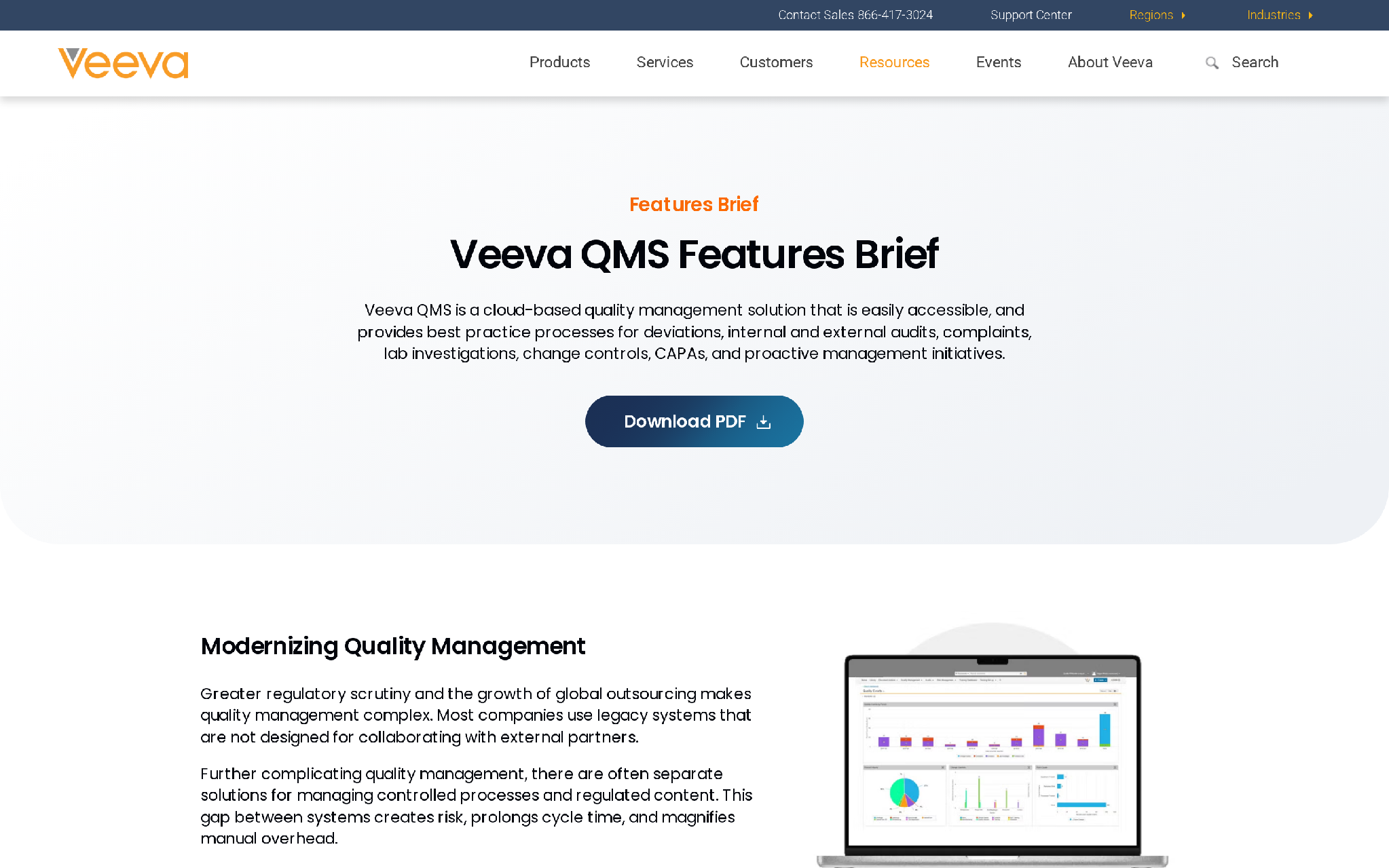
Veeva Vault QMS is best for global biopharma companies that want quality processes, content, suppliers and quality risk management on a single regulated cloud platform.
Why It Made The List
Veeva belongs in this list because it directly supports the quality records pharma teams expect: deviations, audits, complaints, lab investigations, change controls, CAPAs, supplier quality management and quality risk management. It also highlights integration with ERP, LIMS, MES and CRM through Vault API.
That matters in pharma because a CAPA often triggers document updates, training and supplier follow-up. If those records sit in separate systems, the audit trail becomes harder to prove.
Risk Workflows Supported
- Deviations and investigations.
- Internal and external audits.
- Complaints and lab investigations.
- Change control and CAPA.
- Supplier quality management.
- Quality risk management and proactive quality initiatives.
- Reports and dashboards for quality events.
Pharma And Regulatory Fit
Veeva is strongest when quality risk is part of a broader biopharma operating environment. It makes sense for teams already using Veeva systems or companies that want QMS, QualityDocs and partner collaboration to sit close together.
It is not a DPDPA-first product. Privacy and processor-risk workflows may be handled through integrations or adjacent systems rather than as the center of the product.
Features
- Delivered quality processes for deviations, audits, complaints, lab investigations, change control, supplier quality, QRM and CAPA.
- Reporting for deviations, investigations, complaints, audits and CAPA actions.
- Document change-control links through Veeva QualityDocs.
- API-based integrations with ERP, LIMS, MES and CRM.
- Supplier access and partner visibility for external quality workflows.
Pricing
Custom quote. Pricing depends on Vault applications, users, deployment footprint, integrations, validation needs and services.
Pros
- Strong fit for global biopharma quality operations.
- Covers the quality workflows a pharma buyer expects, including deviations, complaints, audits, CAPA and supplier quality.
- Useful when quality risk needs to connect to controlled content and partner collaboration.
- Good option for companies already operating in the Veeva ecosystem.
- Better fit than privacy-first platforms for QMS-linked risk at global scale.
Cons
- It may be too large for smaller Indian pharma teams that do not need a global platform.
- DPDPA privacy, consent, DSAR and PIA workflows are not the natural center of the product.
- Implementation can require significant process design and change management.
- Pricing is not public, so budget planning needs vendor engagement.
- Teams outside the Veeva ecosystem may need more integration work.
Summary
Choose Veeva Vault QMS when the buyer is a global or scaling biopharma quality team. Do not choose it as a replacement for an India-first DPDPA privacy operating layer.
4. TrackWise Digital - Best For High-Volume Deviations And CAPA
Best For
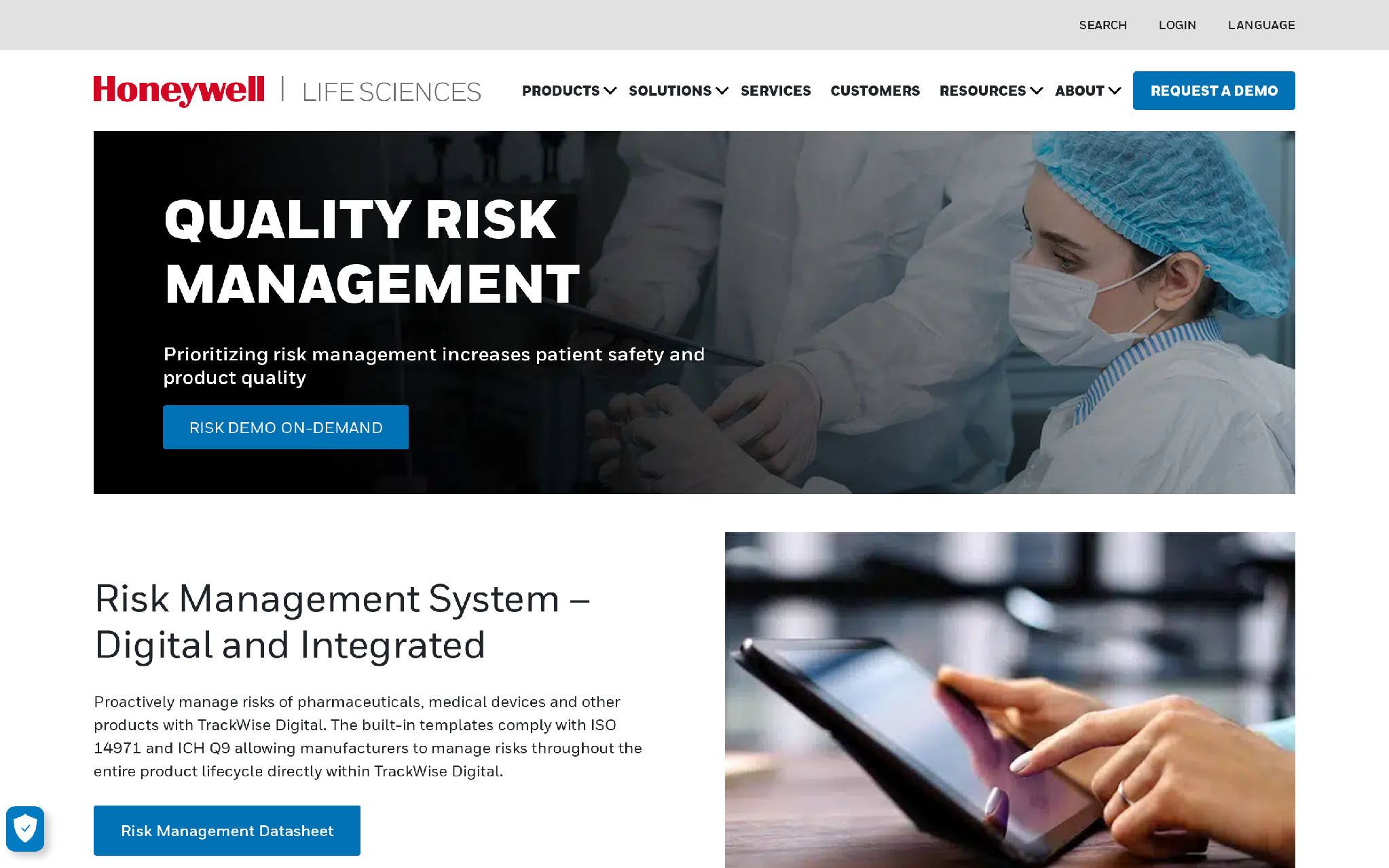
TrackWise Digital is best for pharma manufacturers with high volumes of quality events, deviations, nonconformances, CAPAs and supplier risk analysis.
Why It Made The List
TrackWise Digital has a dedicated quality risk management product. It supports ICH Q9-aligned risk management and connects risk records with complaints, nonconformances, deviations and CAPAs.
Its risk workflow includes templates aligned to ICH Q9 and ISO 14971, residual-risk evaluation, risk-control activities and links from nonconformance/CAPA records to individual residual risks.
That is the kind of operating detail a pharma-quality buyer expects. The system is strongest where risk decisions need to be tied to quality events across the product lifecycle.
Risk Workflows Supported
- Quality risk management files.
- Risk analysis, evaluation, control and residual-risk review.
- Deviations and nonconformance links.
- CAPA links for root-cause analysis.
- Supplier risk analysis.
- Risk matrices and lifecycle risk information.
Pharma And Regulatory Fit
TrackWise Digital is a natural fit where quality risk management has to operate inside a QMS. It is especially relevant when risk records need to follow the product lifecycle and connect to recurring quality events.
For Indian pharma companies, I would evaluate TrackWise when plant quality teams already have mature deviation/CAPA volume and need consistency across sites. It is less relevant if the problem starts with DPDPA data maps, consent withdrawal or DSAR evidence.
Features
- ICH Q9-aligned risk templates.
- Residual-risk evaluation and risk-control tracking.
- Nonconformance, deviation and CAPA links.
- Risk matrix visualization.
- Supplier risk analysis.
- Lifecycle information collection for risk review.
Pricing
Custom quote. Pricing depends on QMS modules, users, sites, validation requirements and implementation services.
Pros
- Strong quality-risk depth for pharma manufacturing environments.
- Good fit for high-volume deviation, nonconformance and CAPA workflows.
- Useful residual-risk and risk-control workflow language for ICH Q9-style QRM.
- Supplier risk analysis fits pharma outsourcing and material-supplier oversight.
- Better than privacy tools when root-cause, CAPA and residual-risk records drive the workflow.
Cons
- It is not designed around India-first DPDPA consent, PIA, DSAR or processor evidence.
- It may be heavy for teams that only need lightweight risk scoring.
- Privacy/vendor data risk still needs a separate governance layer.
- Pricing is not public, so buyers need a scoped vendor quote.
- The strongest value appears when a company already has mature quality-event volume.
Summary
Choose TrackWise Digital when the risk workflow starts in plant quality events and needs CAPA/deviation depth. Do not choose it as the primary system for DPDPA privacy risk.
5. MetricStream - Best For Enterprise GRC And Audit Risk
Best For
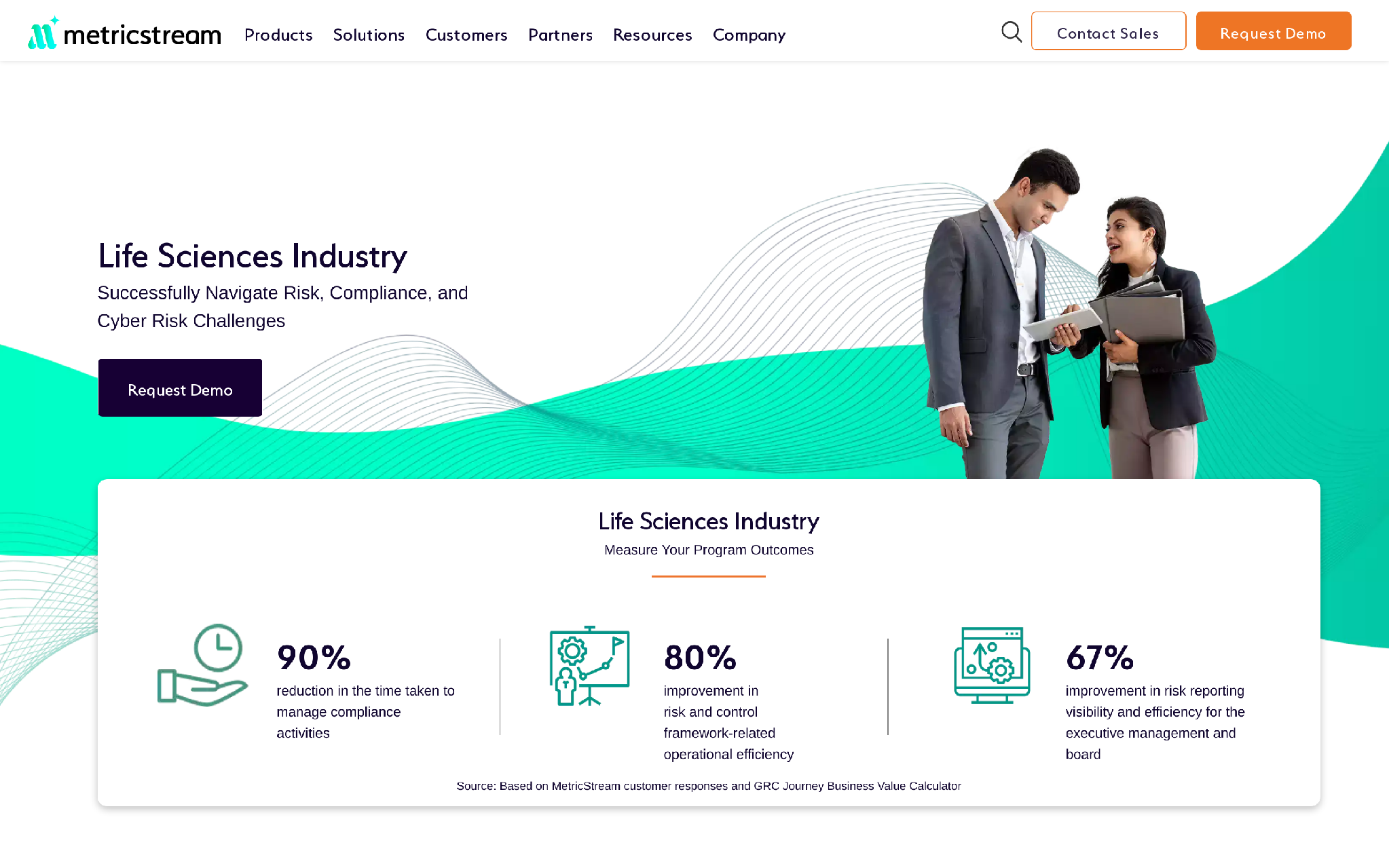
MetricStream is best for large pharma groups that need enterprise risk, internal audit, controls, cyber risk, compliance, third-party risk and leadership reporting in one GRC program.
Why It Made The List
MetricStream is not a specialist pharma QMS and not a DPDPA-only platform. It made the list because enterprise risk is a real pharma requirement once a company has multiple plants, suppliers, audits, IT controls and board-level reporting needs.
MetricStream positions the platform around risk, compliance, audit, cyber risks, third-party risk and suppliers for pharmaceutical, biotech and medical-device companies.
Risk Workflows Supported
- Enterprise risk registers and assessment workflows.
- Internal audit and findings management.
- Control testing and compliance management.
- Third-party and supplier risk management.
- Cyber and operational risk visibility.
- Issue management and management reporting.
Pharma And Regulatory Fit
MetricStream fits risk offices, internal audit teams and enterprise compliance leaders more than plant-quality users. It can help consolidate risk signals across suppliers, cyber, audit and controls, but it should not be treated as a direct replacement for a deep QMS risk module.
For DPDPA, MetricStream can support third-party and control governance, but India-specific privacy workflows may still need configuration or a dedicated DPDPA platform.
Features
- Enterprise GRC platform for risk, audit, compliance and cyber programs.
- Third-party risk lifecycle management.
- Supplier and contractor risk visibility.
- Control testing and issue management.
- Dashboards for risk aggregation and leadership reporting.
- Life-sciences industry positioning for regulated companies.
Pricing
Custom quote. Pricing depends on selected GRC modules, users, business units, third-party volume, integrations and implementation services.
Pros
- Strong fit for enterprise risk and internal audit teams.
- Useful when leadership needs one view across plants, suppliers, controls, cyber and operational risk.
- Good third-party risk depth for procurement and extended enterprise workflows.
- Better fit than QMS tools for risk registers, control testing and executive reporting.
- Can support a broader risk operating model across business functions.
Cons
- It may be too heavy if the only need is DPDPA privacy risk or a QMS risk module.
- Pharma quality workflows may not be as deep as specialist QMS/QRM platforms.
- India-specific DPDPA workflows require careful configuration and privacy ownership.
- Pricing is not public, so buyers need a scoped quote.
- Implementation depends on mature risk taxonomy, control ownership and reporting discipline.
Summary
Choose MetricStream when the risk owner is enterprise risk, internal audit or group compliance. Do not choose it as the first system for plant-level FMEA/CAPA records or India-first DPDPA evidence unless the organization is ready to configure those workflows.
6. AmpleLogic - Best For ICH Q9-Oriented Digital QRM
Best For
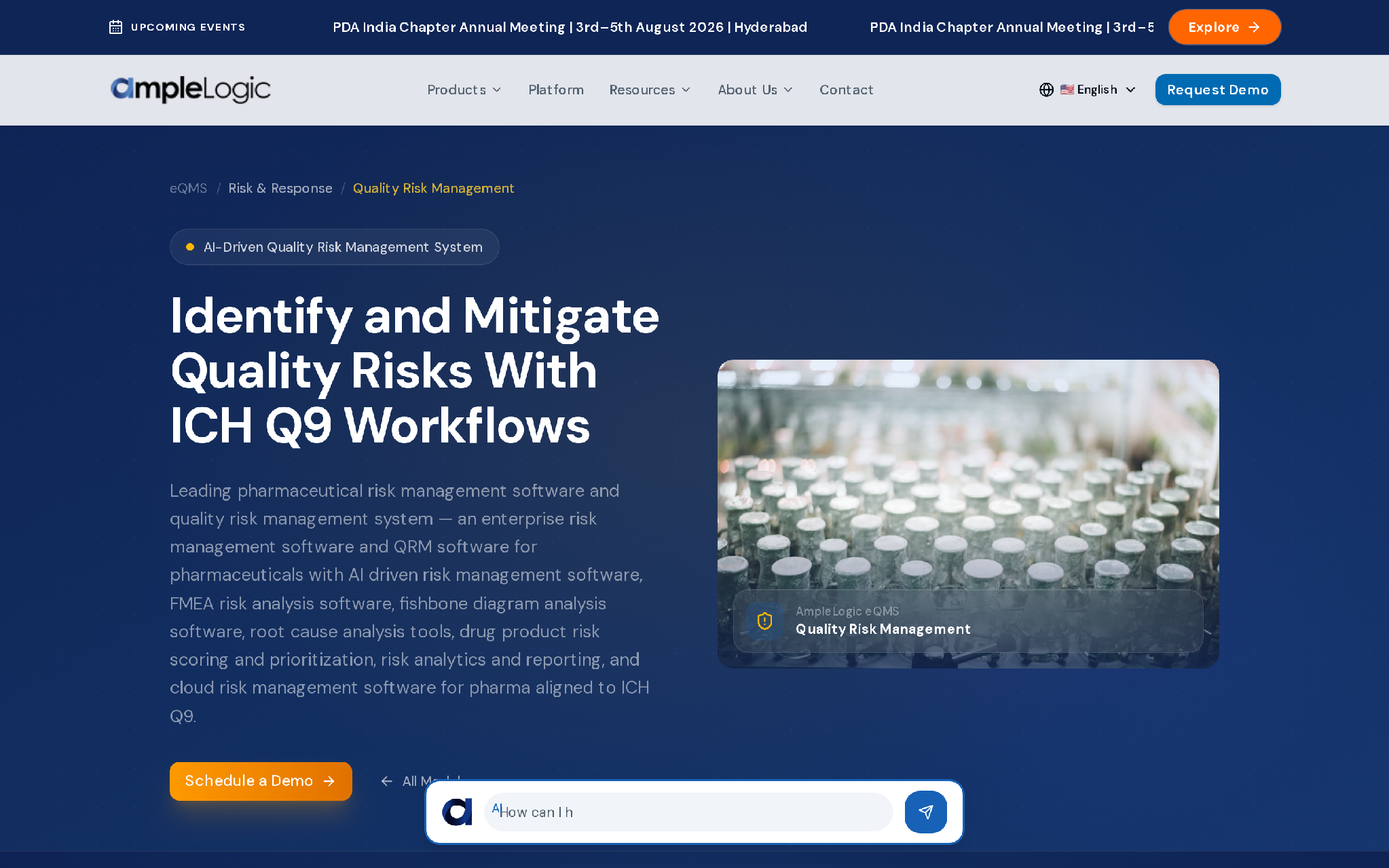
AmpleLogic is best for pharma teams that want digital Quality Risk Management with ICH Q9 language, FMEA, SOD scoring, RPN calculation, deviation links, CAPA links, OOS/OOT adjacency, audits and supplier qualification workflows.
Why It Made The List
AmpleLogic deserved inclusion because it speaks directly to pharma QRM rather than broad risk management. Its quality risk module covers ICH Q9-aligned risk management, FMEA, risk scoring, RPN calculation, mitigation workflows, GMP risk monitoring and connected QMS modules such as deviation, change control, audit management and vendor/supplier qualification.
For Indian pharma buyers, that can be useful when the team wants a pharma-focused QMS risk tool and does not want to start with a large global enterprise platform.
Risk Workflows Supported
- ICH Q9-oriented Quality Risk Management.
- FMEA with Severity, Occurrence and Detectability scoring.
- RPN calculation and drug-product risk prioritization.
- Mitigation tasks, evidence requirements and effectiveness criteria.
- Deviation, CAPA, change control and audit links.
- Supplier qualification and GMP risk monitoring.
Pharma And Regulatory Fit
AmpleLogic fits the practical QRM vocabulary Indian pharma teams use: risk scoring, deviation classification, CAPA evaluation, supplier qualification and GMP defensibility. It is strongest when the buyer wants the risk workflow close to eQMS modules.
It has moderate privacy/vendor depth in the sense that vendor/supplier qualification can support supplier risk, but it is not a dedicated DPDPA privacy platform for consent, DSARs or Data Principal rights.
Features
- ICH Q9-aligned QRM workflows.
- FMEA, SOD scoring and RPN calculation.
- Risk mitigation tasks with evidence requirements.
- Deviation, CAPA, change-control and audit module links.
- GMP risk monitoring and escalation.
- Vendor/supplier qualification adjacency.
Pricing
Custom quote. Pricing depends on selected eQMS modules, users, sites, validation scope, configuration and implementation services.
Pros
- Strong pharma-specific QRM language and workflow fit.
- Useful for FMEA, RPN, mitigation tracking and residual-risk review.
- Good adjacency to deviation, CAPA, audit, change control and supplier qualification records.
- Practical option for Indian pharma teams evaluating ICH Q9-oriented digital workflows.
- More directly aligned to quality-risk work than broad privacy or enterprise GRC tools.
Cons
- It is not a dedicated DPDPA platform for consent, DSAR, PIA or processor evidence.
- Public proof depth may vary by module, so buyers should ask for workflow demos against their exact SOPs.
- Pricing is not self-serve, so commercial comparison requires a quote.
- Global enterprises may prefer Veeva, TrackWise or MasterControl for broader ecosystem maturity.
- Privacy teams will still need a DPDPA evidence layer for personal-data workflows.
Summary
Choose AmpleLogic when the risk workflow is explicitly QRM: ICH Q9, FMEA, RPN, mitigation, CAPA, deviations and supplier qualification. Do not choose it as the only tool for DPDPA privacy risk.
7. Scilife - Best For Growing Life-Sciences Quality Teams

Best For
Scilife is best for growing pharma, biotech and life-sciences teams that need a quality management system with documents, training, CAPA, quality events, deviations, audit trails and risk visibility without starting with the heaviest enterprise platform.
Why It Made The List
Scilife made the list because many pharma companies do not need a full enterprise GRC system on day one. They need a usable QMS where quality records, training evidence, CAPAs, deviations and audit trails are easier to maintain.
Scilife positions the product around quality processes, documents, training, CAPAs and audit trails, with alignment to 21 CFR Part 11, Annex 11, ICH guidelines and GxP requirements.
Risk Workflows Supported
- Quality event management.
- CAPA tracking and corrective action evidence.
- Document management and training records.
- Deviation and audit trails.
- Change-control and audit workflows.
- Quality KPI and process visibility.
Pharma And Regulatory Fit
Scilife is useful when the quality team needs a practical QMS foundation and wants risk to sit near CAPA, training, audits and document control. It is less specialized than TrackWise or MasterControl for complex enterprise QRM, but it may be easier for growing teams to evaluate and adopt.
It is not a DPDPA privacy-risk platform, so personal-data workflows need a separate layer.
Features
- QMS workflows for pharma, biotech and life sciences.
- Document management, training, CAPA and audit trails.
- Quality events and deviation support.
- Change control and audits software adjacency.
- Alignment messaging around 21 CFR Part 11, Annex 11, ICH and GxP.
- Quality KPIs and process visibility.
Pricing
Custom quote. Pricing depends on selected modules, users, validation requirements and services.
Pros
- Practical fit for growing life-sciences quality teams.
- Good QMS adjacency for CAPA, training, documents, deviations and audit trails.
- Easier to consider when a team wants a focused quality platform rather than enterprise GRC.
- Useful for quality-process adoption and inspection preparation.
- Stronger than privacy platforms when the main record is quality-process evidence.
Cons
- It is not built around India-first DPDPA privacy operations.
- It may not match the depth of MasterControl, Veeva or TrackWise for complex global pharma quality operations.
- Vendor privacy risk, consent, DSAR and PIA workflows need another platform.
- Pricing is quote-based, so the buyer must validate cost against scope.
- Enterprise risk, internal audit and executive control reporting may require a GRC platform.
Summary
Choose Scilife when the team needs a quality-system layer for CAPA, training, documents, deviations and audit trails. Do not choose it as the DPDPA privacy-risk system for patient data, processor assessment or Data Principal request evidence.
Why Some Prominent Tools Were Not Included
I did not include every known QMS or GRC platform because this article is meant to help Indian pharma buyers choose across risk categories, not list every possible vendor.
Qualio, ComplianceQuest, ETQ Reliance and QT9 QMS are credible tools to evaluate in a broader QMS shortlist.
They were excluded here because the seven-tool set already covers the main buying patterns: enterprise quality risk, global biopharma QMS, high-volume quality events, India-first DPDPA privacy risk, enterprise GRC, ICH Q9-oriented QRM and growing-team QMS.
A buyer running a formal RFP should still compare those excluded products if their internal stack, budget or validation requirements point that way.
How To Choose The Right Tool
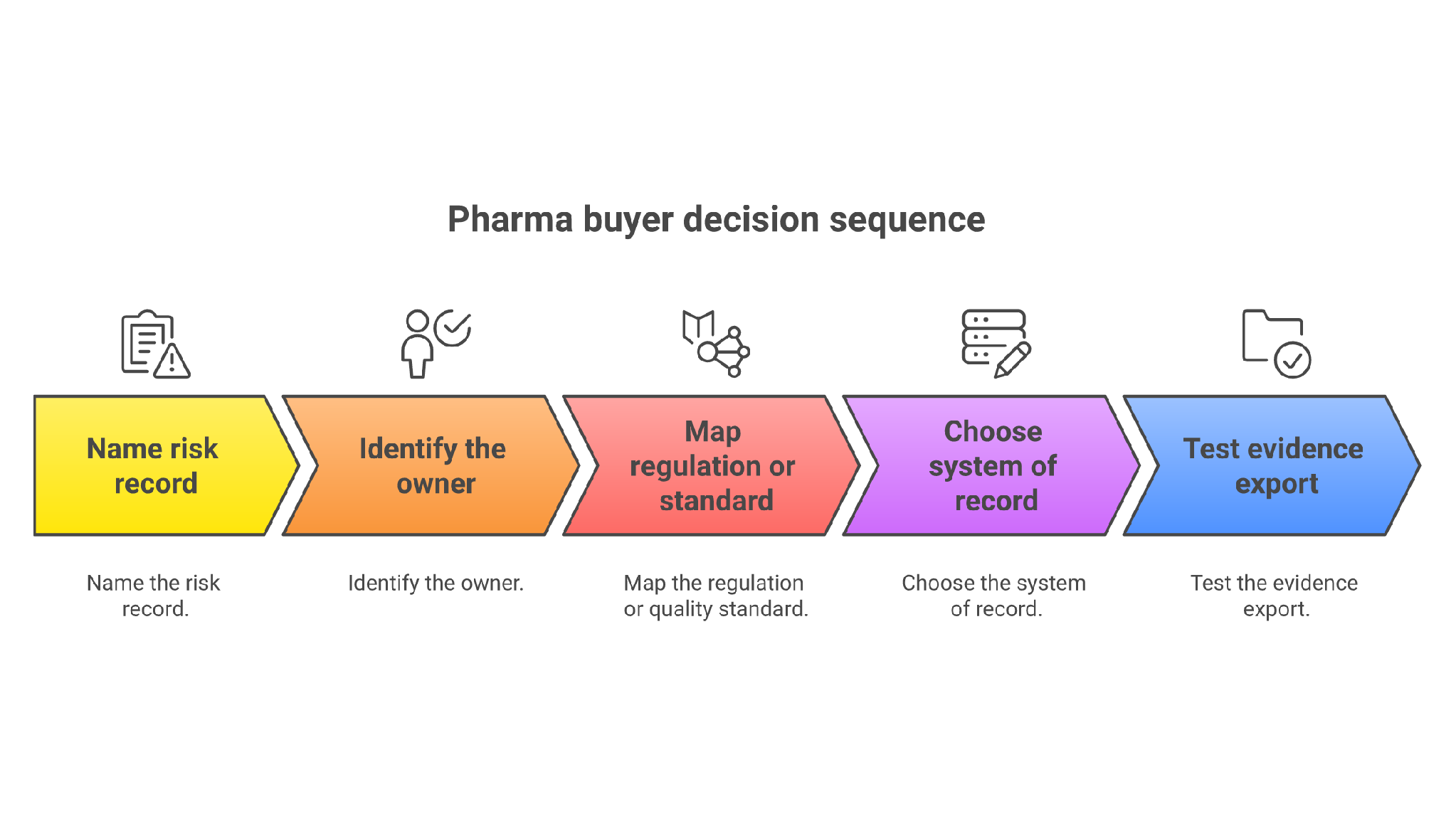
The simplest buying method is to name the record you need to produce.
If the record is a deviation, OOS/OOT investigation, CAPA, FMEA, RPN calculation, change-control risk or supplier qualification, start with a QMS/QRM shortlist: MasterControl, Veeva Vault QMS, TrackWise Digital, AmpleLogic or Scilife.
If the record is a PIA, vendor processor assessment, consent ledger, DSAR log, breach timeline or DPDPA audit export, shortlist Redacto. That is the stronger fit for Indian pharma teams trying to connect privacy obligations to operating evidence.
If the record is an enterprise risk register, internal audit issue, control test, cyber-risk item, procurement risk or board report, evaluate MetricStream.
Do not force all of this into one spreadsheet. The connected-but-not-collapsed model is healthier: quality risk stays in the QMS, privacy risk stays in the DPDPA evidence layer, enterprise risk rolls up what leadership needs to see, and integrations or exports connect the records.
Can One Tool Handle Both DPDPA And Pharma Quality Risk?
Usually, not at sufficient depth.
A pharma QMS can be excellent at deviation risk, CAPA effectiveness, supplier qualification and controlled quality records, while still being thin on consent, DSARs, PIAs and processor evidence.
A privacy platform can be excellent at DPDPA workflows, while still being the wrong place to manage batch quality, OOS/OOT investigations or manufacturing CAPA.
The better question is: which system owns which record?
For example, a CRO onboarding workflow may need two linked records. Quality may assess vendor qualification, GxP impact and audit findings in the QMS. Privacy/legal may assess patient data, processor terms, purpose, safeguards and PIA impact in Redacto. Enterprise risk may roll up the residual risk and control owner in MetricStream.
That is not duplication if each system has a clear evidence job.
Monday-Morning Next Step
This week, do not start with a vendor demo.
Pick ten risk records from your pharma business: two deviations, two CAPAs, two supplier qualifications, two privacy/vendor assessments, one PIA and one internal audit issue. For each record, write down the owner, triggering event, scoring method, approval gate, mitigation action, evidence export and downstream system.
If most records are quality events, start with MasterControl, Veeva, TrackWise, AmpleLogic or Scilife. If the weak records involve patient data, processors, consent, PIAs or DSARs, shortlist Redacto. If leadership cannot see risk across plants, vendors, audits and controls, evaluate MetricStream.
The point is not to collapse every risk into one platform. The point is to make every risk record traceable from obligation to workflow to evidence.