%20Redacto%20logo_New.png)


5 Best PrivEzi Alternatives For DPDPA Compliance India 2026


When we speak to Indian privacy and security teams, the PrivEzi alternatives conversation rarely starts with a feature gap. It starts with a board question: if a Data Principal withdraws consent, if a processor is challenged, or if a breach review starts, can the company show one evidence trail without asking five teams to rebuild the story?
PrivEzi is a serious starting point for that problem. Its platform brings cookie management, consent, data discovery, privacy automation, vendor risk, breach management, Data Principal requests, and process records into one privacy system. For teams moving away from spreadsheet-led privacy work, that breadth matters.
The switch question is narrower and more practical: which tool will give your DPO, CISO, legal team, product owners, and vendors a defensible operating record when the Digital Personal Data Protection Act, 2023 starts biting operationally?
Under Section 6 of the Digital Personal Data Protection Act, 2023, consent has to be specific, informed, unambiguous, withdrawable, and provable. Under Section 8 of the Digital Personal Data Protection Act, 2023, the Data Fiduciary remains responsible for safeguards, processors, breach intimation, erasure, and grievance handling. The tool therefore has to do more than store a consent banner.
My view is simple: a DPDPA platform should not make compliance look tidy. It should make the messy handoffs visible enough to govern.
It has to show who did what, when, why, and with which downstream system.
TL;DR: Best PrivEzi Alternatives
Tool Name: Best if you’re evaluating a specific DPDPA workflow
- Redacto: Best if you’re an Indian enterprise that wants consent, DSAR, PIA, ROPA, vendor risk, data discovery, and audit evidence in one DPDPA-first operating layer.
- OneTrust: Best if you’re a global enterprise already running multi-regulation privacy, third-party risk, and governance programs across several countries.
- Securiti: Best if your hardest problem is data intelligence, discovery, classification, data flows, breach impact, and privacy automation across large environments.
- Privy by IDfy: Best if you’re a BFSI, lending, fintech, or regulated Indian business that wants consent governance tied to identity, digital journey, and audit controls.
- PrivacyEngine: Best if you're building a DPO-led DPDP readiness program around consent, Data Principal rights, RoPA, DPIA, third-party assessment, risk, and breach evidence.
Why Teams Look For PrivEzi Alternatives
PrivEzi does many things well. Its own platform describes eight privacy modules, including consent management, data discovery, vendor risk, breach management, Data Principal request management, and process records.
Its terms also describe a cloud-based privacy management platform for the Digital Personal Data Protection Act, 2023, GDPR, ISO 27701, and other privacy rules.
That breadth is useful when the privacy team wants one place to start.
Teams still compare alternatives when one of four operating questions becomes urgent:
- Can the evidence map to Indian law without translation? The workflow should map cleanly to Section 5 notice, Section 6 consent, Section 8 fiduciary obligations, Section 10 Significant Data Fiduciary obligations, and the Digital Personal Data Protection Rules, 2025.
- Can the platform fit the governance model already in place? Global teams may already use OneTrust, Securiti, or another large governance suite and need DPDPA added to a wider privacy program.
- Can the team actually find the data? Consent and DSAR workflows break when the organization cannot map where personal data sits, moves, and reaches processors.
- Can the buyer avoid paying for the wrong shape of tool? Some companies need a full compliance platform; others need only consent and rights infrastructure for websites, apps, IVR, CRM, or lending journeys.
The common wrong fix is buying a consent tool and calling the DPDPA program done.
That is not enough. A consent record still has to connect with purpose tags, withdrawal, DSAR routing, vendor contracts, PIA decisions, breach evidence, and audit exports.
How I Evaluated These PrivEzi Alternatives
I evaluated each PrivEzi alternative the way I would want a Redacto buyer to evaluate us: can the platform turn DPDPA obligations into operating evidence for an Indian enterprise, and can it expose the human judgment points instead of hiding them behind automation language? The focus was not whether a vendor says “DPDPA-ready,” but whether a DPO or CISO could trace a live workflow from notice to consent, request, vendor, risk decision, and audit record.
- Consent and withdrawal evidence: Can the tool capture, manage, review, and withdraw consent in a way that supports Section 6 of the Digital Personal Data Protection Act, 2023?
- DSAR and grievance workflow: Can Data Principal requests move from intake to verification, routing, response, and evidence without being trapped in email?
- PIA, ROPA, and processing records: Does the tool help map processing activities, purpose tags, risk assessments, and decision records?
- Vendor and processor accountability: Can processors, contracts, risk scores, data categories, and review dates be linked to the data flow?
- Security, breach, and audit trail: Does the workflow support safeguards, logs, breach response, and exportable records under Section 8 of the Digital Personal Data Protection Act, 2023 and the Digital Personal Data Protection Rules, 2025?
- Pricing and procurement clarity: Is pricing public, license-based, custom, or tied to profiles, visitors, admin users, or inventory?
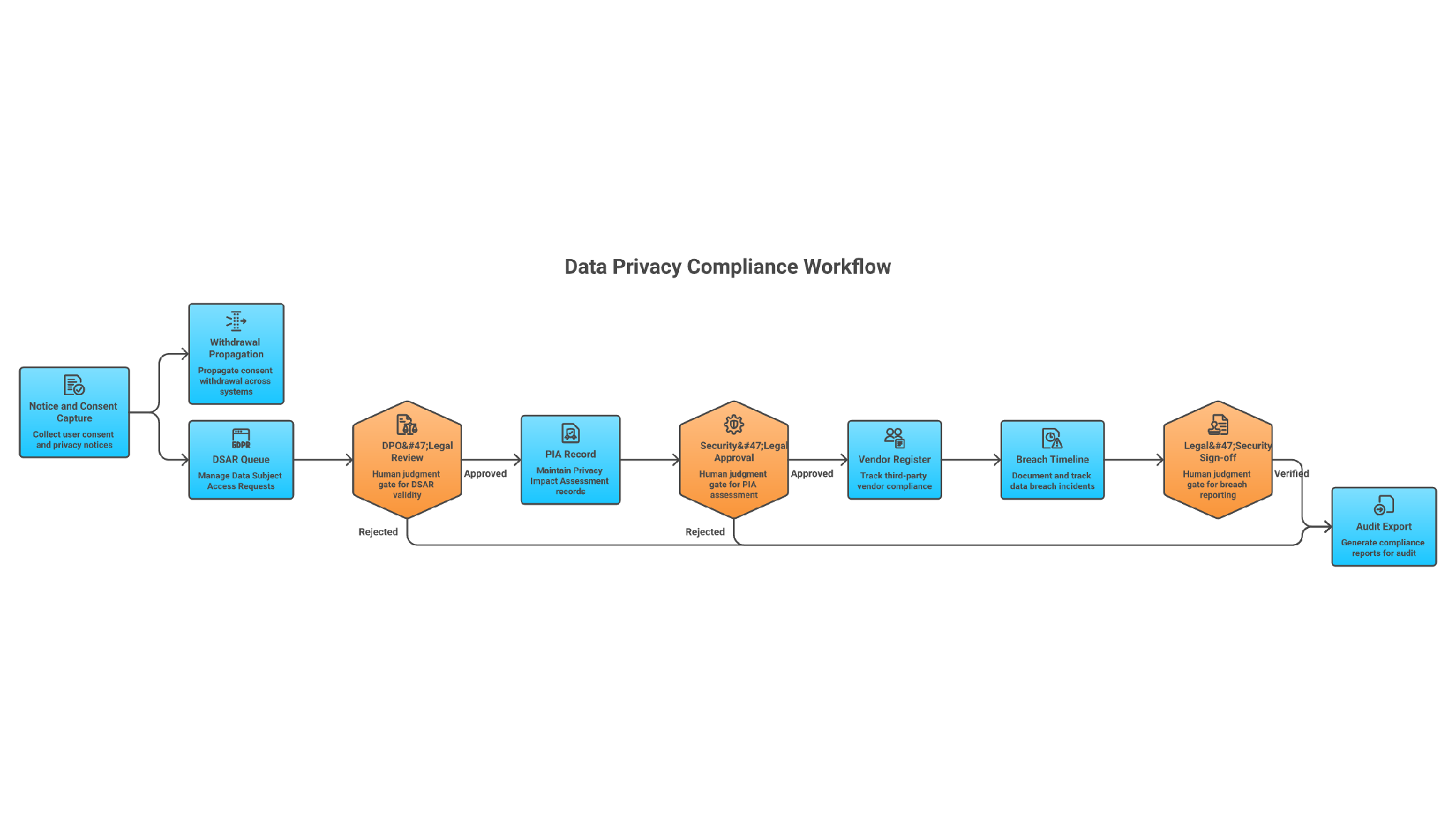
PrivEzi Alternatives Comparison Table
1. Redacto: Best for DPDPA-First Compliance Operations In India
Redacto is the strongest PrivEzi alternative when the buyer wants a DPDPA-first operating system rather than a generic privacy suite adapted for India. It is positioned around consent, data governance, vendor risk, PIA, ROPA, DSAR automation, and audit reporting for Indian enterprises under the Digital Personal Data Protection Act, 2023.
The fit is strongest for BFSI, healthcare, pharma, ecommerce, telecom, and other Indian businesses where the same data flow touches product, legal, security, support, and processors.
That distinction matters. A consent record by itself does not prove that withdrawal reached the CRM, the support tool, the analytics stack, and the processor. A PIA document by itself does not prove that product, security, and legal reviewed the same change. Redacto’s job is to make those handoffs visible as records, not to let them disappear into email.
Key features:
- Unified Consent Manager for consent capture, lifecycle management, withdrawal propagation, and audit evidence.
- Automated DSAR Management for Data Principal request intake, verification, routing, tracking, and response evidence.
- Privacy Impact Assessment (PIA) Automation with Redacto-published 98.5% accuracy on AI-filled PIAs.
- AI-Driven Data Discovery & Mapping for locating and classifying personal data across systems.
- Vendor Risk Management for processor review, risk scoring, follow-up, and evidence records.
- Audit & Reporting for regulator-ready exports and leadership review.
- CI/CD Privacy Scanner for engineering-led privacy checks before product changes ship.
- Unified Privacy & Security Trust Center for communicating privacy and security posture.
Pricing:
License-based; contact Redacto. Redacto does not publish fixed pricing on its site, so budget comparison needs a scoped demo rather than an assumed number.
Pros:
- Stronger India-first DPDPA workflow fit than global suites when the main obligation is the Digital Personal Data Protection Act, 2023, not a global privacy program.
- Broader than consent-only tools because it connects consent with DSAR, PIA, data discovery, vendor risk, and audit reporting.
- Better suited to evidence-led DPDPA operations than tools that treat cookie banners or website consent as the center of the program.
- Redacto’s live capability set aligns with the workflows Indian enterprises need to prove: consent, DSAR, PIA, ROPA, vendor risk, processor review, and audit records.
Cons:
- No public pricing page, so procurement teams cannot benchmark the license without speaking to Redacto.
- India/DPDPA-first by design, so a global multi-regulation team may prefer OneTrust if GDPR, CCPA, DORA, AI governance, and third-party risk already sit in one global program.
Who should use Redacto:
Choose Redacto if your immediate question is, “Can we prove DPDPA compliance across consent, requests, vendors, PIAs, product changes, and audits without stitching together five systems?”
Who should not choose Redacto:
Do not choose Redacto as the default if your privacy team already runs a mature global privacy stack and only needs a DPDPA control pack added to that stack.
2. OneTrust: Best for Global Enterprises Adding DPDPA To A Larger Privacy Program
OneTrust is a strong PrivEzi alternative for enterprises that already manage privacy, consent, third-party risk, AI governance, and GRC across multiple jurisdictions. Its India DPDPA workflow covers consent and withdrawal, Data Principal access requests, data discovery, mapping, classification, vendor assessment, cross-border tracking, and breach response.
The fit is strongest when India is one program inside a larger global compliance estate.
Key features:
- DPDPA-mapped control frameworks for gap identification, remediation, and audit readiness.
- Consent and preference management for collection, withdrawal, and digital channel coverage.
- DSAR automation for intake, identity verification, data retrieval, deletion, and secure communication.
- Data mapping automation for personal data inventory, processing activity records, and flow visibility.
- Privacy impact assessment and mitigation workflows inside OneTrust Privacy Automation.
- Third-party management for vendor inventory, assessments, DPAs, transfers, and monitoring.
- Privacy incident and notification workflows in the Privacy Automation Suite.
Pricing:
Custom; get pricing. OneTrust prices Privacy Automation by users and privacy asset inventory, while consent packages use visitor, profile, or data-volume meters depending on the package.
Pros:
- Good fit for global enterprises that need DPDPA alongside GDPR, CCPA, AI governance, GRC, and third-party management in one ecosystem.
- Mature privacy automation depth across assessments, data maps, vendor risk, DSRs, incidents, and regulatory intelligence.
- Useful when the privacy team needs board-level reporting and cross-country governance rather than only India-specific operations.
Cons:
- May be heavier than needed if the buyer only wants India-first DPDPA workflows and faster local deployment.
- Public pricing is not a fixed rupee figure; buyers need customized pricing and usage meters.
- DPDPA is one supported regulation inside a broader platform, so Indian teams still need to configure the workflow carefully against the Act and Rules.
Who should use OneTrust:
Choose OneTrust if your India program has to sit inside an existing global privacy, risk, and third-party governance architecture.
Competitor-wins scenario:
OneTrust can beat Redacto when the buyer’s primary problem is global multi-regulation governance, not India-first DPDPA execution.
3. Securiti: Best for Data Discovery, Classification, And Privacy Automation At Scale
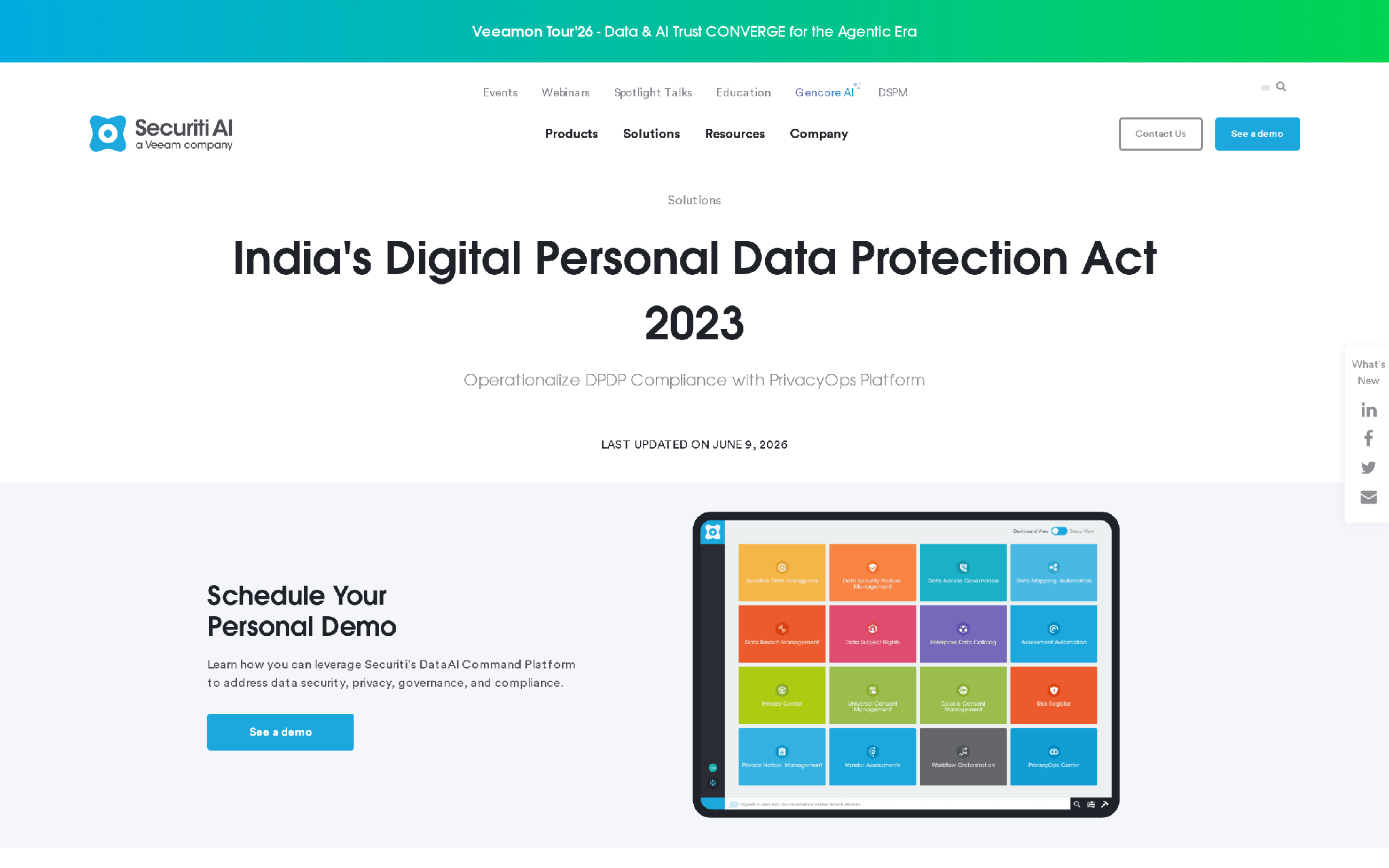
Securiti is a strong PrivEzi alternative when the privacy program is blocked by data visibility. Its India DPDPA workflow is built around AI-driven personal information discovery, DSR automation, documented accountability, data visibility, identity linking, vendor assessment, breach notification, data flow mapping, cookie compliance, notice management, and DPIA automation.
The fit is strongest when the DPO and security team cannot answer where personal data sits, who can access it, and which processors touch it.
Key features:
- AI-driven personal information discovery and classification.
- DSR automation for Data Principal request processing and secure reports.
- Consent tracking and revocation monitoring.
- Third-party and vendor risk assessment linked to processor readiness.
- Data flow mapping and reporting for personal data movement.
- Breach impact analysis and breach notification workflows.
- Privacy policy and notice management.
- DPIA and risk assessment automation.
Pricing:
Custom; request demo. Securiti does not publish a fixed DPDPA product price on the pages reviewed.
Pros:
- Good fit when the central problem is discovering, classifying, mapping, and monitoring personal data across complex enterprise systems.
- Product workflows are mapped to provisions such as Section 8 obligations and DPDP Rule 6 safeguards.
- Useful for security-led teams that need privacy operations connected to data security and breach impact workflows.
Cons:
- May be more data-intelligence-heavy than a team needs if the first problem is consent collection and Data Principal rights intake.
- Custom pricing means procurement cannot compare an exact rupee number from the public page.
- Global platform depth can create implementation work for Indian teams that want a narrower DPDPA-first operating model.
Who should use Securiti:
Choose Securiti if your DPDPA readiness gap starts with unknown personal data, shadow systems, unclear lineage, and breach impact uncertainty.
4. Privy by IDfy: Best for BFSI And Digital Journey Consent Governance
Privy by IDfy is a strong PrivEzi alternative for Indian enterprises that want consent governance tied closely to identity, onboarding, and regulated digital journeys. Privy is positioned as a full-stack DPDP compliance and privacy governance platform with granular consent notices, data processor management, RoPA automation, consent artefacts, digital signatures, versioning, AI assessments, and cookie management.
Privy is also positioned as an enterprise-grade consent and data governance platform for consent, governance, risk, accountability, processing, sharing, retention, monitoring, and audit-ready evidence.
Key features:
- Consent governance for granular notices and lifecycle controls.
- Multilingual support across 22 Indian languages, according to IDfy’s article.
- Consent artefacts with hashing, digital signatures, and versioning, according to IDfy’s article.
- RoPA automation and data processor management.
- Inspect AI for digital journey assessments.
- Cookie Manager for digital consent touchpoints.
- Enterprise governance positioning for BFSI, lending, fintech, and regulated customer journeys.
Pricing:
Custom; contact IDfy/Privy. Public pages reviewed did not provide a fixed Privy price.
Pros:
- Good fit for BFSI and lending teams that already know IDfy's trust infrastructure and want privacy governance close to onboarding and identity workflows.
- More India-specific than many global suites because the product messaging is explicitly built around DPDP operations.
- Useful when consent must work across digital journeys, multilingual notices, and regulated customer acquisition flows.
Cons:
- Public product detail is split across IDfy content, Privy pages, and LinkedIn rather than a single deeply documented pricing and module page.
- No fixed public pricing found, so budget fit still requires sales discovery.
- May be less natural for teams that want consent, DSAR, PIA, vendor risk, data discovery, and audit reporting described as one DPDPA operating system from the start.
Who should use Privy by IDfy:
Choose Privy if your privacy program sits close to BFSI onboarding, identity verification, digital lending, and customer journey governance.
5. PrivacyEngine: Best for DPO-Led DPDP Readiness And Evidence Management
PrivacyEngine is a strong PrivEzi alternative when the privacy office wants DPDP readiness to sit inside a broader governance, risk, training, and evidence program. Its India DPDP page maps the workflow around notices, consent and withdrawal, Data Principal rights, RoPA, third-party assessments, risk management, DPIA, breach, and management evidence.
The fit is strongest when the DPO needs to show senior management, auditors, or the Board how processing records, requests, processors, risk decisions, and incidents are being tracked over time.
Key features:
- PrivacyConsent for notice, consent, withdrawal, and consent-led records.
- Data Principal rights request logging, owner assignment, deadline tracking, decisions, and audit trail.
- Record of Processing Activities for processing documentation, lawful purposes, and data flow visibility.
- Third Party Assessment for processor due diligence and ongoing oversight.
- Risk Management for structured risk registers and remediation tracking.
- DPIA support for privacy risk assessment and decision evidence.
- Breach and incident logs for investigation, response, and review records.
- PrivacyAssist / Support and training-oriented program support for DPO-led operating teams.
Pricing:
Public starting points plus custom enterprise pricing. PrivacyEngine offers a free plan, an Advanced plan from EUR 14,999 per year for organizations up to 500 employees, and custom Enterprise pricing for larger or more flexible deployments.
Pros:
- Good fit when the DPO wants a governance-led system of record rather than only consent capture.
- Useful for teams that need RoPA, rights requests, third-party assessment, risk, DPIA, and breach logs connected to management evidence.
- Public pricing gives procurement more starting context than fully contact-sales privacy suites.
Cons:
- Pricing is listed in euro-based annual plans, so Indian buyers still need to confirm local commercial terms, taxes, implementation support, and enterprise scope.
- PrivacyEngine is broader than a narrow consent deployment, which may be more than a team needs if the only immediate gap is a website or app consent layer.
- India DPDP is one program inside a wider privacy platform, so teams still need to configure workflows carefully against the Digital Personal Data Protection Act, 2023 and the Digital Personal Data Protection Rules, 2025.
Who should use PrivacyEngine:
Choose PrivacyEngine if your privacy office wants DPDP readiness connected to RoPA, Data Principal rights, third-party assessments, risk, DPIA, breach logs, and DPO-led governance.
Which PrivEzi Alternative Should You Choose?
ick by the workflow that would fail first in a regulator, board, or customer review.
- Choose Redacto if your main risk is fragmented DPDPA evidence across consent, DSAR, PIA, ROPA, vendor risk, and audit reporting.
- Choose OneTrust if your India program needs to sit inside a global privacy and risk governance stack.
- Choose Securiti if personal data discovery, classification, access, data flow mapping, and breach impact are the hardest parts.
- Choose Privy by IDfy if consent governance is tied to BFSI, digital lending, identity, onboarding, and regulated customer journeys.
- Choose PrivacyEngine if your privacy team wants DPDP readiness connected to RoPA, Data Principal rights, third-party assessment, DPIA, risk, breach logs, and DPO-led governance.
The DPDPA buying mistake is choosing by feature labels alone.
The better question is: which tool gives you an evidence trail that survives handoffs between legal, security, product, support, engineering, and processors?
DPDPA Obligations The Tool Has To Support
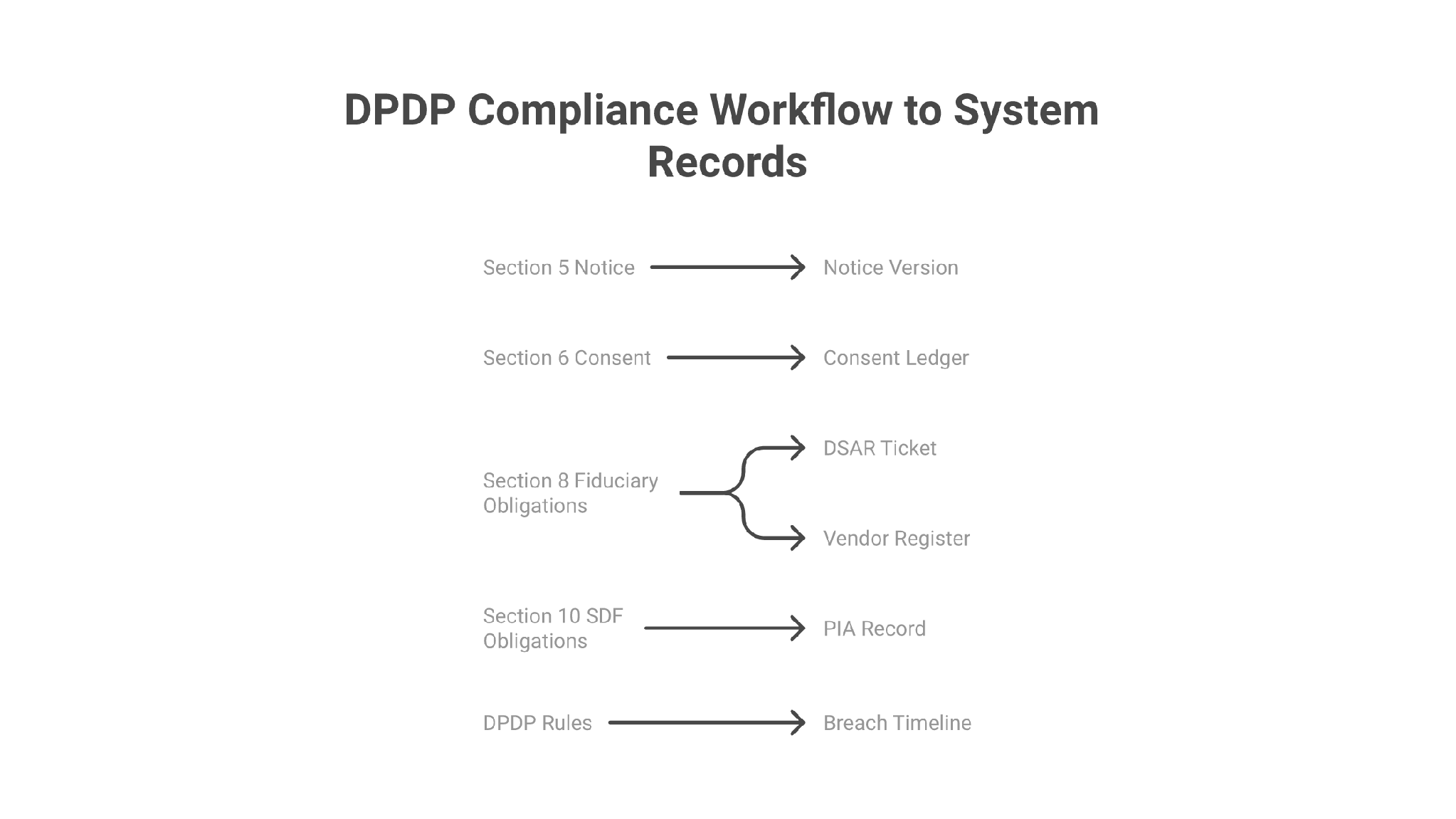
The Act and Rules turn privacy into workflow design.
Section 5 of the Digital Personal Data Protection Act, 2023 requires notice before or with consent. Section 6 of the Digital Personal Data Protection Act, 2023 sets the consent standard and lets a Data Principal give, manage, review, or withdraw consent through a Consent Manager. Section 8 of the Digital Personal Data Protection Act, 2023 places general obligations on Data Fiduciaries, including reasonable security safeguards, processor contracts, breach intimation, erasure, grievance response, and data accuracy.
The Digital Personal Data Protection Rules, 2025 make this more operational. Rule 3 covers notice content and rights links. Rule 4 covers Consent Manager registration and obligations. Rule 6 names reasonable security safeguards. Rule 7 covers breach intimation. Rule 13 covers Significant Data Fiduciary duties. Rule 14 covers Data Principal rights request mechanics.
As of July 3, 2026, the official Rules PDF says Rules 1, 2, and 17 to 21 came into force on publication in the Official Gazette; Rule 4 comes into force one year after that publication; Rules 3, 5 to 16, 22, and 23 come into force eighteen months after publication. That phase-in is exactly why buyers should build workflows now, not wait for the final operational deadline.
The maximum penalty readers usually remember is ₹250 crore. In the Act’s Schedule, breach of the obligation under Section 8(5) to take reasonable security safeguards to prevent a personal data breach may extend to ₹250 crore.
Final Recommendation
Redacto is the best PrivEzi alternative if the buyer wants an India-first DPDPA compliance platform that connects consent, DSAR, PIA, ROPA, vendor risk, data discovery, and audit evidence.
OneTrust is the better fit when the program is global. Securiti is the better fit when data intelligence is the blocking problem. Privy by IDfy is the better fit when BFSI or lending consent governance is the center of gravity. PrivacyEngine is the better fit when the privacy office wants DPDP readiness tied to RoPA, rights requests, third-party assessments, risk, and breach evidence.
This week, take one high-volume consent flow and trace it end to end: notice version, consent capture, withdrawal, downstream processor notification, DSAR route, vendor owner, PIA record, and audit export. If that evidence lives in more than three places, your PrivEzi alternative search should start with the workflow that breaks first, not the feature list that looks longest.