%20Redacto%20logo_New.png)


11 Best DPDP Compliance Software and Tools in India (2026)


MeitY notified the DPDP Rules on 13 November 2025, and the 18-month clock runs out on 13 May 2027. If your company processes personal data in India, you need consent, notices, rights requests and breach reporting running on a system by then, not in spreadsheets.
I compared 11 DPDP compliance software platforms to help you build a shortlist. For each one, I cover what it does, where it stops, which teams it fits and what it costs.
You will also find the checklist I use to judge any DPDP tool, a breakdown by industry and answers to the questions buyers ask me most.
Best DPDP Compliance Software at a Glance
Almost every vendor here prices by custom quote. Dollar figures are third-party estimates from Vendr, not vendor list prices. Your quote depends on data volume, modules, deployment model and support level.
What Is DPDP Compliance Software?
DPDP compliance software is the system you use to meet your duties as a data fiduciary under the Digital Personal Data Protection Act, 2023 and the DPDP Rules, 2025. It records what personal data you hold, why you hold it, who agreed to it and what you did when someone asked to see, fix or erase it.
Most platforms cover six jobs:
- Consent and notice: collecting consent against a stated purpose, showing a standalone notice and processing withdrawal.
- Data principal rights: intake, identity checks and replies for access, correction, erasure and grievance requests.
- Data discovery and mapping: finding personal data across databases, SaaS apps and files, then keeping a record of processing.
- Assessments: DPIAs and privacy reviews for new products, vendors and data uses.
- Vendor and processor risk: checking the companies that process data for you.
- Breach handling: logging an incident and informing the Data Protection Board and affected users.
When I call a tool a full DPDP platform in this guide, I mean it covers all six jobs with one audit trail across them.
DPDP Compliance Software vs a Consent Banner or CMP
A cookie banner records whether a visitor accepted tracking on your website. A consent management platform (CMP) goes further and stores purpose-level consent across web, app and offline channels.
Neither handles rights requests, vendor risk, DPIAs or breach reporting. If consent is your only gap right now, a CMP can carry you for a while, and I compared those in my guide to consent management platforms in India.
One more point that confuses buyers: the Rules also create registered Consent Managers. According to MeitY, these must be Indian companies, and they help individuals manage their permissions across many businesses. A registered Consent Manager is a separate entity from the CMP you run on your own site.
What the DPDP Rules, 2025 Require From Your Software
The Rules turn the Act into dated duties, and your software has to produce evidence for each one. Here is what applies and when.
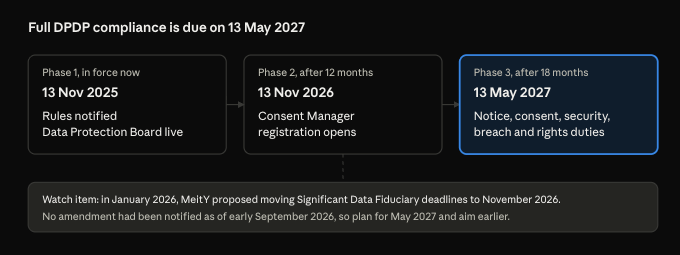
Sources differ by a day on the later dates. Vinsys uses 13 November 2026 and 13 May 2027, while some trackers use 14 November 2026 and 14 May 2027. On the proposed change, Business Standard reported that MeitY raised it with industry in January 2026, and Aufait Technologies found no amendment notified as of 6 September 2026.
Obligations for Every Data Fiduciary
These come from MeitY's release on the notified Rules. The right column is what I check for in a tool.
Extra Obligations for Significant Data Fiduciaries
The government designates Significant Data Fiduciaries based on the volume and sensitivity of the data they process. MeitY lists independent audits, impact assessments, stronger due diligence on the technology they deploy and government-set limits on certain data, including localisation where required.
If your company could be designated, your software needs a DPIA workflow, audit-ready evidence exports, a record of algorithm checks and controls over where data is stored.
Compliance Timeline and Penalties
The Schedule to the DPDP Act sets penalties per breach of duty. The highest is up to ₹250 crore for failing to take reasonable security safeguards. Failing to report a breach or meet children's data duties can cost up to ₹200 crore, and a Significant Data Fiduciary that misses its extra duties faces up to ₹150 crore.
My advice is to treat November 2026 as your internal deadline for consent and records design, even though full compliance is due in May 2027. That leaves you six months to test workflows before the Board can enforce them.
How to Evaluate DPDP Compliance Software
Every vendor demo shows a clean dashboard. These are the eight checks I use to see whether a tool will hold up when the Data Protection Board asks for proof.
1) Consent Collection, Withdrawal and Opt-Out
The Act lets a person withdraw consent as easily as they gave it, and processing has to stop once they do. A tool that records withdrawal but never tells your CRM, data warehouse or marketing stack has only done half the job.
If you already run KYC and onboarding, look for APIs or SDKs that add consent and withdrawal to your existing flows, so you do not rebuild onboarding.
Ask in the demo: withdraw consent in the app and show me which downstream systems stop using the data.
2) Notices in Indian Languages
Section 5(3) of the DPDP Act gives people the option to read your notice in English or in any language listed in the Eighth Schedule of the Constitution. If your customers are spread across states, multilingual consent is a requirement, not a nice extra.
Ask in the demo: which Eighth Schedule languages ship with the product, and who owns the translations?
3) Audit Trails and Compliance Evidence
Rule 8(3) requires personal data, traffic data and processing logs to be kept for at least one year for specified purposes, as Aufait Technologies explains. Your tool should keep a tamper-evident log of every consent, notice version, request and decision.
Ask in the demo: export the full evidence pack for one person, from first notice to latest request.
4) Rights Requests and Records of Processing
You have up to 90 days to reply to access, correction, update and erasure requests. A request queue with identity checks, due dates and templated replies keeps that clock visible.
The queue only works if you know where the data lives. Tools that build your record of processing (ROPA) from automated discovery stay accurate longer than ones that depend on manual surveys.
Ask in the demo: raise an erasure request and show me every system the tool will search.
5) DPIA, Vendor Risk and Breach Workflows
DPIAs are mandatory for Significant Data Fiduciaries and useful for everyone else before a new product or vendor goes live. Vendor risk matters because your processors handle data on your behalf, and their failures become yours.
For breaches, check that the tool can log an incident, draft notices for affected users and prepare the report for the Board from the same record.
Ask in the demo: run a sample breach and show me the notice it drafts.
6) India Hosting and Data Residency
Significant Data Fiduciaries may face localisation limits on certain data, and many BFSI and healthcare buyers want data stored in India anyway. Check where the vendor hosts your records and whether an on-premise or private cloud option exists.
Ask in the demo: which Indian region hosts my data, and what leaves the country?
7) DPDP and GDPR in One Tool
If you also serve customers in the EU or the US, you want one platform that maps controls across DPDP, GDPR and CCPA. The risk with global tools is that DPDP is a template added late, with gaps around Indian consent flows and notices.
Ask in the demo: show me a DPDP-specific notice and a GDPR notice side by side.
8) How Much Is Automated
Most vendors now describe their product as AI-powered. What matters is which tasks the tool completes without a person, such as classifying data, drafting DPIA answers or routing requests.
Ask in the demo: which steps in a DPIA does the tool complete, and which does my team still write?
How I Evaluated These Tools
I scored each platform against the eight checks above, using vendor product pages, documentation and public material.
I weighted three things above the rest: coverage of all six DPDP jobs in one system, how closely the product follows Indian rules rather than a GDPR template, and how much work your team still does by hand after setup.
Every vendor in this guide prices by custom quote. I used each vendor's own pricing or contact page and, for OneTrust and TrustArc, Vendr's buyer data. Treat every figure as a directional estimate, not a quote.
DPDP Compliance Software Comparison
Yes means the vendor documents a native module for that job. Partial means the job is covered through an add-on, an integration or a narrower feature. No means I found no public evidence of it.
Coverage is only half the picture. A global suite can tick every box and still need months of setup to fit Indian consent flows, which is why the tool sections below cover where each one stops.
11 Best DPDP Compliance Software in India
Each section covers what the tool does, where it stops, why you would pick it and who it suits.
#1. Redacto: Best for DPDP-First Compliance Automation
Redacto is a privacy compliance platform built in India around DPDP workflows. It runs consent, rights requests, privacy impact assessments, data discovery, vendor risk, audit reporting and a trust centre from one system. It is a newer vendor, so you will find fewer long-running enterprise references than with the global suites.
Key Features
- Unified consent management across web, app and offline channels
- Automated DSAR handling with request tracking
- PIA automation with AI-assisted assessments
- AI-driven data discovery and mapping
- Anonymisation and pseudonymisation
- CI/CD privacy scanner that checks code before release
- Vendor risk management, audit reporting and a public trust centre
Why Redacto Is Better for Indian Enterprises
- DPDP workflows are the base of the product, not a template added to a GDPR tool.
- One system covers all six DPDP jobs, so you manage one vendor and one audit trail.
- Setup follows Indian consent and notice flows, so your team spends less time adapting templates.
- The CI/CD scanner flags privacy issues in code before they reach users.
Where It Falls Short
- The company was incorporated in 2025, so its enterprise track record is shorter than OneTrust's or TrustArc's.
Pricing
Redacto does not publish a rate card. It prices on a simple licence-based fee and shares a quote after a demo.
Best For
- Mid-size and large Indian enterprises that want one DPDP platform
- BFSI, healthcare and SaaS teams that need consent records and evidence in one place
#2. OneTrust: Best for Global Privacy Programmes
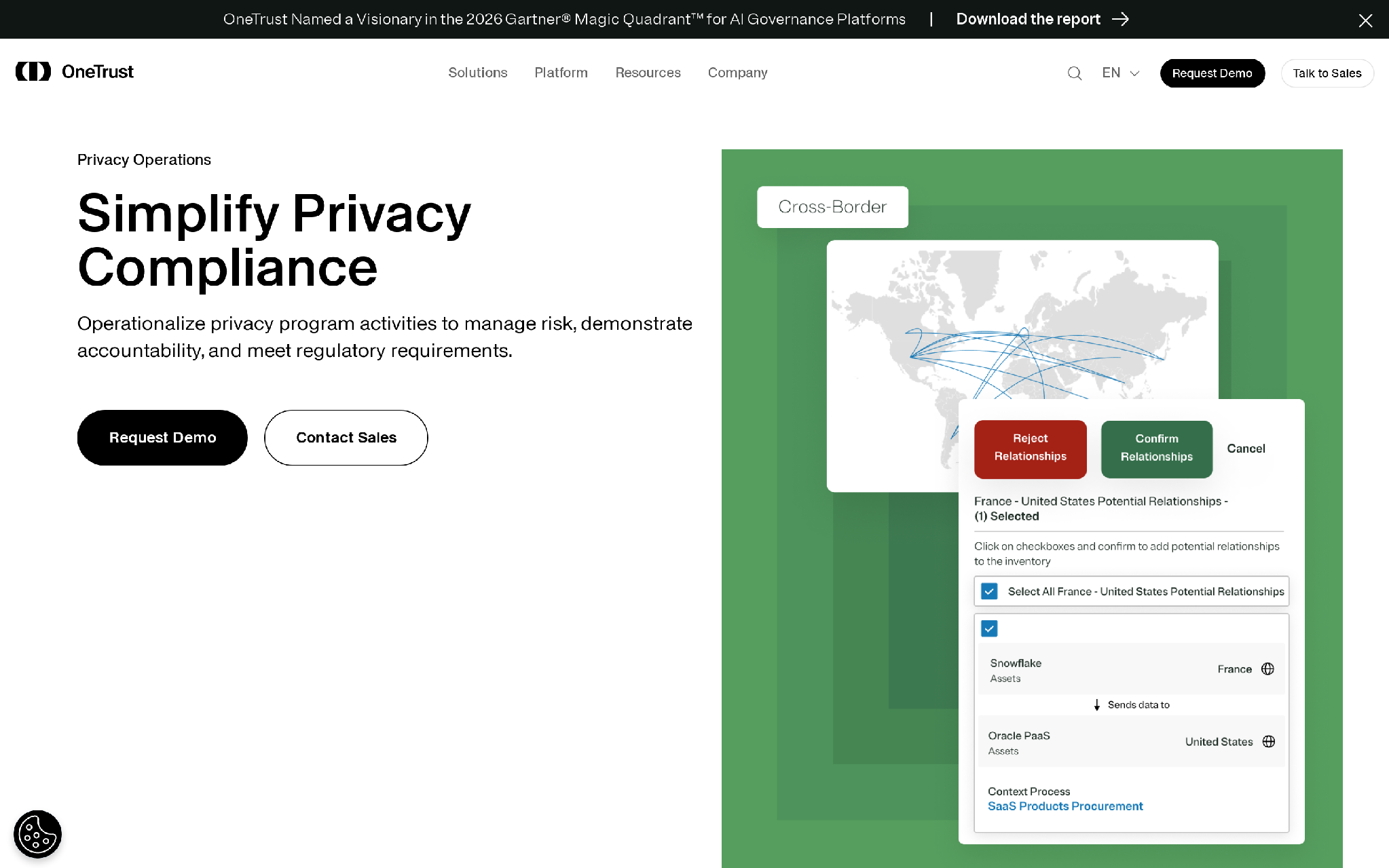
OneTrust is a global privacy and trust platform that large enterprises use to run programmes across many laws at once. It covers consent and preferences, rights requests, assessments, data mapping, third-party risk and incident management.
DPDP support sits inside a platform designed for dozens of jurisdictions, so Indian consent flows usually need configuration.
Key Features
- Consent and preference management across web, mobile and connected devices
- Rights request automation with workflows per jurisdiction
- Assessment automation for DPIAs and PIAs
- Data mapping and ROPA
- Third-party risk management
- Incident and breach management
Why OneTrust Is Better for Multi-Country Compliance
- One programme covers DPDP, GDPR, CCPA and other laws.
- A large integration catalogue connects to most enterprise systems.
- If your global team already runs OneTrust, adding India is simpler than adding a second vendor.
Where It Falls Short
- Licence and setup costs are high for most Indian mid-market companies.
- DPDP notices and consent flows need configuration on top of global templates.
- You will likely need a dedicated admin or an implementation partner.
Pricing
OneTrust does not publish rates. Its pricing page points buyers to customised pricing, with packages metered by items such as admin users, average daily visitors, data subject profiles and third-party inventory. Vendr's buyer data puts the median buyer at about $12,000 a year across 309 purchases, in a range of $1,620 to $48,215.
Vendr also notes that multi-module mid-market deployments can reach six figures, so read the median as the middle of the deals Vendr handled, not the cost of an enterprise rollout.
Best For
- Multinationals with operations in India
- Companies already using OneTrust for GDPR or CCPA
#3. Securiti: Best for Multi-Cloud Data Governance
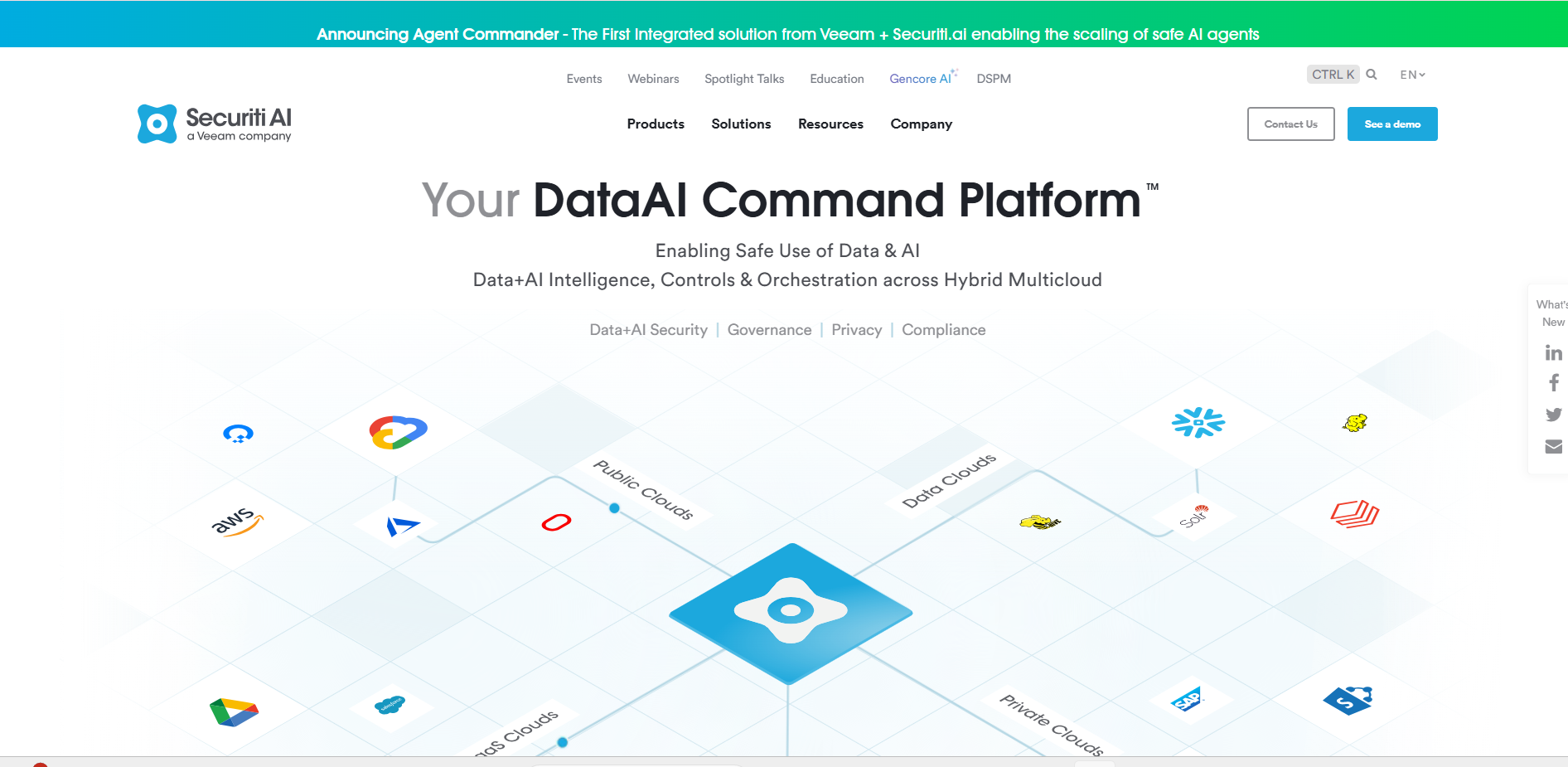
Securiti.ai combines data discovery, data security posture management and privacy operations in one platform. It connects to cloud, SaaS and on-premise systems, then runs rights requests, consent, assessments and breach response on top of that data map.
Its value depends on connecting your data systems, which takes planning and engineering time.
Key Features
- Discovery and classification across multi-cloud and SaaS sources
- Rights request automation linked to discovered data
- Consent and preference management
- Assessments and ROPA
- Breach management workflows
- AI and data security governance
Why Securiti Is Better for Large Data Estates
- Rights requests search your actual data, not a manual inventory.
- You get one view of privacy and security risk across clouds.
- AI governance sits in the same platform as privacy.
Where It Falls Short
- Setup is heavy for companies with a small data team.
- Cost grows with the number of data sources and modules.
- DPDP is one framework among many rather than the centre of the product.
Pricing
Securiti quotes on request. Its pricing page asks buyers to contact sales for a custom quote, and SaaSworthy lists no fixed public price and no free trial.
Best For
- Large enterprises with data across AWS, Azure and Google Cloud
- Teams that want privacy and data security under one owner
#4. BigID: Best for Data Discovery and Classification
BigID finds, classifies and catalogues sensitive data across structured and unstructured sources. Privacy features such as rights requests, ROPA and retention run as apps on top of that discovery layer. Consent collection and vendor risk are thinner, so most DPDP buyers pair BigID with a separate consent tool.
Key Features
- Machine-learning discovery and classification
- Data catalogue and inventory
- Rights request app
- ROPA and data mapping apps
- Retention and deletion policies
- Data risk scoring
Why BigID Is Better for Data-Heavy Teams
- It finds personal data in places manual surveys miss.
- It scales to very large, mixed data environments.
- It gives the rest of your privacy stack an accurate inventory to work from.
Where It Falls Short
- It is not a full DPDP platform on its own.
- You will need other tools for consent notices and vendor reviews.
- The cost is high if you only need DPDP basics.
Pricing
BigID quotes on request. Its pricing page says cost depends on the number of data sources, apps and connectors, the deployment type and services or support, and it offers a free trial.
Vendr's TrustArc guide describes BigID pricing as opaque and puts mid-market deployments at roughly $120,000 to $280,000 a year, with implementation often adding $20,000 to $60,000 or more. Treat that as a directional estimate, not a quote.
Best For
- Enterprises with large, scattered data estates
- Teams whose first gap is knowing where personal data lives
#5. TrustArc: Best for Established Privacy Programmes
TrustArc is a privacy management platform with a long history in assessments, certifications and regulatory research. It covers consent, rights requests, assessments, data inventory and vendor reviews, with regulatory guidance built in.
Automated discovery is lighter than in discovery-first tools, and its India content is thinner than its GDPR and US coverage.
Key Features
- Cookie and consent management
- Rights request management
- PIA and DPIA templates
- Data inventory and ROPA
- Vendor assessments
- Regulatory research and guidance for privacy teams
Why TrustArc Is Better for Mature Privacy Teams
- Assessment templates and regulatory guidance save legal research time.
- Programme dashboards show readiness across frameworks.
- It fits teams that already run structured privacy reviews.
Where It Falls Short
- Data inventory relies more on surveys than automated scanning.
- DPDP-specific flows are less developed than its GDPR ones.
- Rollout takes time and experienced admins.
Pricing
TrustArc has no public pricing page and sends buyers to its contact form. Vendr's buyer data puts the median buyer at about $15,660 a year across 54 purchases, in a range of $8,096 to $43,985.
Vendr's estimates rise with scope: about $30,000 to $75,000 a year for limited deployments, $100,000 to $250,000 for mid-market multi-module setups and $250,000 to $500,000 or more for enterprise.
Best For
- Enterprises with in-house privacy counsel
- Organisations running privacy reviews across several regions
#6. Lightbeam: Best for Mid-Market Teams Moving Off Spreadsheets
Lightbeam links discovered personal data to the people it belongs to, then runs privacy workflows on top of that map. It covers discovery, rights requests, consent, ROPA and assessments with a lighter setup than the large suites. Vendor risk and breach workflows are less developed than its discovery features.
Key Features
- Identity-linked data discovery
- Automated rights request fulfilment
- Consent management
- ROPA and data mapping
- Privacy assessments
- Data security posture checks
Why Lightbeam Is Better for Mid-Sized Teams
- Setup is lighter than the enterprise suites.
- Discovery ties each record to a person, which speeds up rights requests.
- It covers the core DPDP jobs without a large admin team.
Where It Falls Short
- Vendor risk features are limited.
- Breach handling is narrower than in full platforms.
- It has fewer India-specific templates than India-built tools.
Pricing
Lightbeam does not publish pricing. You book a demo to get a quote, and I found no credible third-party figure.
Best For
- Mid-market companies starting a structured privacy programme
- Teams replacing spreadsheet-based compliance
#7. Privy by IDfy: Best for BFSI and Regulated Indian Enterprises
Privy is IDfy's DPDP-focused consent and privacy governance suite. It sits next to IDfy's identity verification and KYC products, which many Indian banks, NBFCs and fintechs already use. Consent and data discovery are its strongest areas, while assessment and vendor risk features are less documented in public material.
Key Features
- DPDP consent management
- Privacy notices and a preference centre
- Rights request handling
- Personal data discovery
- DPO dashboards
- Links to IDfy identity and KYC services
Why Privy Is Better for BFSI Teams
- It is built in India, with consent designed around Indian onboarding journeys.
- It is simple to add if you already use IDfy for KYC.
- It focuses on regulated sectors.
Where It Falls Short
- DPIA and vendor risk depth is harder to verify from public material.
- Enterprise rollouts can need customisation.
- It is a weaker fit if you want one vendor for global privacy.
Pricing
Privy by IDfy does not publish pricing. You book a demo or talk to a privacy expert to get a quote, and I found no credible third-party figure.
Best For
- Banks, NBFCs and fintechs already using IDfy
- Regulated Indian enterprises focused on consent first
#8. Privado: Best for Engineering-Led Privacy
Privado scans source code to map how personal data moves through your apps, APIs and third-party SDKs. It builds a ROPA from the code and flags privacy risks in pull requests before release. It does not run consent or rights request operations, so you pair it with a governance platform.
Key Features
- Source code scanning for personal data flows
- Auto-generated ROPA and data maps
- Privacy checks in CI/CD and pull requests
- Website and app tracker scanning
- Third-party SDK and API mapping
Why Privado Is Better for Product and Engineering Teams
- It finds data flows at the code level, where manual surveys miss them.
- Data maps stay current as new code ships.
- It catches issues before release instead of after an audit.
Where It Falls Short
- It does not run full consent or rights request operations.
- It has no breach workflow.
- You need a governance tool alongside it.
Pricing
Privado shows no numeric pricing on its site. You request a demo or a free audit to get a quote. An older third-party listing shows low monthly plans, but it appears to describe earlier cookie tooling, so I would not use it to budget for the current product.
Best For
- SaaS companies with large engineering teams
- Product teams that ship code every week
#9. IQWorks: Best for AI-Assisted Privacy Operations
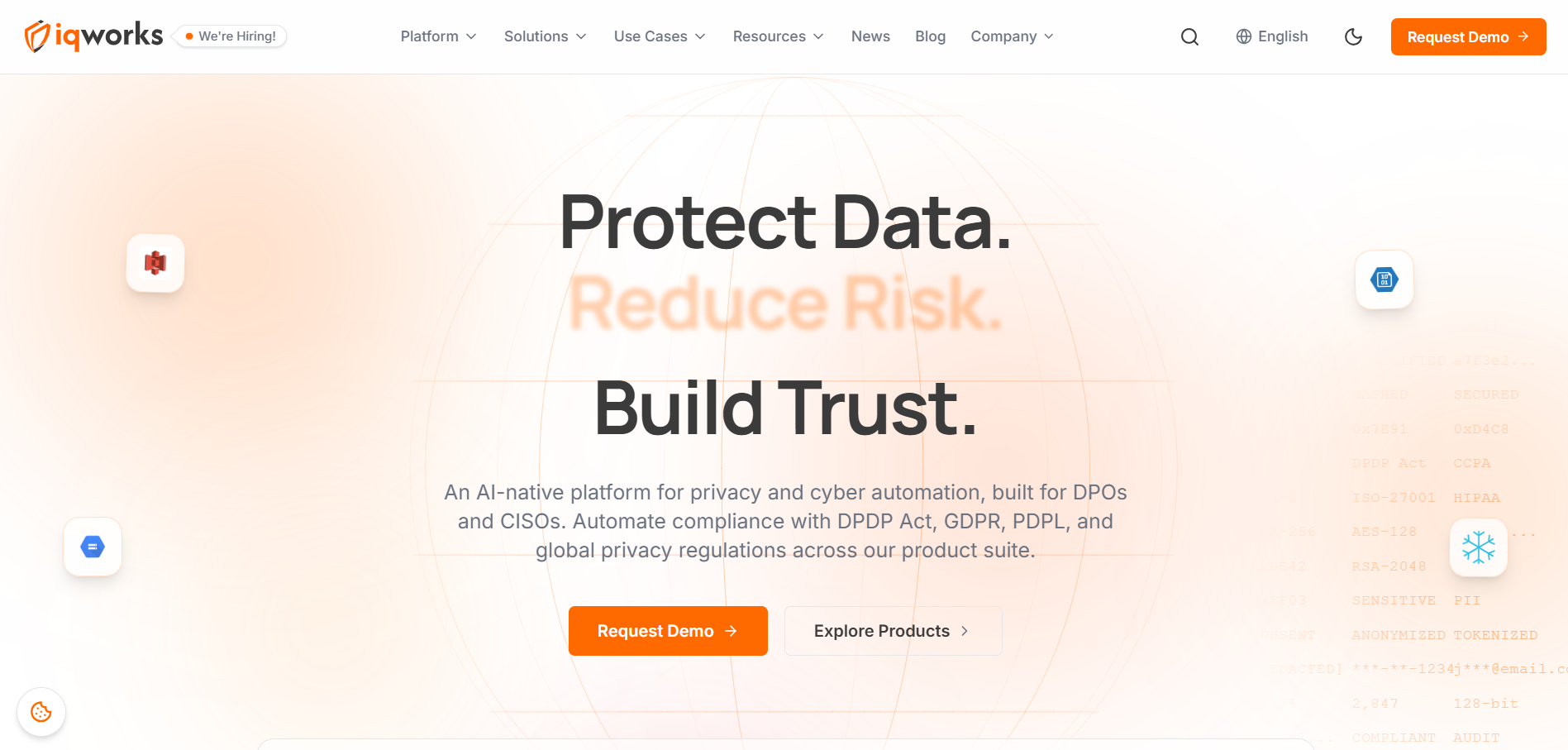
IQWorks is an Indian data protection platform made up of nine connected products, with ComplyIQ at the centre for privacy operations. ComplyIQ runs rights requests, DPIAs, ROPA, vendor assessments, incidents and audit evidence, while ConsentIQ and DiscoverIQ handle consent and data discovery. Because each job sits in its own product, you need to scope which modules you buy before you compare it with a single-platform tool.
Key Features
- ComplyIQ for rights requests, DPIAs, vendor assessments, incidents and approval workflows
- ROPA built from the data flows DiscoverIQ finds, with a one-click audit-ready PDF export
- ConsentIQ for cookie consent, a preference centre and consent analytics
- DiscoverIQ and ClassifyIQ for finding and classifying sensitive data
- RetainIQ for retention policies, auto-archival and legal hold
- ConsultIQ, an AI privacy advisor that drafts documents inside Microsoft Office
- AIQ engine that detects personal data in more than 50 languages
Why IQWorks Is Better for Privacy Operations Teams
- Your ROPA updates as data flows change, instead of going stale after the last audit.
- The AI assistant takes routine DPIA reviews, vendor assessments and request routing off your DPO's desk.
- On-premise deployment of ComplyIQ suits banks and hospitals that keep data inside their own network.
- Retention and legal hold sit in the same platform as your privacy workflows.
- One platform covers DPDP, GDPR and PDPL if you also operate in the Gulf.
Where It Falls Short
- Consent and discovery sit in separate products, so ComplyIQ alone does not cover every DPDP job.
- Nine product names make scoping and price comparison harder.
- Integration depth with your CRM, lending or support systems needs testing on your own scenarios, not a generic demo.
Pricing
IQWorks does not publish rates, and its own DPDP platform comparison lists ComplyIQ as quote-based. Because ComplyIQ, ConsentIQ and DiscoverIQ are separate products, ask for a quote that names every module you need.
Best For
- DPOs who want privacy operations, ROPA and audit evidence in one workspace
- BFSI and healthcare teams that need on-premise deployment
- Companies handling DPDP alongside GDPR or PDPL
#10. Privasapien: Best for Privacy Engineering and Responsible AI
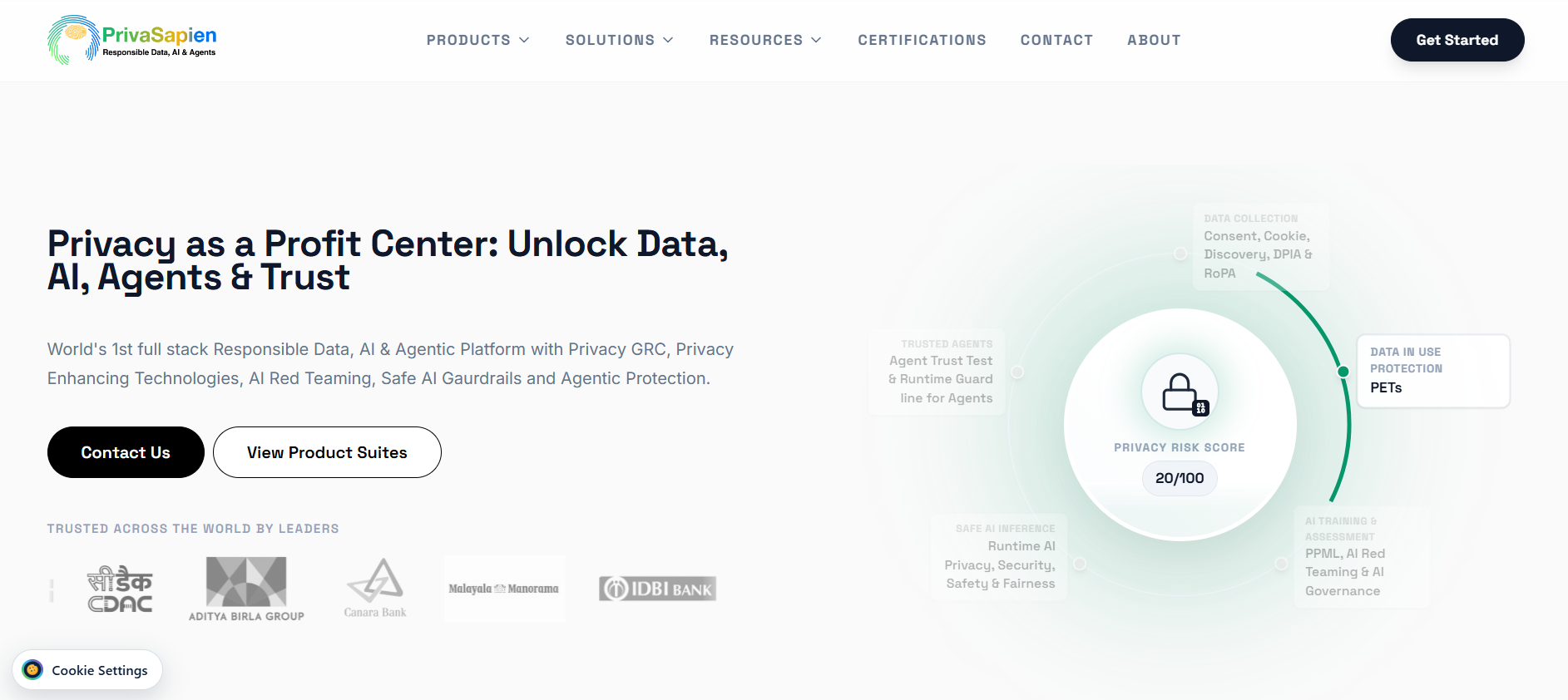
Privasapien is an Indian privacy engineering platform focused on protecting data while it is in use, including in analytics and AI systems. It covers privacy risk assessment, anonymisation, synthetic data and responsible AI governance. Consent and rights request operations are lighter, so it usually sits beside a consent platform.
Key Features
- Privacy risk assessment for datasets
- Anonymisation and de-identification
- Synthetic data generation
- Responsible AI and model governance
- Personal data discovery
Why Privasapien Is Better for Teams Building AI
- It lowers re-identification risk before data reaches a model.
- Privacy and AI governance sit in one review.
- Data science teams can use it, not only legal.
Where It Falls Short
- Consent and rights request operations are limited.
- Your team needs some AI governance knowledge to get value from it.
- It is more than you need if you only want DPDP basics.
Pricing
Privasapien does not publish pricing. You contact the team for a quote, and I found no credible third-party figure.
Best For
- Enterprises training models on personal data
- Analytics-heavy teams in BFSI and healthcare
#11. PrivEzi: Best for a Modular India-First Setup
PrivEzi is an India-first privacy platform sold as modules for consent, rights requests, data discovery, vendor risk and breach workflows. You can start with one module and add others as your programme grows. It is a younger vendor with a smaller integration library, and its DPIA and ROPA depth is less documented.
Key Features
- Consent and notice management
- Rights request handling
- Personal data discovery
- Vendor risk management
- Breach workflows
- Module-by-module licensing
Why PrivEzi Is Better for Teams Buying in Stages
- You can start with consent and add modules as budget allows.
- It is built for Indian compliance from the start.
- Breach workflows are included, which several global tools treat as an add-on.
Where It Falls Short
- As a younger vendor, it has fewer public enterprise references.
- Its integration library is smaller.
- DPIA and ROPA depth is less documented.
Pricing
I could not find public pricing for PrivEzi. Ask the vendor for a written quote before you shortlist it.
Best For
- Indian SMEs and mid-market companies
- Teams spreading compliance spend across financial years
Best DPDP Compliance Software by Industry
The right tool depends as much on your sector as on features. Here is how I would build a shortlist for the industries that ask me about DPDP most.
1) Fintech, NBFCs and Banks
Most fintechs already run KYC and digital onboarding, and they do not want to rebuild it. What you need is a consent layer that plugs into existing journeys through APIs, records explicit consent per purpose, handles withdrawal and keeps an audit trail you can show RBI as well as the Data Protection Board.
Many large banks and insurers could also be designated Significant Data Fiduciaries, which adds DPIAs, audits and possible localisation limits.
Shortlist: Redacto for full DPDP coverage, Privy by IDfy if you already use IDfy for KYC, OneTrust if you run a global programme. I compare these in more depth in my guide to DPDPA compliance software for BFSI.
2) Healthcare and Hospitals
Hospitals hold health records, insurance details and often children's data. The Rules require verifiable parental consent for children, with limited exemptions for essential purposes such as healthcare, so your tool needs to record which exemption applies and why.
Research and analytics teams also need de-identified data they can safely use.
Shortlist: Redacto for consent and rights across patient journeys, Privasapien for anonymisation before research use, Securiti for large hospital chains with data across clouds. For sector detail, read DPDP guidelines for healthcare and hospitals.
3) E-commerce and D2C Brands
You collect consent on the website, in the app, at checkout and for marketing, often through a dozen third-party SDKs. Rights requests come in at high volume, and each one has to reach your order, CRM and marketing systems.
Shortlist: Redacto or OneTrust for consent across channels, plus Privado if your app ships with many third-party SDKs you need to map.
4) HR and Staff Data
Recruitment, payroll, background checks and HRMS tools all process personal data about your people. Most of that sits with vendors, so vendor risk and processor contracts matter as much as consent.
Shortlist: any full DPDP platform with vendor risk, such as Redacto, OneTrust or PrivEzi. Ask whether the tool can run staff notices and requests separately from customer ones.
5) Customer Communications and WhatsApp
If you message customers on WhatsApp, SMS or email, you need purpose-level consent before marketing messages and a withdrawal that reaches your messaging provider within minutes, not days. Every message template should link back to your notice.
Shortlist: platforms with consent APIs that sync to your CRM and messaging tools. Ask the vendor to show a WhatsApp opt-out reaching your messaging provider live.
6) SaaS and IT Companies
SaaS companies are often a data fiduciary for their own users and a data processor for their clients at the same time. You need DPDP and GDPR coverage in one place, plus checks that stop new features from leaking personal data.
Shortlist: Redacto for its CI/CD privacy scanner alongside DPDP workflows, Privado for code-level mapping, OneTrust for multi-country programmes.
7) Consultants and DPOs Managing Several Clients
If you run DPDP compliance for clients, you need separate workspaces per client, reusable templates and reports you can hand over. Moving from spreadsheets to one system also gives each client an audit trail they can defend.
Shortlist: ask each vendor about multi-entity workspaces and partner pricing. Redacto runs a partner programme for consultants and implementation firms.
DPDP Compliance Software vs Consultants: Which Do You Need?
Most companies need both, in that order: a consultant or legal advisor to interpret the Act for your business, then software to run the processes every day. The mistake I see most is paying for a gap assessment that ends in a spreadsheet nobody maintains.
If you are comparing providers in your city, such as Pune, Bengaluru or Mumbai, ask whether they implement a specific platform or only advise. I cover firms that do both in my list of DPDPA compliance consulting services.
How to Buy DPDP Compliance Software
Buying goes faster when you know what drives the quote, what the rollout involves and what to ask before you sign.
What Drives the Price
- Modules: a consent-only licence costs far less than a full platform with discovery, DPIA and vendor risk.
- Data volume: the number of data principals, records or connected data sources.
- Entities: group companies, brands or client workspaces you need to separate.
- Deployment: SaaS in an Indian region, private cloud or on-premise.
- Support: self-serve setup, vendor-led implementation or a partner.
Implementation Steps
- Map your personal data and the purpose behind each use, using discovery where possible.
- Rewrite notices per purpose and publish them in the languages your customers use.
- Connect consent and withdrawal to onboarding, CRM, marketing and messaging tools.
- Set up rights request intake with identity checks and 90-day tracking.
- Move vendors into risk reviews and update processor contracts.
- Write a breach runbook and test it with a mock incident.
- Run an internal audit against the Rules before your November 2026 target.
Questions to Ask Before You Sign
- Which Indian region hosts my data, and is on-premise available?
- Is pricing per record, per module or per entity, and what happens at renewal when volume grows?
- Who runs implementation: your team, the vendor or a partner?
- Can you share references from companies in my sector in India?
- Which security certifications do you hold, such as SOC 2 or ISO 27001?
- How do I export all my records and audit logs if I leave?
Which DPDP Compliance Software Should You Choose?
Start from your biggest gap, not the longest feature list.
- You want all six DPDP jobs in one India-first system: Redacto.
- You run privacy across several countries: OneTrust or TrustArc.
- Your data sits across many clouds and SaaS tools: Securiti.
- You do not yet know where your personal data lives: BigID, paired with a consent tool.
- You are a mid-sized team moving off spreadsheets: Lightbeam.
- You are a bank, NBFC or fintech already on IDfy: Privy by IDfy.
- Your engineering team ships code every week: Privado, beside a governance platform.
- Your DPO wants AI-assisted privacy operations with an on-premise option: IQWorks.
- You train AI models on personal data: Privasapien.
- You want to buy one module at a time: PrivEzi.
Conclusion
The DPDP deadline is fixed, and the evidence the Board will ask for has to come from a system, not a folder of policies. Pick the tool that closes your biggest gap first, and test it against the eight checks in this guide before you sign.
If you want consent, rights requests, DPIAs, vendor risk and breach workflows in one India-first platform, book a Redacto demo and see it run on your own use case.