%20Redacto%20logo_New.png)


10 DPDPA Act Compliance Requirements You Must Be Aware Of (2026 Guide)


Handling user data today feels simple… until someone asks:
“Can you show, update, or delete my data right now?”
Most teams can’t.
- Data is spread across tools
- Consent is collected but not tracked properly
- No clear process for user requests (DSAR)
- Deletion and retention rules are unclear
That’s where the DPDPA Act changes things. It doesn’t just ask you to collect data responsibly. It forces you to manage it end-to-end.
In this guide, you’ll know the exact DPDPA compliance requirements you must follow, and where most companies get stuck.
TL;DR
If your business handles personal data in India, the DPDPA applies to you, regardless of your size.
To stay compliant, you must:
- Know if the law applies and your role (fiduciary vs processor)
- Take clear, trackable user consent
- Provide proper notices about data usage
- Map and manage where your data lives
- Delete data when it’s no longer needed
- Handle user requests (access, update, delete)
- Implement strong security + report breaches
- Build an ongoing compliance system (not a one-time setup)
Most companies fail because they rely on manual processes and scattered tools.
Non-compliance can lead to penalties up to ₹250 crore, along with trust and reputation loss.
What Are DPDPA Compliance Requirements?
DPDPA compliance requirements are the rules your business must follow when you collect, use, store, or share personal data.
If you handle user data, you are responsible for protecting it and using it properly.
This applies to:
- Startups, SaaS, and agencies
- Enterprises across BFSI, healthcare, e-commerce, etc.
- Any company collecting emails, phone numbers, or user details
It also covers:
- Indian businesses
- global companies offering products or services to users in India
👉 One important thing:
DPDPA compliance is not optional.
If your business handles digital personal data, you are expected to follow these requirements, regardless of your size.
Who Needs to Comply With DPDPA?
It applies to almost every business that handles user data, and if you think DPDPA is only for large enterprises, that’s a mistake.
This includes:
- BFSI → banks, NBFCs, fintech, insurance (KYC, transactions, financial data)
- Healthcare & pharma → hospitals, diagnostics, healthtech (patient records, prescriptions)
- E-commerce & retail → online stores, marketplaces, delivery apps
- SaaS, startups, agencies → CRMs, marketing tools, analytics platforms
Even smaller teams are not exempt.
If you collect emails, phone numbers, or any personal data from users, DPDPA applies to you.
10 DPDPA Compliance Requirements You Must Follow
1. Check If DPDPA Applies to You
If you handle digital personal data, the law likely applies.
- Includes collected, processed, and even converted data
- Covers global companies targeting Indian users
If you miss this step → your entire compliance approach will be wrong
2. Identify Your Role (Data Fiduciary vs Processor)
You need clarity on your role.
- Data Fiduciary → decides why and how data is used
- Data Processor → processes data on behalf of someone else
👉 This decides your legal responsibilities
3. Take Clear & Informed User Consent
Consent is not just a checkbox.
It must be:
- explicit
- informed
- easy to withdraw
4. Provide Proper Notice to Users
Users must know what’s happening with their data. You need to clearly state:
- What data do you collect
- Why do you collect it
- What rights users have
5. Maintain Data Inventory & Mapping
You can’t protect what you don’t know.
You must track:
- What data do you collect
- Where it is stored
- How it moves across systems
In my experience, this is where most companies fail
6. Delete Data After Purpose Is Completed
Data cannot be stored forever.
- Define clear retention timelines
- Delete data once the purpose is fulfilled
- Also, delete if consent is withdrawn
7. Handle Data Principal Rights (DSAR)
Users have rights over their data.
They can:
- access their data
- correct it
- request deletion
⏱ You must respond within the required timelines
8. Appoint a Data Protection Officer (If Required)
For significant data fiduciaries, this is mandatory.
- DPO handles compliance oversight
- Acts as a contact point for user complaints
👉 Many companies delay this and face issues later
9. Implement Strong Security Measures
You are responsible for protecting data.
- Prevent unauthorized access
- Secure sensitive information
If a breach happens:
- Inform authorities
- Notify affected users
10. Build a Complete Compliance Framework
Compliance is not a one-time setup.
You need:
- Policies
- Defined workflows
- Regular audits
- Continuous monitoring
Common Mistakes Companies Make
Most companies don’t ignore DPDPA. They just approach it the wrong way. They treat it like a legal checklist, not an operational problem.
So consent gets handled… but data is still scattered.
DSAR requests come in… but responses are manual and slow.
There’s no clear visibility into:
- Where data lives
- Who owns it
- How it flows
Add to that:
- No vendor risk checks
- No real breach response plan
And suddenly, “compliance” exists only on paper.
Must Read - 7 Best Vendor Risk Management Software for DPDPA Compliance in India
What Happens If You Don’t Comply?
If you don’t comply with the DPDPA Act, penalties can go up to ₹250 crore. But the bigger risk is not just the fine.
It’s:
- Losing customer trust
- Damaging your brand
- Dealing with complaints and audits
One important thing most people miss:
Penalties are based on the impact of the violation, not your company's size. So even smaller companies are not “safe.”
A Quick Way to Check If You’re Compliant
Instead of overthinking it, start simple.
Ask yourself:
- Do we have a clear consent system in place?
- Do we know exactly what data we have and where it is?
- Can we handle user data requests without chaos?
- Do we delete data when it’s no longer needed?
- Have we reviewed vendors who handle our data?
- Are our security measures actually strong?
If the answer is “no” to even a few of these, there are gaps.
How Companies Are Solving This Today
What I’m seeing now is a clear shift. Teams are moving away from manual processes and disconnected tools.
Spreadsheets, email-based workflows, and patchy systems don’t scale.
Instead, companies are now:
- Automating consent and DSAR workflows
- Handling DPIA and vendor risk in one place
- Reducing dependency on manual work
The focus is simple: fewer tools, less friction, faster compliance.
Where Most Tools Still Fall Short
But even after adopting tools, many teams struggle. Because:
- Tools are split into too many modules
- Pricing is complex and hard to predict
- Implementation takes too long
- Manual work still doesn’t go away
So instead of solving the problem, it just shifts it. Instead of managing separate tools for consent, DSAR, and risk… Bringing everything into one system makes things easier to control.
That means:
- One place for consent management
- Built-in vendor risk workflows
- AI-assisted DPIA processes
- Faster, more structured compliance operations
Must Read: Best Consent Management Platforms for Indian Enterprises (DPDPA-Compliant 2026)
This is how some teams are reducing weeks of work into days. If you’re evaluating how to handle DPDPA, don’t just look at features.
Look at how easy it is to actually run compliance day-to-day.
Things that matter more:
- How fast can you get started
- How much work is automated
- how well it fits Indian compliance needs
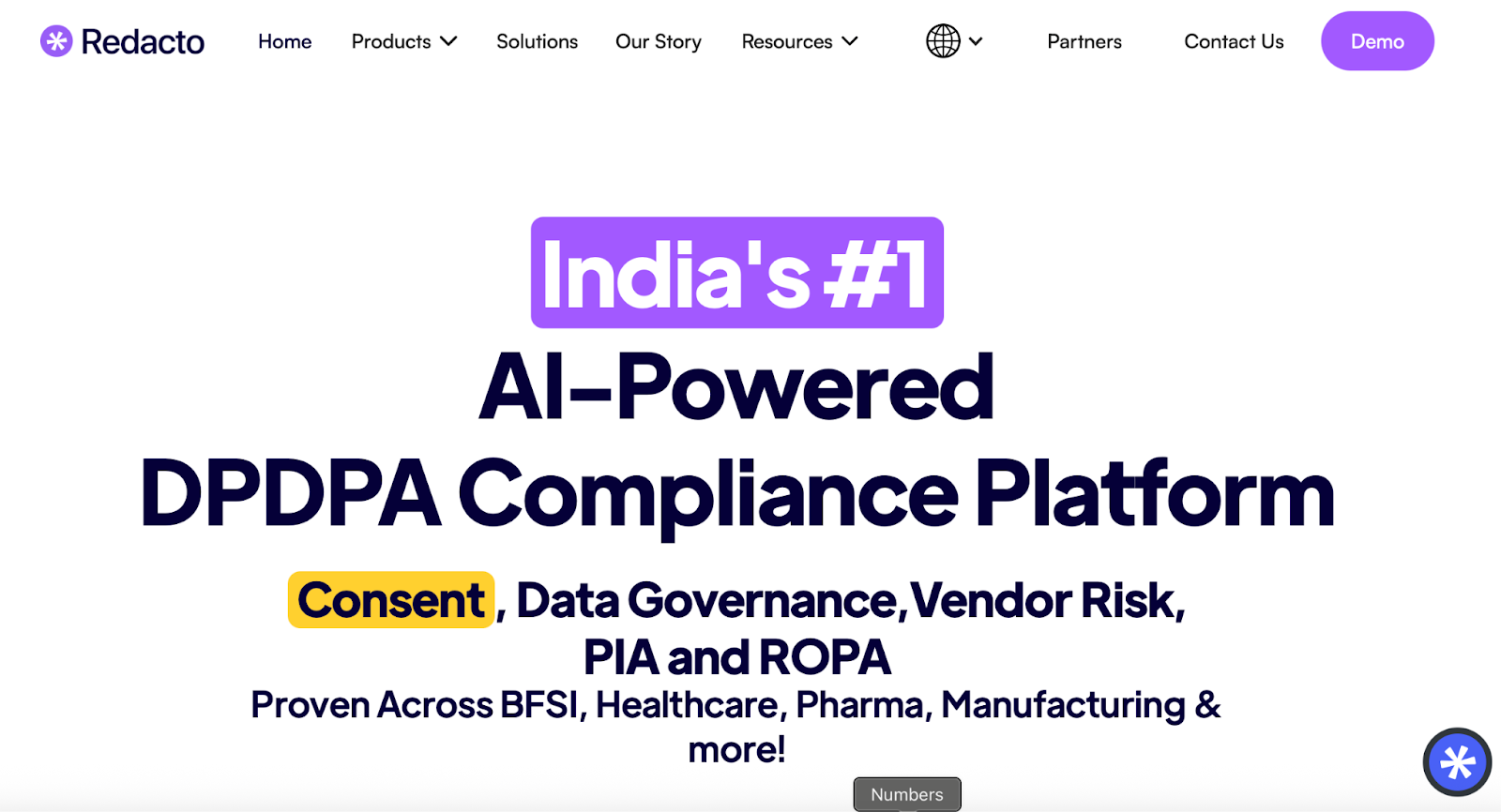
Platforms like Redacto are built around this idea, helping teams manage compliance without adding more manual overhead.
Conclusion
DPDPA compliance is not about adding more policies; it’s about fixing how your data actually moves and gets managed day to day.
Most teams struggle because they try to patch things on top of broken systems. Consent sits in one place, data in another, and requests get handled manually.
That’s where compliance starts to fall apart.
The companies getting this right are not doing more work.
They’re building systems where consent, data, risk, and user requests are all connected and easy to manage.
If you’re serious about getting compliant without adding operational chaos, it’s worth looking at how Redacto bring everything into one place and simplifies the entire process.