%20Redacto%20logo_New.png)


10 Best Compliance Management Softwares For Indian Enterprises


I can approve a policy and still lose the evidence that proves it worked, and you may face the same gap when a consent withdrawal reaches one system but stops before it reaches the others. A failed control can sit in a dashboard while no one owns the fix.
Section 8(5) of the Digital Personal Data Protection Act, 2023 requires reasonable security safeguards. Section 8(6) requires notice to the Board and each affected Data Principal after a personal data breach.
The notified Digital Personal Data Protection Rules, 2025 turn those duties into operating work. You need a route that moves each obligation from trigger to owner and then to a record you can produce.
I start with the break in that route. You can trace one live request or failed control and ask who receives it. Then check who decides what happens next and which record proves the work finished. That trace makes the problem clear before any product enters the discussion.
TL;DR
- Redacto - Best for India-first DPDPA privacy operations
- OneTrust - Best for global privacy and third-party governance
- Securiti - Best for data discovery across hybrid estates
- Scrut Automation - Best for guided security compliance programs
- Sprinto - Best for continuous compliance in cloud companies
- Vanta - Best for integration-led audit evidence collection
- Drata - Best for continuous control monitoring
- Hyperproof - Best for mapping controls across frameworks
- MetricStream - Best for large regulated GRC programs
- AuditBoard - Best for internal audit and SOX teams
Disclosure: Redacto publishes this comparison and appears in it. I assess it by the same workflow criteria as the other tools, because a bank tracing consent and a SaaS company collecting SOC 2 evidence have different jobs.
How I evaluated compliance management software
I judged each platform by the workflow it can own after a policy is approved, whether the system routes work when records change, and whether it preserves evidence after a failed control or a new vendor approval.
- India fit: Does it cover DPDPA consent and rights requests? Can the deployment meet an Indian enterprise’s needs?
- Evidence trail: Can a reviewer trace an obligation to its owner and action? Does the export retain a timestamp?
- Control depth: Does it test controls or merely store documents?
- Integration fit: Can it collect evidence from the systems the enterprise already uses?
- Human gates: Can legal and security owners approve exceptions? Can the business owner record a risk decision?
- Cost shape: Do extra modules or assets increase the contract value?
10 Best Compliance Management Softwares
The table uses vendor figures where they are public. Sales-gated ranges come from recent procurement estimates noted in each entry. Use every range only to set a budget; request a current quote before purchase.
1. Redacto: Best for India-first DPDPA privacy operations
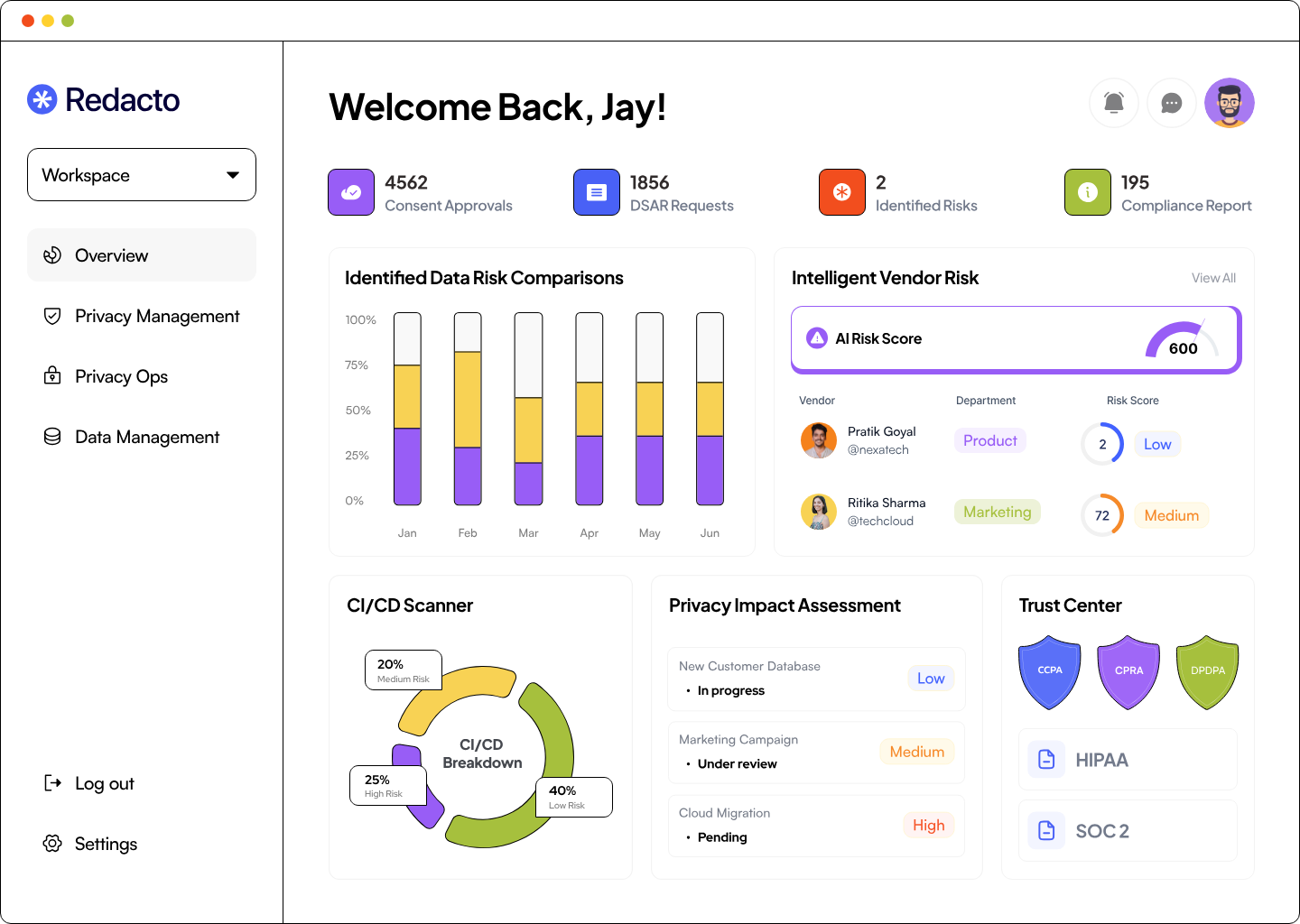
I use Redacto to bring privacy work together when it is spread across legal mailboxes and spreadsheets. Consent and DSAR records sit alongside data mapping, so I can trace an obligation to its owner, follow the action through connected systems, and keep the result ready for review, even when several departments handle the request.
A withdrawal event can update the consent ledger and route the work to the owner of each affected system. A Data Principal request can move through intake, verification, assignment, response, and closure while the platform keeps timestamps for review.
I use Redacto's 7,000+ consent integrations and 98.5% accuracy for AI-filled privacy impact assessments.
Redacto workflow coverage:
- Unified Consent Manager records consent given and withdrawn.
- Automated DSAR Management routes requests from data principals.
- AI-Driven Data Discovery & Mapping helps find where personal data is stored.
- Privacy Impact Assessment Automation prepares review records.
- Vendor Risk Management keeps processor assessments up to date.
- Audit & Reporting exports evidence for review.
Pricing:
Pricing is deployment-based, so you’ll need to book a call to get a quote. Here's a quick video to understand how our pricing works.
Pros:
- India-first workflows reduce the configuration needed for DPDPA work.
- Private cloud and on-premises options suit regulated estates.
- One record can connect consent, vendors, PIAs, and requests.
- Data discovery can link personal data stores to privacy records.
- Audit exports preserve evidence for internal and regulator-facing review.
Cons:
- Public pricing is unavailable.
- Its India focus offers less multi-regulation depth than global suites.
- A 2025 company has fewer public case studies than established vendors.
- Legal owners still need to validate statutory interpretations and exceptions.
- Data mapping quality depends on complete access to the systems in scope.
Redacto suits a BFSI, healthcare, or pharma team whose primary gap is privacy evidence. Do not choose Redacto if you need one mature global GRC suite across many jurisdictions.
2. OneTrust: Best for global privacy and third-party governance
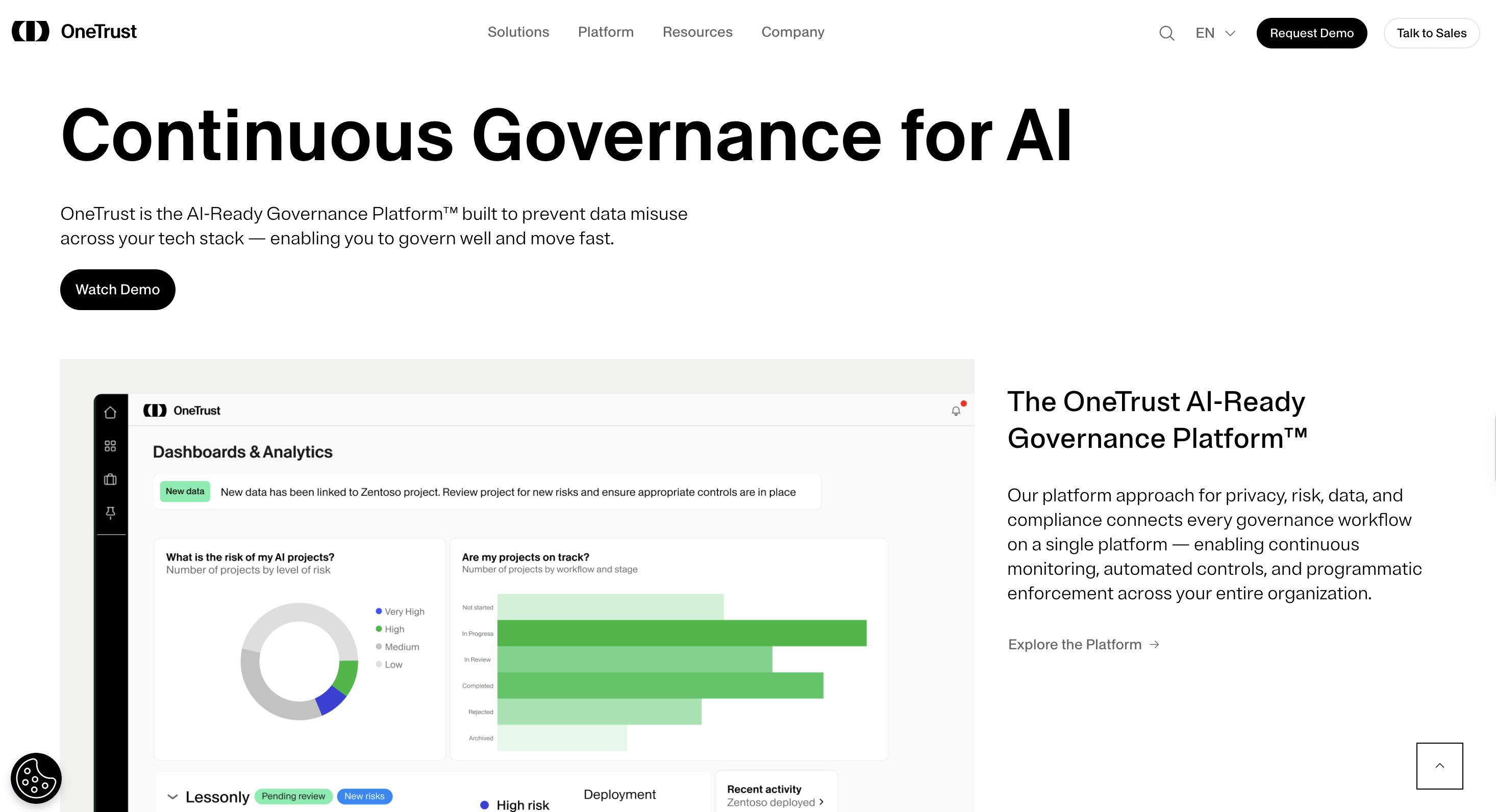
OneTrust is a strong fit if you want privacy automation and third-party governance in one place. Its privacy tools help teams manage processing records, assessments, and rights requests, while the governance layer connects vendors to the data they handle and keeps work visible to the right owners.
Because everything sits in a shared inventory, changes in one record can flow through to related assessments and controls. I’d shortlist it for global companies that want a single model across jurisdictions, but it does take thoughtful setup before rollout.
OneTrust governance scope:
- Privacy automation manages assessments and rights workflows.
- Consent and preference tools govern collection channels.
- Third-party management tracks vendor lifecycle risk.
- Data discovery links assets to governance records.
- AI governance maintains model and agent inventories.
Pricing:
Free access and a trial are unavailable. Recent procurement data places the median near $10,514 per year with a $10,000 annual floor. Multi-module deployments can cost more.
Pros:
- Broad modules support global privacy and risk programs.
- Configurable inventories suit complex business structures.
- Large enterprises can consolidate several governance workflows.
- Rights requests can route through assigned owners and response stages.
- Vendor records can connect contract reviews to privacy risk.
Cons:
- Configuration and implementation add work before value appears.
- Usage meters can make expansion harder to budget.
- A narrow Indian consent project may buy more platform than it needs.
- Inventory design can become difficult when business units use different taxonomies.
- Administrators need governance rules to prevent duplicate or stale records.
OneTrust gives a global privacy office one inventory for jurisdiction rules and vendor risk, but an India-only consent project will carry the cost of modules it may never use, which can make the broader platform hard to justify for that narrower job.
3. Securiti: Best for data discovery across hybrid estates
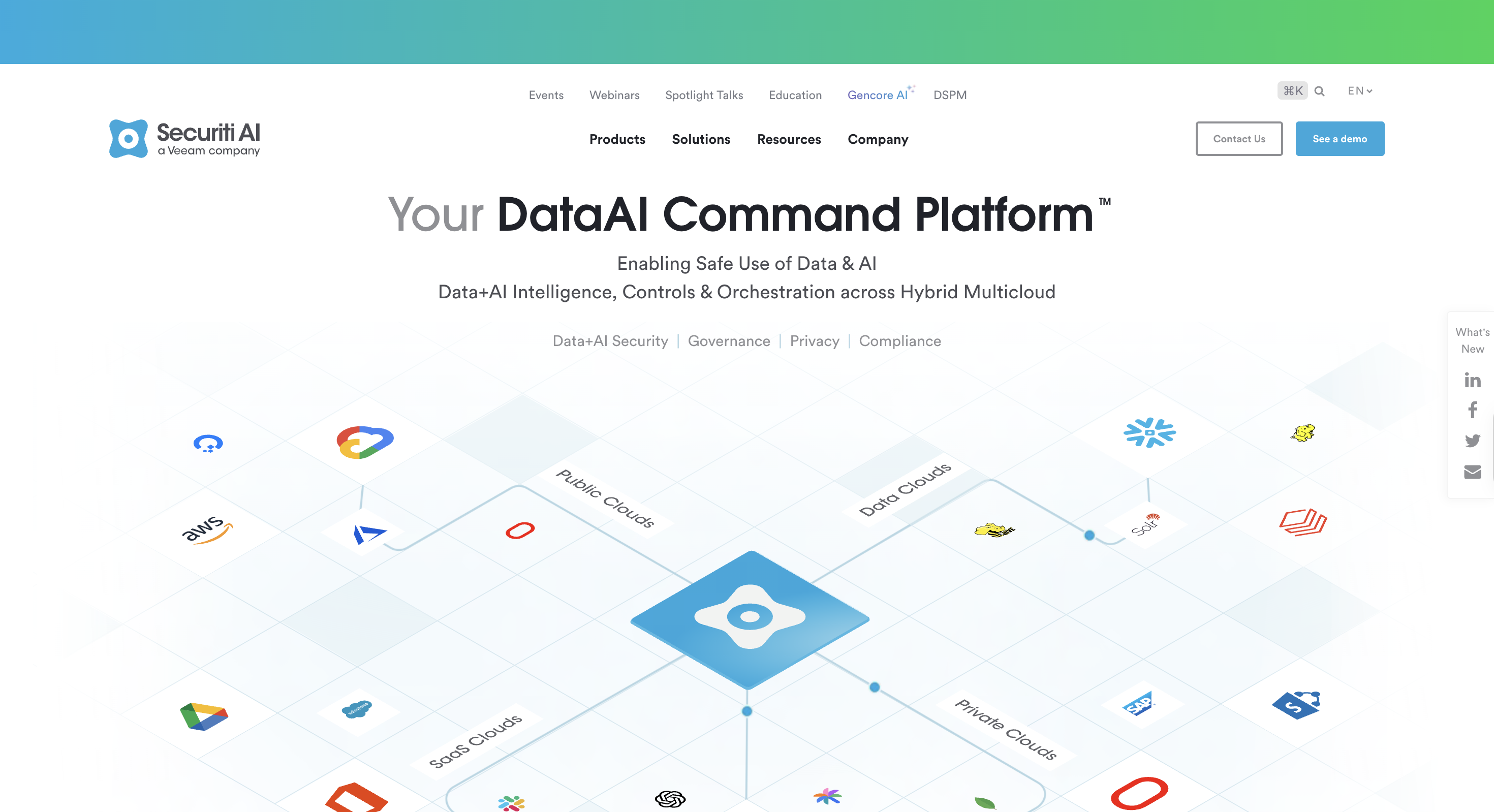
Securiti begins by mapping your data estate. It finds sensitive data across cloud and on-prem systems, classifies what it discovers, and gives teams a live view of data stores that may never have made it into a manual register.
That map then becomes useful across the business: privacy teams can use it for rights requests or assessments, while security and access teams can use the same context to investigate exposure and manage access.
Securiti data context:
- Sensitive data intelligence builds an asset view.
- DSPM monitors exposure and security risk.
- Privacy workflows handle rights and assessment work.
- Consent modules cover first-party and third-party collection.
- Data-flow controls track movement between systems.
Pricing:
Personalized quote; buyer-market estimates commonly start near $60,000 per year. The vendor lists neither free access nor a public trial.
Pros:
- Discovery links governance to real data stores.
- Hybrid coverage suits large technical estates.
- Privacy and security teams can work from shared context.
- Data-flow context helps owners trace movement between systems.
- Classification can expose stores missing from a manual privacy register.
Cons:
- The platform can exceed the needs of a smaller data estate.
- Licensing by modules makes early scoping important.
- India-specific legal workflows require validation during procurement.
- Discovery results need review when classification confidence is low.
- Broad access requirements can slow deployment in restricted environments.
Securiti can find a personal-data store before the privacy team knows it exists, then attach policy context to that asset. Choose Redacto when the missing record is a DPDPA consent or DSAR trail instead.
4. Scrut Automation: Best for guided security compliance programs
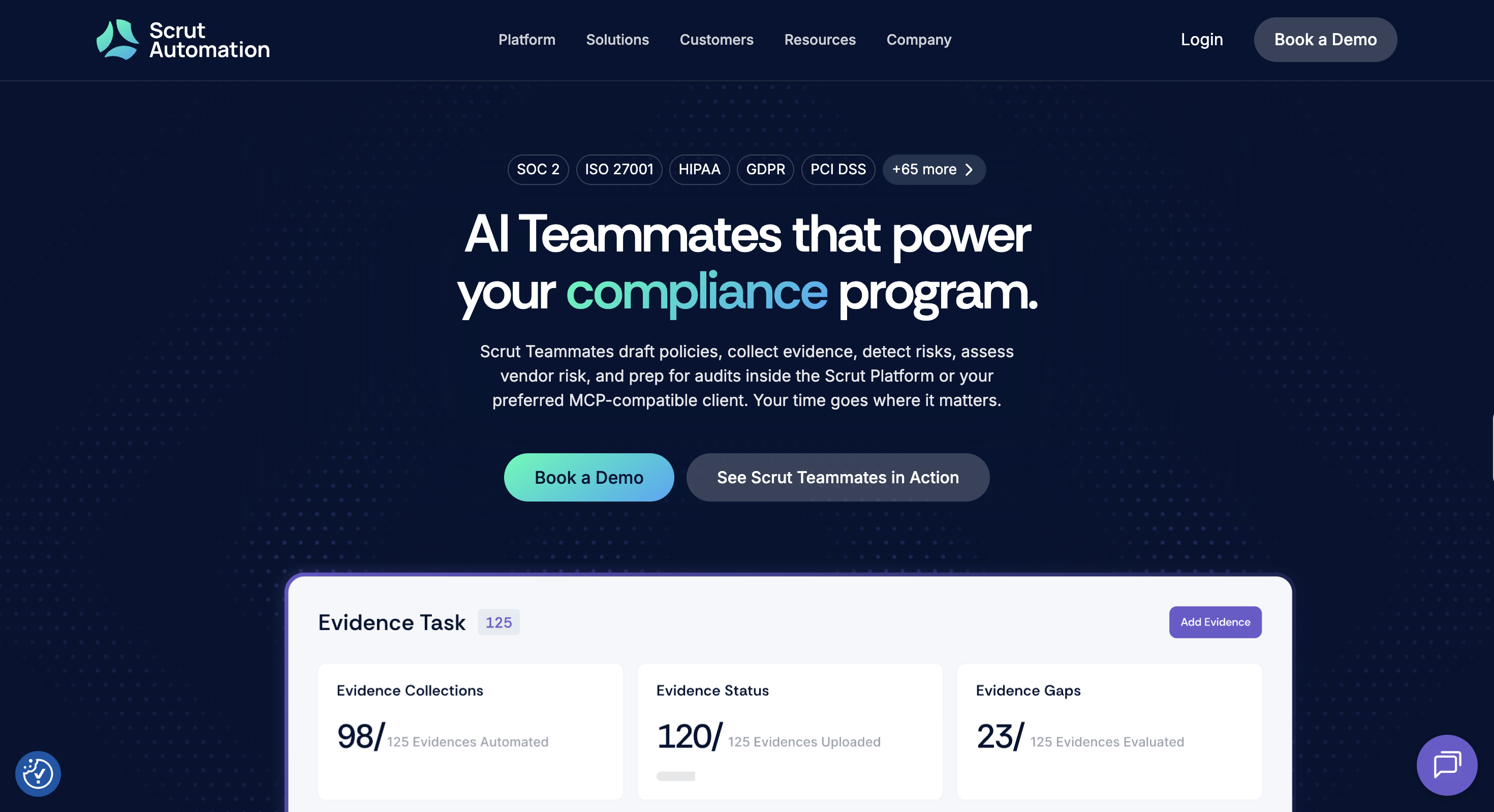
Scrut helps teams manage security frameworks and gather audit evidence. It maps requirements to common controls, assigns an owner to each one, and keeps test results in the same place, so the next audit starts with a record of past work instead of a fresh evidence chase.
Connected systems can provide evidence, while risk and vendor records explain why a gap is still open. For an Indian technology company working toward ISO 27001 or SOC 2, the same program can support audit prep and remediation tracking.
Scrut control workflows:
- Common control mapping reduces duplicate evidence work.
- Automated evidence collection connects cloud and business systems.
- Risk registers link findings to owners.
- Vendor risk workflows collect assessments.
- Policy management tracks review and approval.
Pricing:
Free access is unavailable. Market listings place entry contracts near $15,000 per year. Access starts through a demo rather than a public trial.
Pros:
- Guided implementation helps a lean compliance team begin.
- Control mapping supports more than one security framework.
- Vendor risk sits beside audit preparation.
- Assigned evidence tasks make ownership visible.
- Risk records can connect a failed control to treatment work.
Cons:
- It is not a dedicated consent or DSAR system.
- Some evidence still needs manual collection when an integration is absent.
- Final cost depends on frameworks and scope.
- Control owners can face repeated tasks when source systems lack integrations.
- Privacy teams need another workflow for withdrawal propagation.
Scrut wins when the team needs ISO or SOC evidence now. Its control map assigns audit work, while the buyer must source consent and Data Principal request workflows elsewhere.
5. Sprinto: Best for continuous compliance in cloud companies
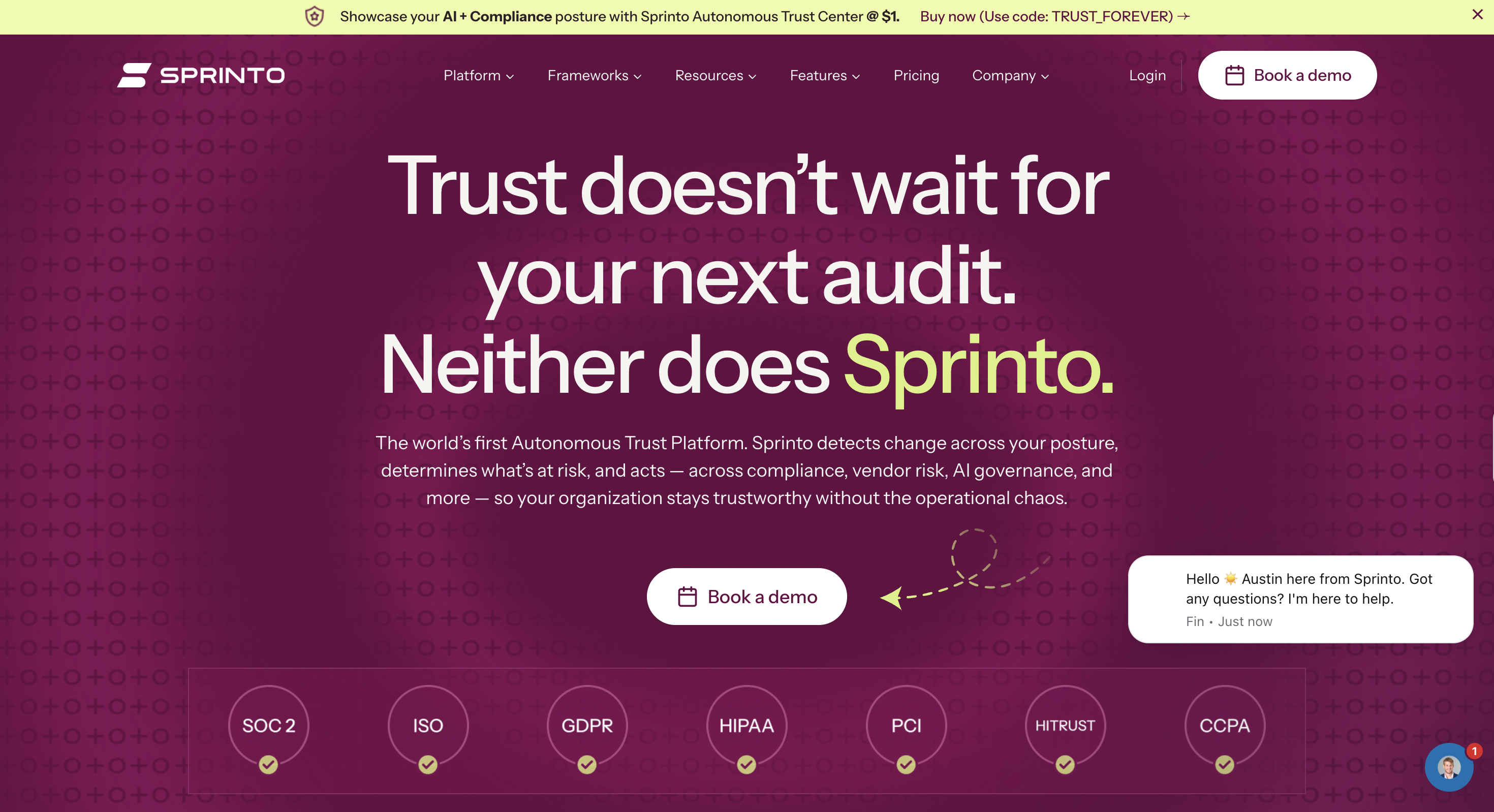
Sprinto is built for continuous compliance in cloud-first companies. It monitors security controls across cloud tools and turns any gaps into assigned work. Because it connects infrastructure, identity, and HR systems to framework controls and evidence requirements, owners can quickly see why a check failed before fixing it.
When a test fails, Sprinto logs the issue and routes remediation to the right owner. Its framework library also supports ongoing checks after certification, making it a strong fit for teams that want continuous compliance without a large GRC team.
Sprinto monitoring workflow:
- Continuous control monitoring detects failed checks.
- Evidence collection connects infrastructure and HR systems.
- Risk workflows assign treatment owners.
- Vendor reviews track third-party exposure.
- Trust-center tools support customer assurance.
Pricing:
No free plan or self-serve trial is published. Recent buyer data puts the median near $15,000 per year with reported deals around $11,500 to $19,300.
Pros:
- Ongoing checks catch drift between audits.
- Cloud integrations reduce evidence chasing.
- The workflow fits small security teams.
- Failed tests can route remediation to named owners.
- Shared controls reduce repeated work across frameworks.
Cons:
- Privacy rights and consent are not its main operating model.
- Audit scope affects implementation effort.
- Buyers need a sales process before seeing a firm price.
- Unsupported systems still require manual evidence uploads.
- Control alerts can create noise if owners do not tune the checks.
Sprinto can pull a failed check from the cloud stack and assign the remediation to a security owner. The privacy team still needs another system for consent withdrawal and Data Principal requests.
6. Vanta: Best for integration-led audit evidence collection
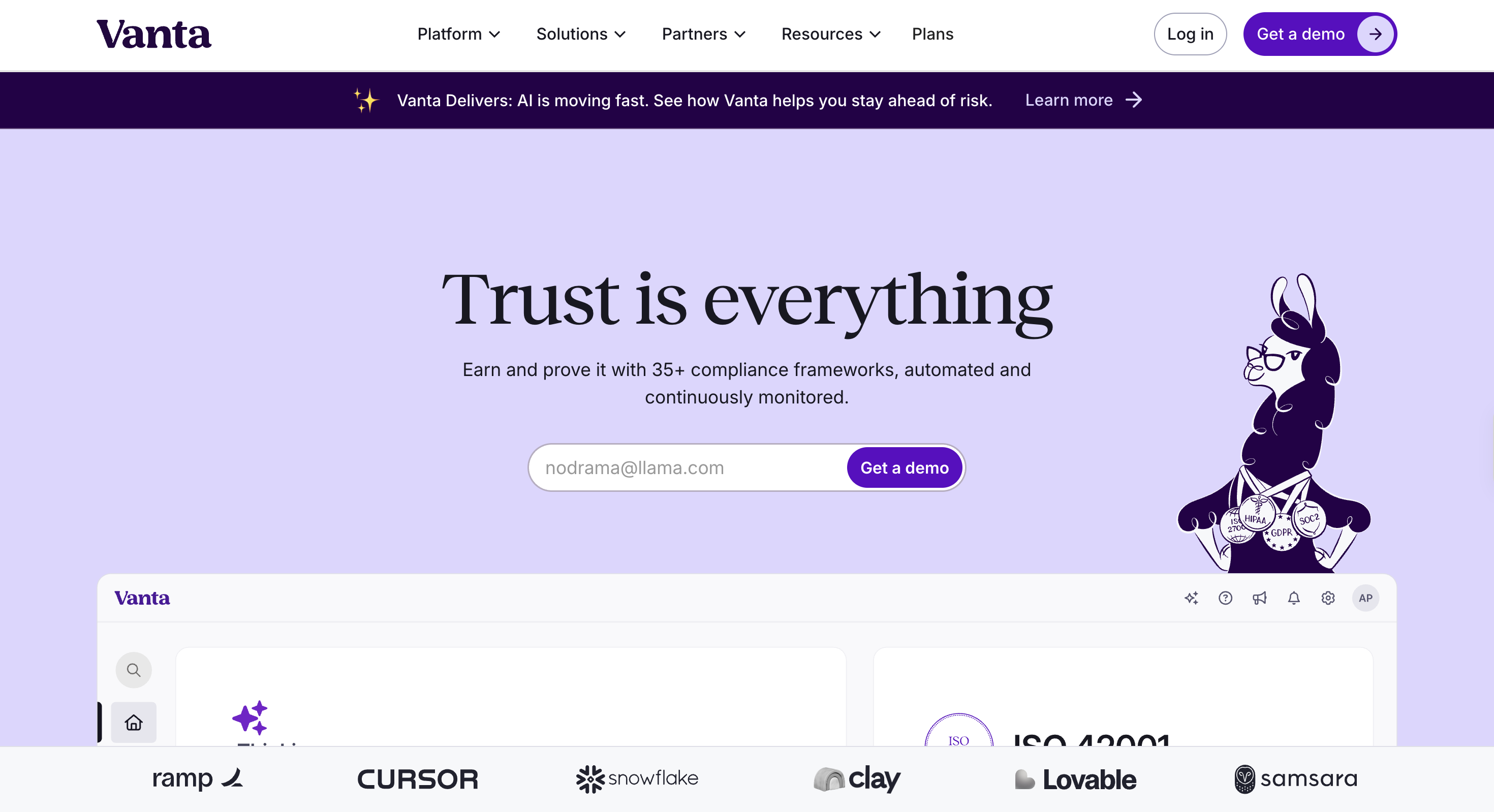
Vanta connects your cloud and identity systems to collect control evidence in one audit workflow. It pulls together code, access, and HR records, maps them to framework controls, and lets an owner inspect the source of any failed test. Auditors can trace the evidence back to the system that produced it without needing a separate document exchange.
It’s a good fit for SOC 2 and ISO 27001 work when broad integration coverage matters more than deep privacy workflow support.
Vanta evidence connections:
- Automated tests monitor configured controls.
- Framework mapping reuses evidence.
- Vendor risk tracks questionnaires and reviews.
- Access reviews record periodic decisions.
- Trust centers share assurance material.
Pricing:
No free plan or public trial is listed. Buyer data shows contracts from about $7,500 per year and higher tiers up to roughly $56,781 depending on scope.
Pros:
- A large integration footprint reduces manual uploads.
- Continuous tests make failed controls visible.
- Auditor familiarity can reduce onboarding friction.
- Access reviews keep decisions beside identity records.
- Framework mapping lets one evidence item support several requirements.
Cons:
- Costs rise with frameworks and add-ons.
- Custom control logic can require extra work.
- DPDPA consent and DSAR operations need another system.
- Unsupported evidence sources still depend on manual uploads.
Vanta can pull access and cloud evidence into the control record before an auditor asks for it. A DPO still needs a separate route for consent withdrawal and Data Principal requests.
7. Drata: Best for continuous control monitoring
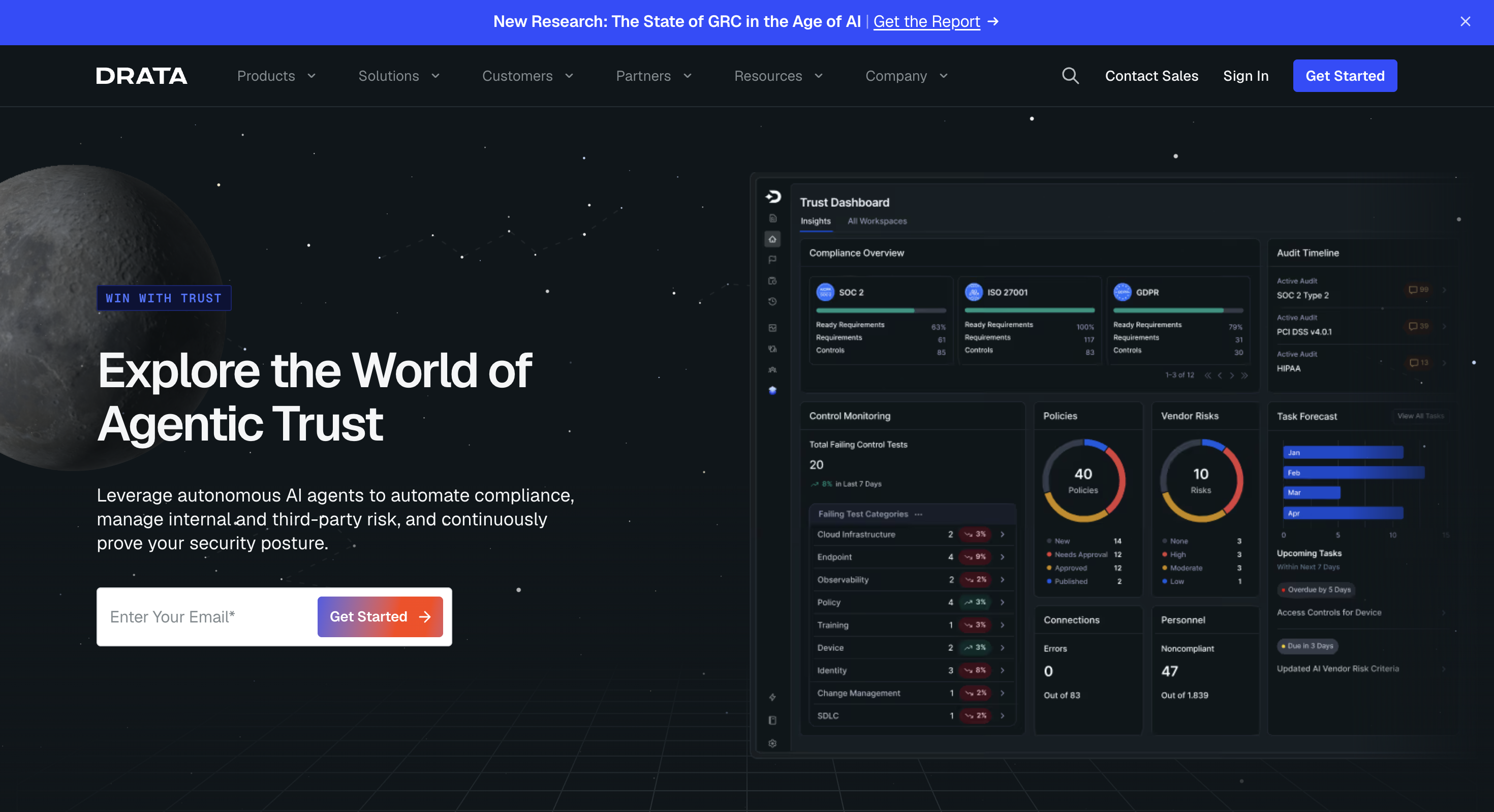
Drata gives you a live view of your controls and evidence. Its integrations check technical and personnel controls, link each result to the relevant requirement, and keep a record as control status changes. That means you can see not just the current state, but also the history of failures and fixes.
If a check fails, the control owner gets work to do, while the audit record still preserves the earlier result and remediation evidence. Risk owners and auditors can rely on the same record. It’s a strong fit for security teams managing a growing technical environment.
Drata control operations:
- Continuous monitoring checks control status.
- Evidence collection connects technical systems.
- Risk management records treatment work.
- Policy workflows collect staff acceptance.
- Auditor workspaces organize review evidence.
Pricing:
No free plan or public trial is published. Recent buyer estimates start near $9,649 per year and reach about $60,000 for broader packages.
Pros:
- Detailed monitoring supports year-round assurance.
- Framework mapping reduces repeated control work.
- Audit workspaces keep requests and evidence together.
- Personnel checks connect workforce events to control status.
- Risk treatment records keep findings with assigned actions.
Cons:
- The platform centers security compliance. Privacy rights need a separate operating system.
- Initial integrations need careful ownership.
- Broader packages can exceed a small team’s budget.
- Alert volume can increase when control thresholds are poorly configured.
- Manual evidence remains necessary for systems without a connector.
Drata alerts the control owner when a technical check fails and keeps the evidence with the control. That record does not replace a consent ledger or DSAR queue.
8. Hyperproof: Best for mapping controls across frameworks
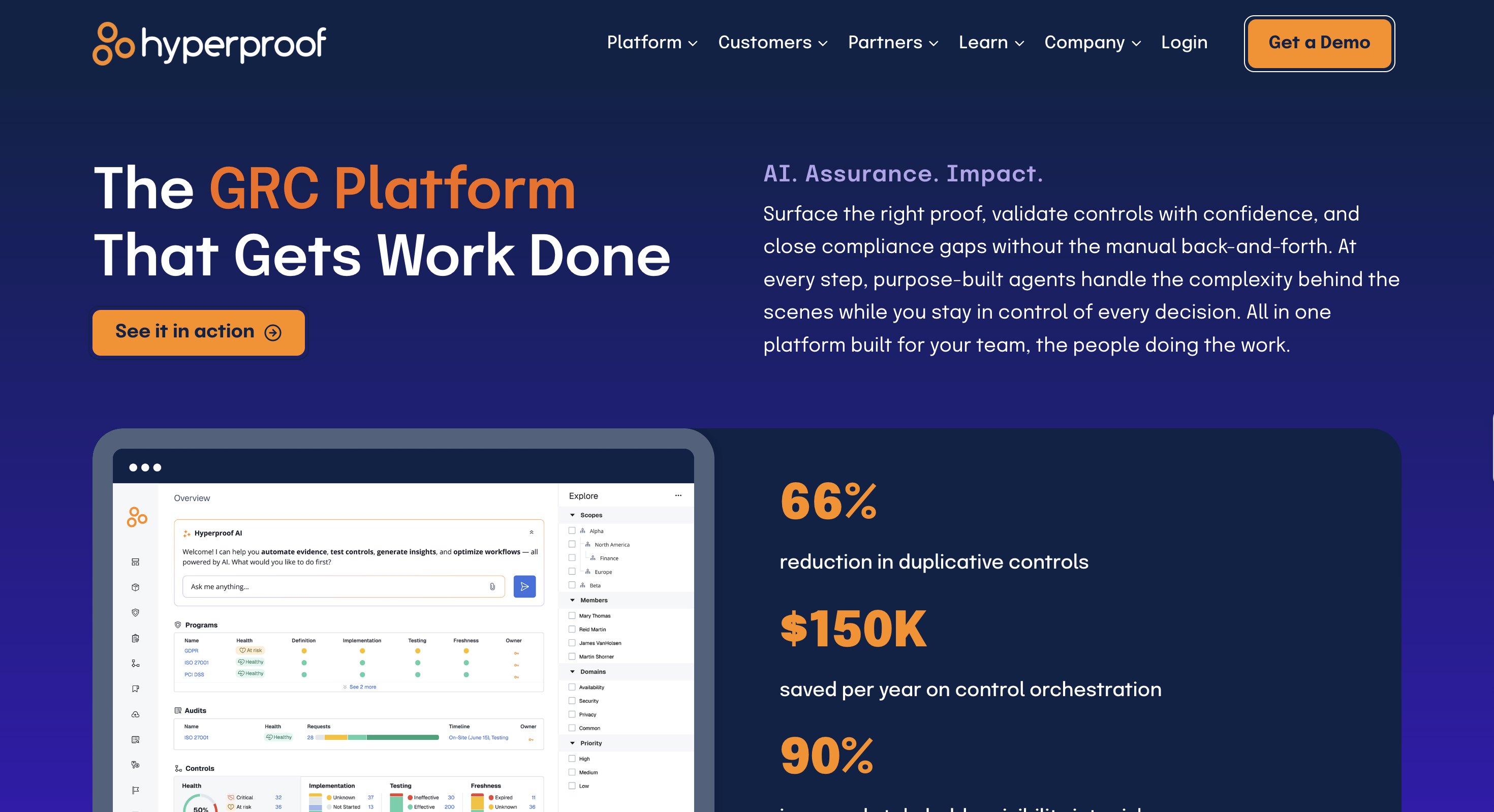
Hyperproof helps teams manage controls across multiple frameworks in one place. An owner can collect evidence once, link it to several requirements, and keep future updates tied to the same control record, so a framework change doesn’t mean rebuilding all the supporting files.
Tasks show who is responsible for the next item and when it’s due. Risk records can then connect a failed control to treatment and review. This is especially useful when duplicated control work is the main burden across ISO or SOC programs.
Hyperproof framework mapping:
- Common controls map across frameworks.
- Evidence tasks route to named owners.
- Risk registers connect findings to treatment.
- Dashboards show program status.
- Integrations pull records from work systems.
Pricing:
No free plan is published. Buyer estimates put entry contracts near $12,000 per year. A guided demo replaces a public trial.
Pros:
- Common controls cut repeated evidence requests.
- Flexible programs support internal frameworks.
- Ownership workflows make delays visible.
- Risk links show how control failures affect treatment plans.
- Evidence tasks keep due dates and owners in one record.
Cons:
- DPDPA templates still require legal mapping and validation.
- Consent capture and withdrawal need another product.
- Configuration quality determines reporting quality.
- Teams must govern control changes to prevent duplicate mappings.
- Limited source integrations can leave evidence collection manual.
Hyperproof lets one control owner submit evidence once and map it across several frameworks. The privacy team must still configure DPDPA obligations and source consent capture elsewhere.
9. MetricStream: Best for large regulated GRC programs
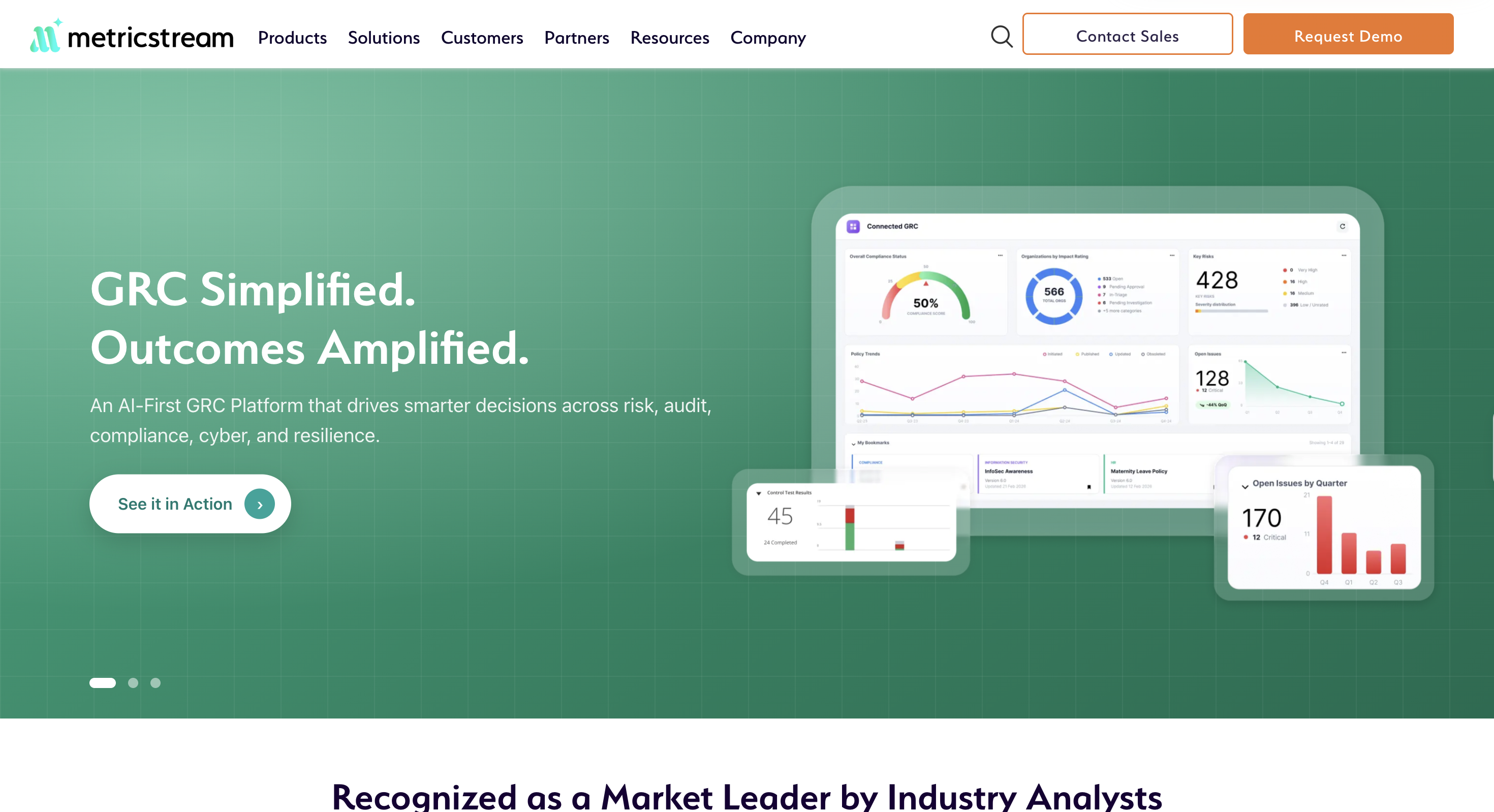
MetricStream is built for enterprise risk and compliance teams. It gives business units a shared way to log risks, connect regulatory obligations to controls, route exceptions for approval, and link audit findings to third-party or cyber records before remediation goes through formal review.
It also rolls local reporting into an enterprise-wide taxonomy, making it a better fit for organizations with multiple lines of defense and established platform administration.
MetricStream GRC coverage:
- Enterprise risk management aggregates risk registers.
- Regulatory compliance maps obligations and controls.
- Internal audit manages plans and findings.
- Third-party risk tracks supplier oversight.
- Cyber GRC connects technology risk to governance.
Pricing:
No free plan or trial is published. Third-party procurement estimates place entry deployments around $75,000 per year. Multi-module programs can reach several hundred thousand dollars.
Pros:
- Broad GRC coverage supports regulated groups.
- Configurable taxonomies align business units.
- Executive reporting combines risk domains.
- Formal workflows preserve approvals and escalation records.
- Connected modules can trace findings across audit and third-party risk.
Cons:
- Implementation demands specialist time.
- Cost is hard to justify for a narrow requirement.
- DPDPA workflows need local configuration and legal review.
- Taxonomy changes require governance across business units.
- A broad deployment can slow when ownership rules are unclear.
MetricStream can roll a business-unit risk into a group taxonomy and route the response through formal review. That model pays off for a regulated group, but it adds administration to a narrow privacy project.
10. AuditBoard (Optro): Best for internal audit and SOX teams
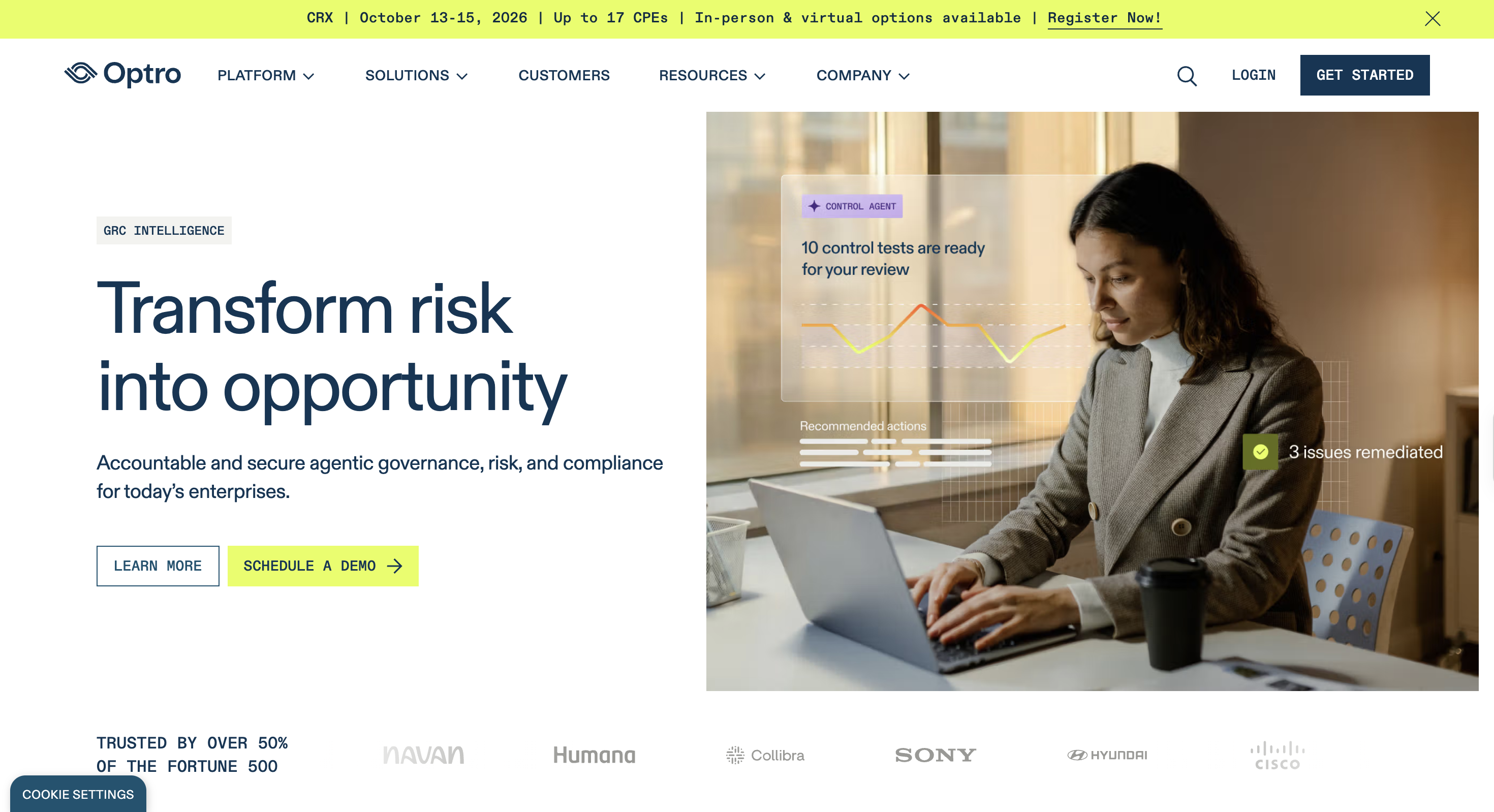
AuditBoard connected risk platform
(AuditBoard) Optro is built for audit and SOX teams. It connects risk assessments with controls and testing plans, making it easy for auditors to request evidence, record test results, assign findings, and track remediation from fieldwork to closure in one place.
Compliance teams can also manage third-party oversight without separating vendor findings from the related risk. That makes Optro a great fit for internal audit teams that want a single place to manage testing and findings.
AuditBoard audit workflows:
- Audit management handles plans and fieldwork.
- SOX workflows track controls and testing.
- Risk oversight maintains assessments.
- Compliance management maps requirements.
- Third-party risk records vendor reviews.
Pricing:
No free plan or trial is published. Procurement estimates put entry deployments near $30,000 per year. Reported contracts often fall between $40,000 and $150,000.
Pros:
- Audit teams get detailed testing workflows.
- Findings connect to owners and remediation.
- Shared records support risk and compliance reporting.
- Evidence requests retain status and ownership through fieldwork.
- Risk assessments can feed audit plans and testing priorities.
Cons:
- Privacy operations are not its main strength.
- Licensing and implementation need enterprise budgets.
- A DPO still needs consent and Data Principal request tooling.
- Teams need process design before they can standardize testing records.
- Privacy-specific evidence requires configuration or another system.
AuditBoard sends a failed test to the control owner and keeps remediation beside the audit finding. Choose it when internal audit owns that chain; a DPO-led consent program needs different software.
How to choose the right platform
Start with one broken evidence chain: consent withdrawal, a failed cloud control, or an overdue vendor review. That break tells you whether to buy privacy operations, security automation, or enterprise GRC.
- Choose Redacto when consent and DSAR evidence drive the project. Its PIA workflow adds the review record.
- Put OneTrust or Securiti on the shortlist for a global privacy program with a large data estate.
- Compare Scrut, Sprinto, Vanta, and Drata when cloud control evidence drives an ISO or SOC audit.
- Use Hyperproof when several frameworks repeat the same controls.
- Consider MetricStream or AuditBoard when formal GRC and internal audit own the program.
Before procurement, run one real workflow through every demo. Ask a vendor to trace a consent withdrawal or a failed access control from trigger to owner. Then request the timestamped evidence an auditor would receive. A dashboard without that chain only makes the gap easier to look at.
The first action to take this week
Before you buy, run one real workflow all the way through each demo. Ask a vendor to trace a consent withdrawal or a failed access control from the trigger to the owner, then show the timestamped evidence an auditor would see. If a dashboard can’t show that full chain, it’s not giving you the clarity you need.
The first action to take this week
On Monday, pick one obligation and trace it through your current systems. A privacy team can use a consent withdrawal; a security team can use a failed cloud control. Note the trigger, the owner, and the approval, then capture the evidence record.
That trace will help you decide what to buy. If the gap is in DPDPA privacy operations, compare your workflow against Redacto’s Unified Consent Manager or Automated DSAR Management. Legal and the DPO still own the interpretation, while automation can handle the routing and keep the record intact.