%20Redacto%20logo_New.png)


10 Best ROPA Softwares for Privacy Compliance in India


A spreadsheet ROPA works until a product owner changes a purpose, a vendor starts receiving another data field, or the system owner moves teams without updating the record. When that happens, you and I face a register that still describes last quarter even though the processing activity has already changed.
It shows what we approved last quarter instead of what the company does now.
The Digital Personal Data Protection Act, 2023 does not name a Record of Processing Activities. Yet its duties still require traceable facts about the data, its purpose, and the party responsible for it. Section 5 requires a notice that states the personal data and purpose, while Section 6 governs consent.
General obligations sit under Section 8 of the Digital Personal Data Protection Act, 2023. A useful ROPA connects those duties to systems and owners.
ROPA software helps maintain that connection. It records each processing activity and routes review when a system or purpose changes. It also preserves the evidence behind the entry. This guide compares ten options for Indian privacy teams.
Also Read - What is ROPA in Data Privacy? & How It Fails in Practice
TL;DR - 10 Best ROPA Softwares for Privacy Compliance
- Redacto - Best for India-first DPDPA privacy operations
- dcomply - Best for modular Indian compliance work
- DPDPOne - Best for a small Indian team starting a ROPA
- ComplyDP - Best for a guided readiness programme
- Privado AI - Best for ROPAs triggered by product and code risk
- Sypher - Best for a focused guided ROPA workflow
- Rowpa - Best for a small UK or EU-facing business
- RoPA Pilot - Best for a solo adviser or basic register
- GDPR Hero - Best for teams that also need GDPR training records
- Armadillex - Best for a multi-regulation privacy office
Disclosure: Redacto publishes this article and appears in the list. I apply the same ROPA criteria to it as I do to every other product.
How I evaluated ROPA software
I evaluated each tool by the work required to keep a processing register current. A form that exports a report can help with initial documentation, but it cannot catch a new data flow or show who accepted a change.
The stronger products connect discovery to review, keep the prior value beside the approved change, and leave enough context for a DPO to reconstruct the decision months later.
- Processing model: Does each entry capture purpose and data category plus owner?
- Change control: Can the tool trigger review when a system or vendor changes?
- Evidence: Does it retain approvals and versions with exportable records?
- India fit: Can the workflow reflect DPDPA notices and consent plus erasure duties?
- Human gate: Can legal or the DPO correct automated suggestions before approval?
Best ROPA Softwares for Privacy Compliance in India (detailedcomparison
Plan figures were checked on 2026-08-13. Taxes and annual billing terms can change the effective cost.
1. Redacto
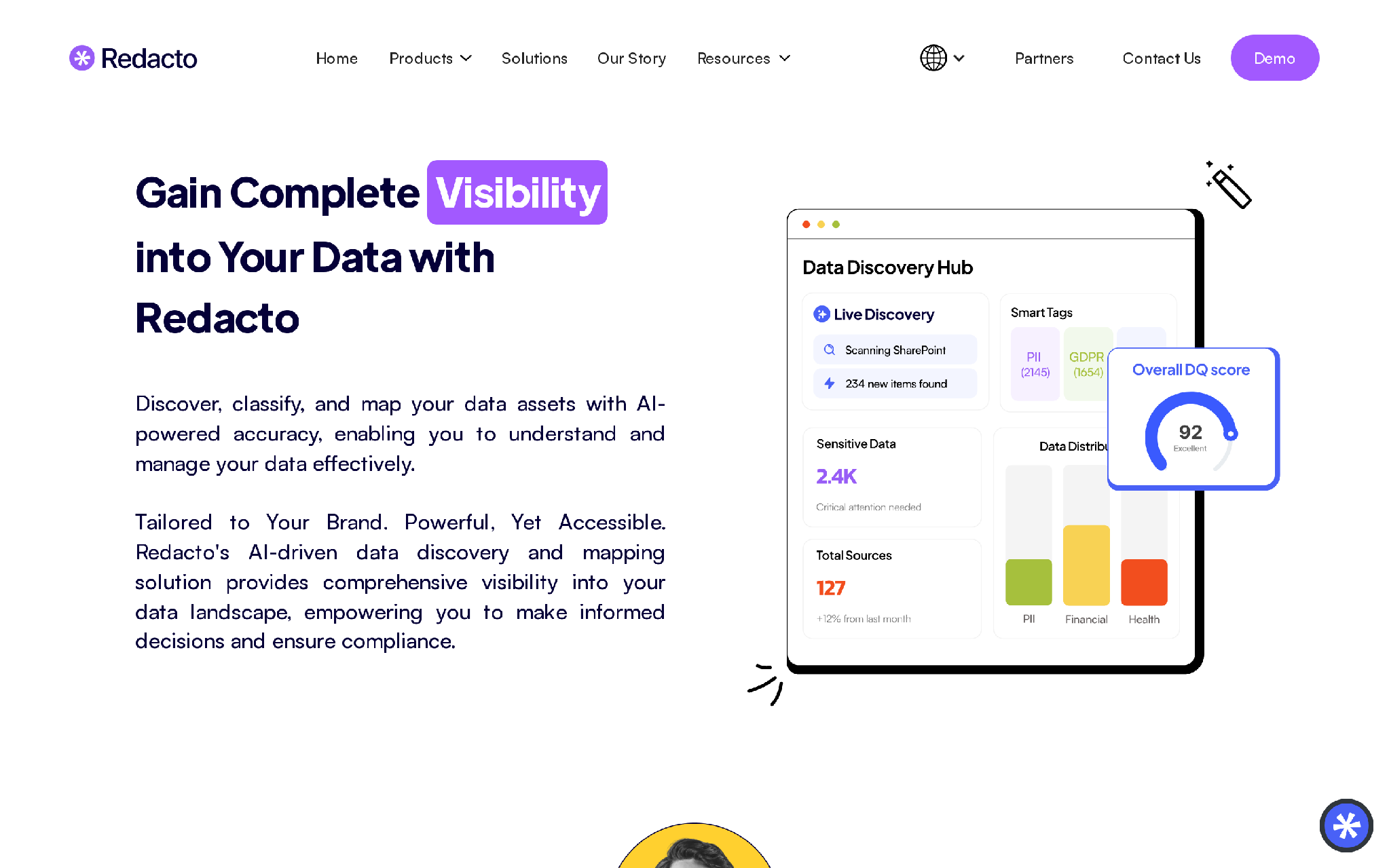
Redacto links a ROPA to its AI-Driven Data Discovery & Mapping capability. The workflow starts with systems and data assets, moves through purpose and ownership review, and ends with a record in Audit & Reporting. Privacy teams can correct each activity before approval.
This setup matters when consent and vendor records live outside the ROPA, because a purpose change can affect the Unified Consent Manager while a new processor enters Vendor Risk Management. The privacy team still owns legal interpretation and final approval.
Features
- Discovers data across connected sources
- Inventories systems and data assets
- Classifies personal data with configurable tags
- Maps lineage from source to destination
- Links processing activities with purpose and ownership review
- Connects ROPA work with PIA and vendor risk
- Records approvals through Audit & Reporting
- Connects consent records through Unified Consent Manager
Pricing: Redacto
Pricing: Redacto uses a license-based fee and asks buyers to contact its team for a quote. It publishes no self-serve plan price or public trial. The quote depends on the scope agreed during procurement, so buyers need to confirm modules, data sources, users, implementation work, support, and contract term before comparing total cost.
Pros
- The workflow reflects DPDPA work inside Indian enterprises.
- Data discovery can expose processing that questionnaires miss.
- Lineage mapping connects an activity to its source and destination.
- Consent and PIA records can sit beside the processing register.
- Audit records preserve the review trail for later evidence.
Cons
- Its India-first scope fits a global multi-law programme less closely.
- The company has fewer public case studies than established suites.
- Its 2025 incorporation means buyers have a shorter operating record to assess.
- Teams still need legal review for purpose and retention decisions.
- Implementation requires access to the systems that hold processing context.
Redacto summary
Choose Redacto when DPDPA operations drive the purchase and ROPA must connect with consent or PIA evidence. Who should not choose Redacto: a team seeking a low-cost standalone register with self-serve checkout.
2. dcomply
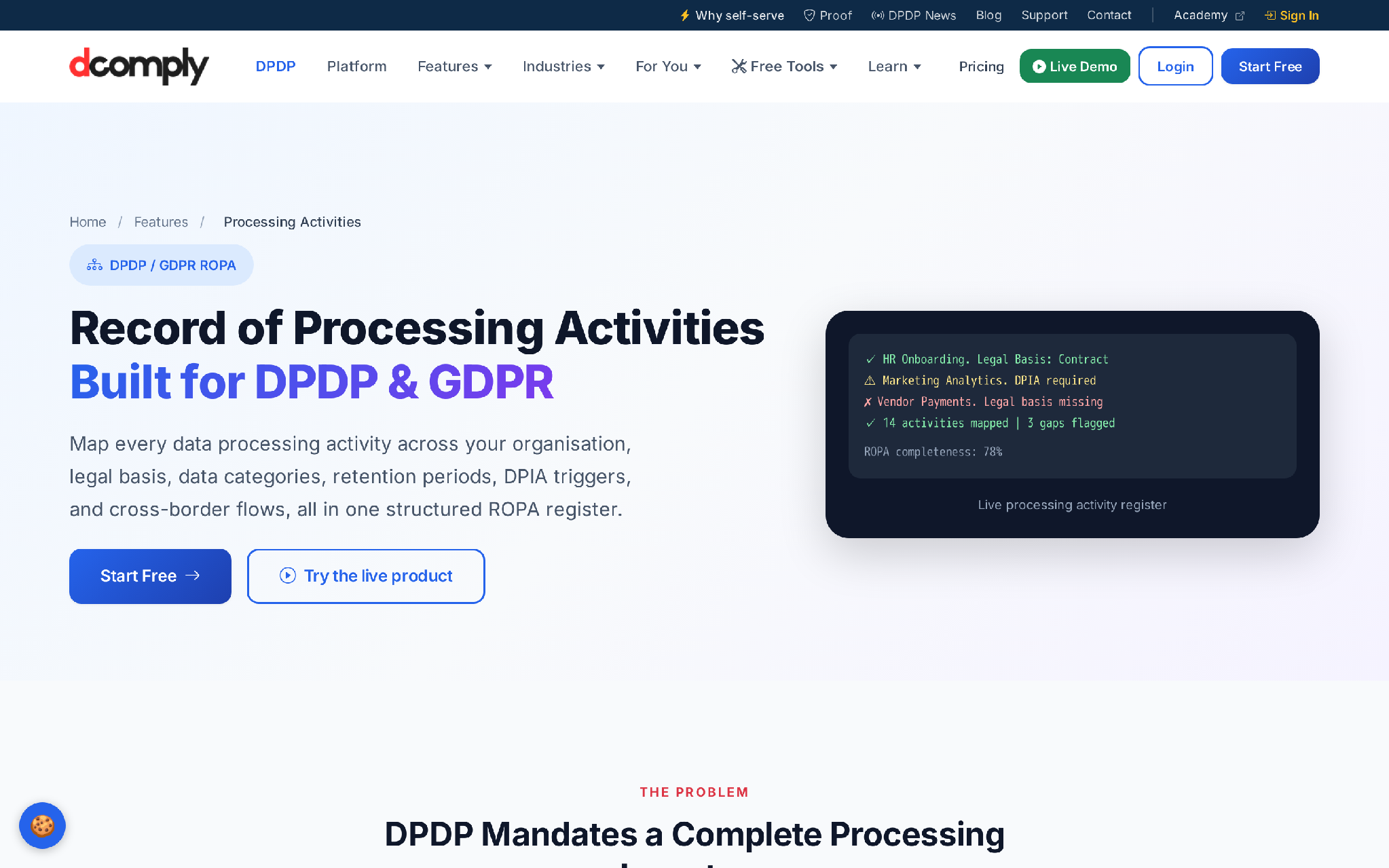
dcomply places ROPA inside its Data Privacy industry pack. Teams record the purpose, legal basis, data categories, and retention periods for each activity. The register also covers DPIA triggers and cross-border flows.
Its pack model suits a company that wants ROPA beside a wider compliance calendar, and connectors can bring source context into the workspace. Even then, the owner still needs to confirm the purpose and retention rule.
Features
- Creates structured processing activity records
- Captures purpose and legal basis
- Records data categories and retention periods
- Tracks cross-border processing fields
- Flags DPIA triggers
- Exports PDF records and audit reports
- Stores evidence on eligible plans
- Adds source context through connectors
Pricing: dcomply
Pricing: Starter costs ₹11,041 per month when billed annually. The free vDPO tier gives buyers an entry point before a paid pack. Paid scope expands through industry packs and connectors, so a quote comparison needs the selected Data Privacy pack, connector allowance, users, evidence storage, and annual commitment stated in one order form.
Pros
- The Data Privacy pack includes a structured ROPA.
- Retention fields keep disposal decisions inside each activity.
- DPIA triggers connect the register with risk review.
- Cross-border fields help teams identify transfer questions.
- The modular pack model lets buyers add adjacent controls over time.
Cons
- The pack and credit model takes time to scope.
- Connector access varies across the product tiers.
- A narrow ROPA use case may inherit modules the team does not need.
- Activity owners still need to validate purpose and retention answers.
- The workspace depends on teams keeping connector and evidence inputs current.
dcomply summary
dcomply fits an Indian company that wants a defined ROPA module and a broader compliance calendar. Compare its chosen pack with DPDPOne before purchase because the lower-priced option may cover a simple register.
3. DPDPOne
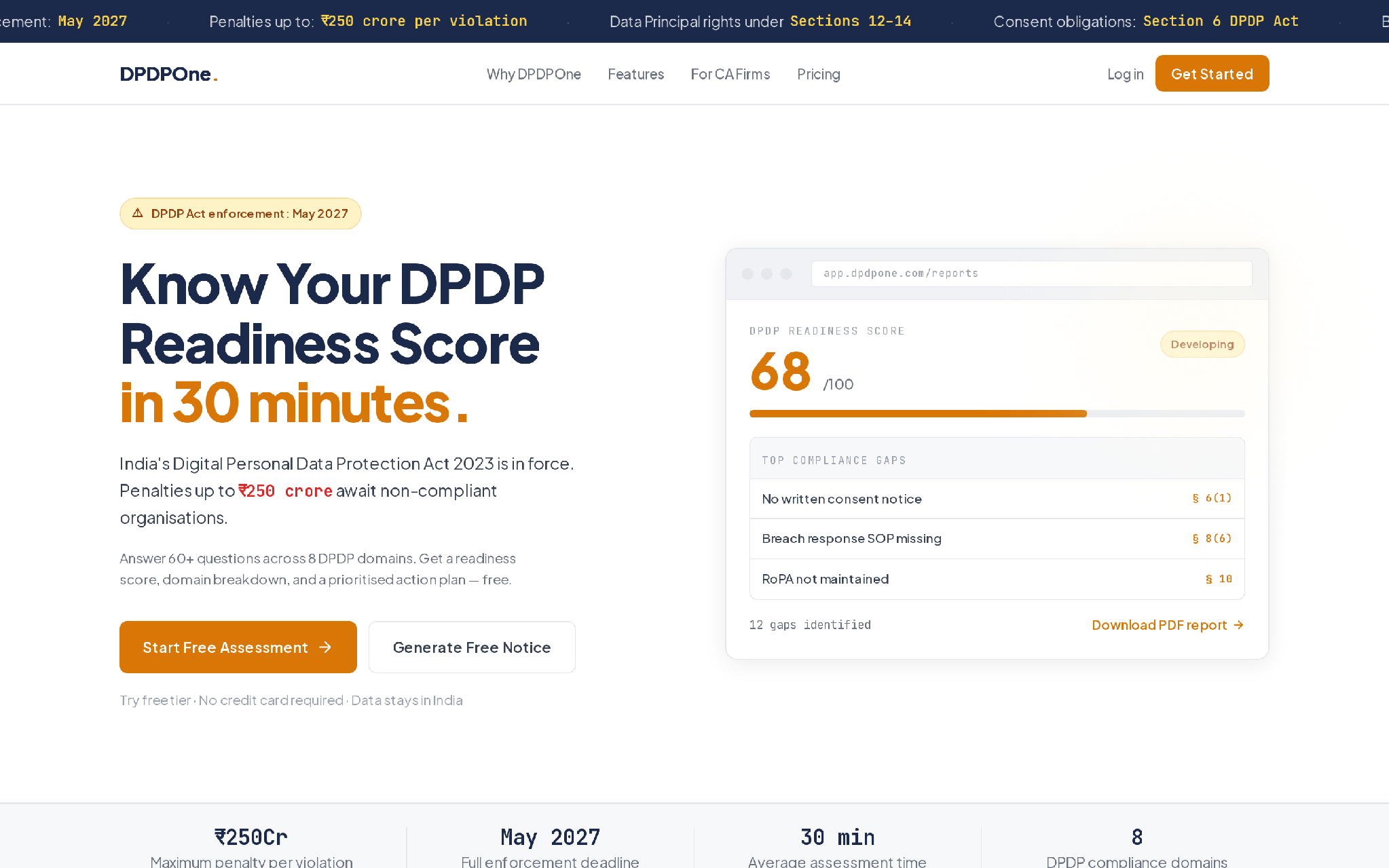
DPDPOne gives a small team a capped ROPA inside a wider DPDPA workspace. The Starter plan supports 30 activities, adds evidence storage, and produces reports from the same account. That scope is easy to test.
This is a guided record instead of a discovery-led data map. It works when activity owners already know which systems and vendors process personal data. Gaps in that knowledge still need interviews or a separate scan.
Features
- Creates ROPA entries inside a DPDPA workspace
- Supports 30 activities on Starter
- Runs compliance assessments
- Stores evidence against compliance work
- Produces reports from the same account
- Includes a Data Principal rights portal
- Tracks breach response work
- Offers client workspaces for consultants
Pricing: DPDPOne
Pricing: Starter costs ₹1,990 per month at the published founding rate and includes up to 30 ROPA activities. Annual billing gives two months without charge. The product lists no free plan or trial. Buyers with more activities should confirm the next plan’s activity allowance, users, client workspaces, API access, evidence storage, and renewal rate.
Pros
- The activity cap gives a small team a clear starting scope.
- Evidence storage sits beside the register.
- Reports come from the same workspace as the assessments.
- The rights portal connects ROPA context with request handling.
- Consultant workspaces support separate client records.
Cons
- Thirty activities will not cover a group with many systems.
- Automated discovery is not the main source of ROPA input.
- Teams need interviews when owners cannot name every activity.
- API access sits outside the starter workflow.
- Large approval chains need more governance depth than the entry setup provides.
DPDPOne summary
DPDPOne works for a small Indian company that can name its activities and wants structure. A bank with many systems will need stronger discovery and change detection.
4. ComplyDP
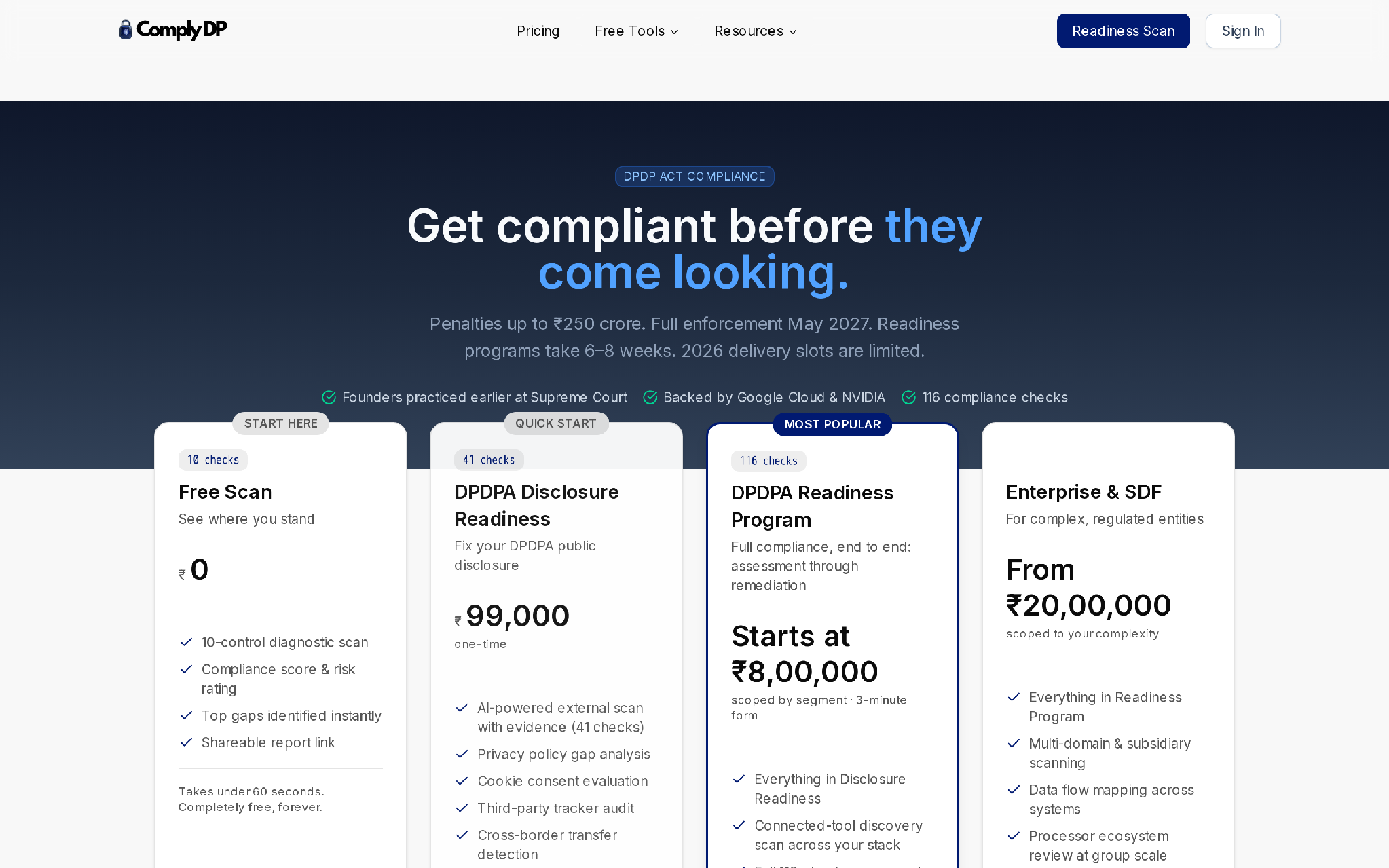
ComplyDP treats ROPA as one deliverable in a readiness programme. Its process combines a connected-tool scan, automated checks, lawyer review, and a versioned register that can be exported. The result is closer to an implementation project than a point tool.
This model shifts work toward a scoped implementation. It can help a team that lacks internal privacy capacity. It offers less appeal to a mature DPO office that only wants software for continuous activity ownership.
Features
- Scans connected tools for data use
- Builds a versioned ROPA
- Exports the approved register
- Maps processors
- Provides DPA templates
- Documents cross-border transfers
- Adds lawyer review to the readiness programme
- Monitors the environment on annual plans
Pricing: ComplyDP
Pricing: Disclosure Readiness costs ₹99,000 once and includes a diagnostic scan at no extra charge. The broader Readiness Programme starts at ₹8,00,000. The company lists no free software plan or trial. Procurement should separate the one-time assessment from ongoing monitoring and confirm the entity count, processor count, connected tools, lawyer review, deliverables, and support period.
Pros
- The engagement combines discovery with reviewed implementation.
- A versioned export gives the buyer a defined evidence artifact.
- Processor mapping sits inside the same readiness work.
- Lawyer review helps a team with limited privacy capacity.
- Indian regulation shapes the programme and its deliverables.
Cons
- The programme model gives mature DPO teams less direct control.
- Implementation scope grows with processors and connected tools.
- Buyers still need internal owners for every activity.
- Signed contracts remain outside the vendor’s control.
- A project-led engagement can be heavier than a focused register rollout.
ComplyDP summary
ComplyDP makes sense when the immediate job is a managed readiness project. DPO teams that already know their control model may prefer software they can configure directly.
5. Privado AI
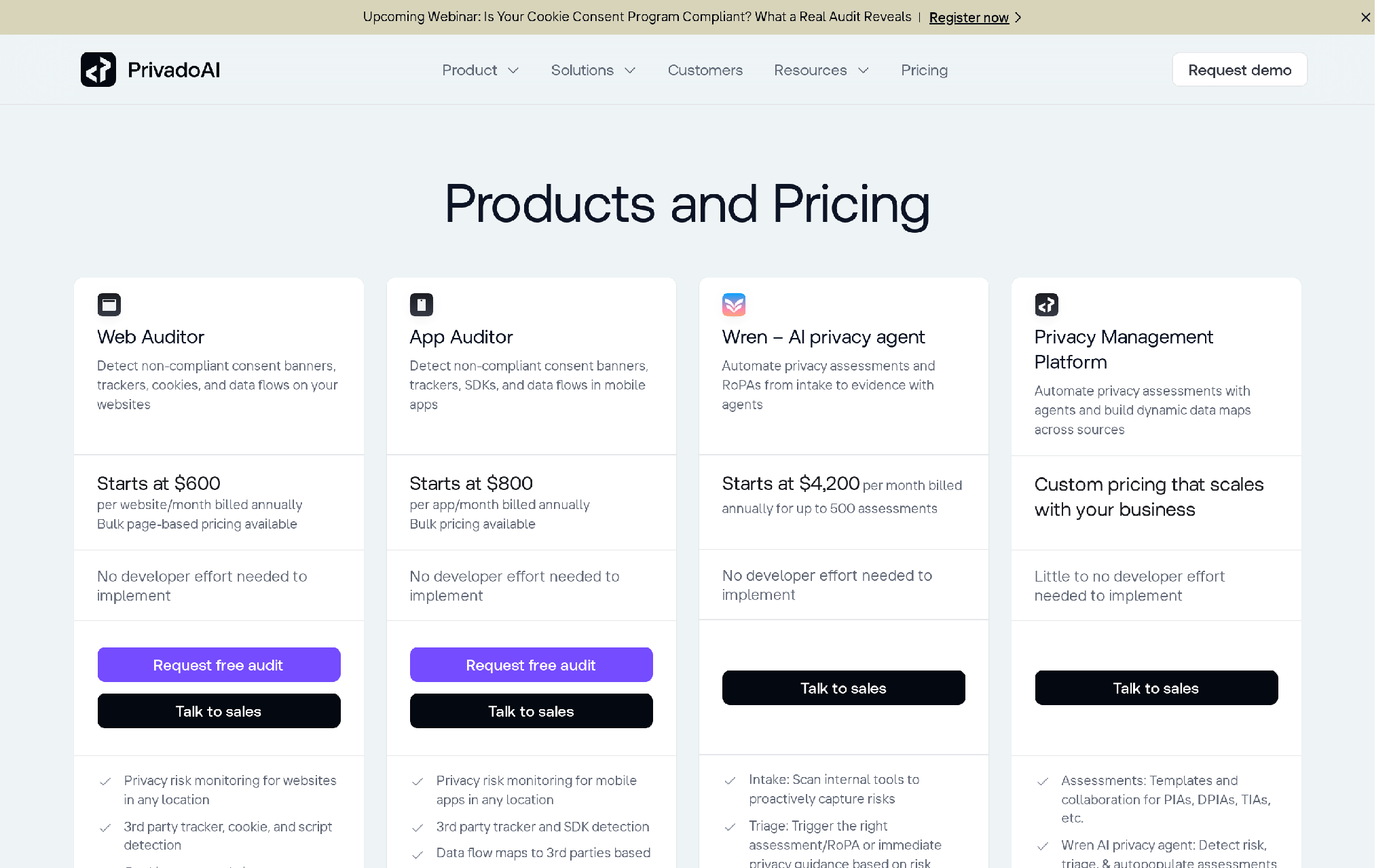
Privado AI’s Wren product automates assessments and ROPAs from intake to evidence. It can scan internal tools, detect privacy risk, route the right assessment, and collect evidence. This makes the product relevant when processing changes start in engineering.
The approach can keep a register closer to code and product work, where privacy reviewers can see a change before the quarterly register review. Technical detection can flag the event, but the reviewer still has to verify purpose and lawful treatment.
Features
- Scans internal tools for privacy risk
- Detects changes in product and code workflows
- Triages ROPA and assessment requests
- Routes work to privacy reviewers
- Collects evidence during assessment
- Monitors product privacy risk
- Connects with developer work systems
- Tracks assessments from intake through approval
Pricing: Privado AI
Pricing: Wren starts at $4,200 per month on annual billing and includes up to 500 assessments. No free tier or trial is published. Buyers should confirm what counts as an assessment, connected repositories, internal tools, user seats, evidence retention, onboarding, support, and the charge for volume above the included allowance.
Pros
- Product changes can trigger privacy work before a periodic review.
- Internal tool scanning reduces dependence on owner memory.
- Assessment triage routes detected risk to the privacy team.
- Evidence stays attached to the review workflow.
- Developer integrations place privacy review near engineering work.
Cons
- DPDPA content is not the product’s main focus.
- Engineering access affects how much the scanner can see.
- Repository setup requires support from technical owners.
- Detection still cannot decide purpose or lawful treatment.
- A privacy team without code-led change may use little of its core workflow.
Privado AI summary
Privado AI wins when code and internal tools change faster than questionnaires can track. It is harder to justify when the company needs an India-first compliance register with a modest budget.
6. Sypher
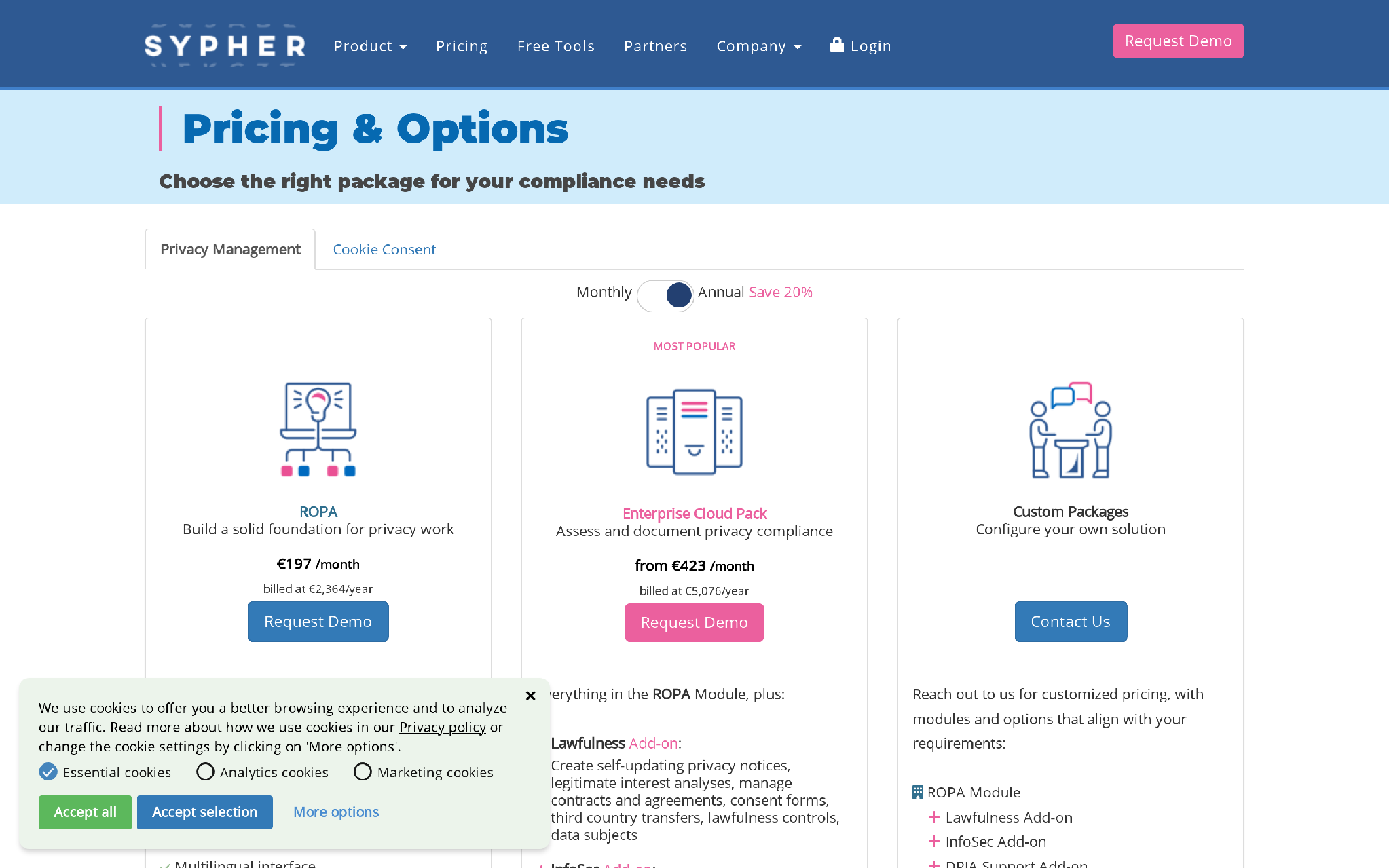
Sypher offers a dedicated ROPA module with guided mapping. It tracks progress, preserves prior versions, and routes an activity through formal review before approval. A completed form does not become final by default.
The product is rooted in GDPR work. Indian teams can still use the inventory mechanics. They would need to adapt fields and review logic for DPDPA rather than assume a GDPR legal basis maps directly.
Features
- Supports unlimited processing activities
- Guides activity mapping
- Tracks completion progress
- Validates ROPA entries
- Routes formal review before approval
- Preserves prior versions
- Displays a visual activity map
- Supports up to 25 seats on the cited ROPA plan
Pricing: Sypher
Pricing: The ROPA module costs €197 per month with annual billing or €247 per month on a month-to-month term. The published plan includes 25 seats and unlimited processing activities. No free plan or trial is shown. Buyers should confirm onboarding, additional seats, exports, support, renewal terms, and whether other privacy modules require separate subscriptions.
Pros
- The dedicated module keeps the workflow centred on ROPA work.
- Formal review prevents a completed form from becoming final by default.
- Version history preserves evidence of changed answers.
- Unlimited activities suit a shared register across business units.
- The visual map helps reviewers inspect relationships between activities.
Cons
- Its legal model starts from GDPR.
- Indian teams need to configure DPDPA fields and review logic.
- A GDPR legal basis cannot be copied into a DPDPA decision.
- Guided mapping still depends on accurate owner answers.
- Teams seeking automated system discovery need another input method.
Sypher summary
Sypher fits a privacy team that values guided review and already manages GDPR. DPDPA-only buyers will find more native language in Redacto or dcomply.
7. Rowpa
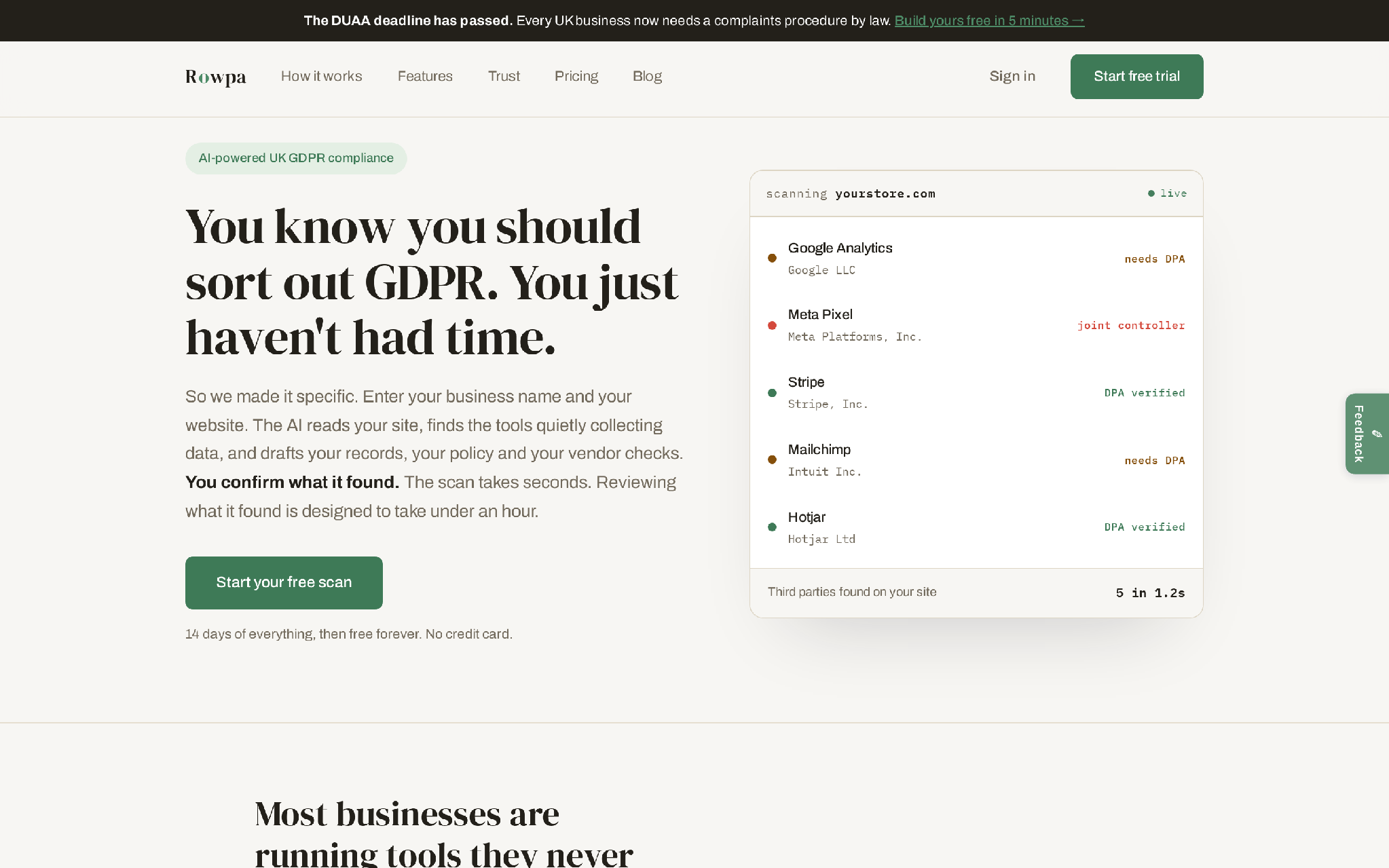
Rowpa scans a business website and builds a draft profile of tools and processing activities. It then proposes a legal basis, adds a retention period, flags uncertainty, and waits for user approval. The approved register can be exported.
The small-business model keeps setup short, although its legal assumptions come from UK and EU GDPR. For an Indian company, each proposed legal basis still needs a separate DPDPA review before approval.
Features
- Scans websites and trackers
- Builds a draft business profile
- Generates processing activities
- Suggests legal basis and retention fields
- Flags uncertain answers for review
- Waits for user approval
- Keeps an audit log
- Exports PDF and CSV records
Pricing: Rowpa
Pricing: Starter costs £49 per month. The free tier holds five ROPA activities. Growth includes a 14-day trial that does not require a card. Buyers should compare activity limits, users, export formats, audit history, trial-to-paid conversion, and any allowance for multiple sites or entities before choosing a plan.
Pros
- The free plan supports a pilot with real activities.
- Website scanning gives small teams a quick first input.
- Uncertain suggestions remain visible for human review.
- User approval is explicit before the register becomes final.
- PDF and CSV exports make the register portable.
Cons
- The workflow targets UK and EU law.
- Website discovery misses internal systems unless users add them.
- Indian teams need a separate DPDPA review of suggested fields.
- Automated suggestions depend on what the public site exposes.
- Special-category processing needs professional oversight beyond the generated record.
Rowpa summary
Rowpa is the better fit for a small UK-facing company that wants a guided first register. Indian BFSI and healthcare teams need a platform with deeper internal discovery and DPDPA configuration.
8. RoPA Pilot
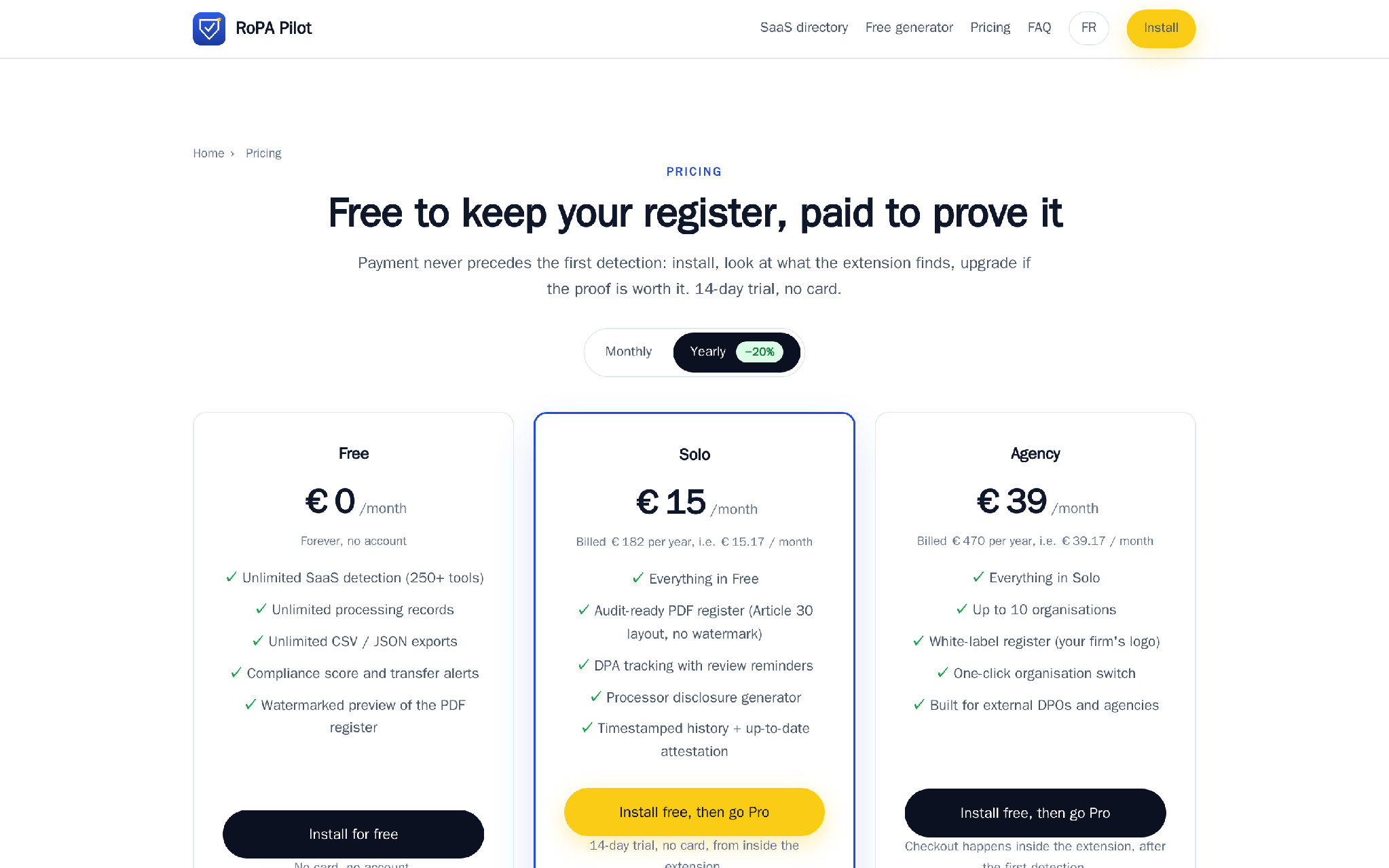
RoPA Pilot provides a narrow register for processing activities. It suits a solo practitioner who wants a managed record, a simple export, and separate client workspaces. Agency features add branding.
The product does not replace discovery. Owners must supply current activity facts and revisit them after change. Indian statutory mapping also remains the user’s responsibility.
Features
- Creates processing activity records
- Separates solo and agency workspaces
- Keeps client records apart
- Exports the register
- Supports agency branding
- Provides a free entry tier
- Uses a focused register interface
Pricing: RoPA Pilot
Pricing: Solo costs €19 per month after the €0 free plan. Agency costs €49 per month and adds agency use cases such as separate client workspaces and branding. Buyers can evaluate the register on the free tier. Consultants should confirm client limits, collaborators, export access, branding controls, record history, and upgrade rules.
Pros
- The narrow scope keeps initial setup short.
- Separate workspaces help consultants divide client records.
- Register export supports an evidence handoff outside the tool.
- Agency branding helps advisers present client deliverables.
- The focused interface suits a single register owner.
Cons
- The product has no automated discovery layer.
- DPDPA workflows are not built in.
- Owners must supply current activity facts themselves.
- Large approval chains need a deeper governance workflow.
- The user must create a separate process for change detection.
RoPA Pilot summary
The product works when one adviser owns a small register. Before a consultant adopts this register for several clients, they can create the same processing activity in two workspaces where only one purpose has changed, then ask a second reviewer to identify the correct owner from each export without opening the application, because workspace separation matters only when the evidence pack stays unambiguous outside the tool. It should not lead the shortlist for an Indian enterprise with changing systems and many activity owners.
9. GDPR Hero

GDPR Hero privacy management plans — SCREENSHOT PENDING (manual)
GDPR Hero combines ROPA work with other records in a GDPR programme, which can help when activity owners also need training before they complete a register. Teams document processing purpose and retention, then assign responsibility for the record.
That combination can improve participation. It does not remove the legal translation required for India. DPDPA notices and consent duties need their own fields and review.
Features
- Creates processing purpose records
- Captures data sharing fields
- Records retention information
- Assigns responsibility for records
- Supports organisational accounts
- Provides guidance for activity owners
- Includes training material
- Keeps ROPA beside other GDPR programme records
Pricing: GDPR Hero
Pricing: The entry plan costs €50 per month and Premium costs €140 per month. No free tier or trial is published. A buyer should confirm which plan includes the required ROPA functions, organisational accounts, training access, users, exports, support, and any limits on entities before signing an annual or monthly term.
Pros
- Training can help activity owners understand the requested fields.
- Responsibility can be assigned inside the record workflow.
- Data sharing and retention sit beside processing purpose.
- Organisational accounts support participation across a team.
- The register connects with other GDPR programme records.
Cons
- GDPR drives the terminology and guidance.
- Indian teams must add local notice and consent evidence.
- The product lacks discovery-led change detection.
- Training does not verify that an owner’s system inventory is complete.
- DPDPA interpretation still needs a separate legal review.
GDPR Hero summary
GDPR Hero fits a team that needs staff guidance alongside a GDPR register. It ranks lower for India because the local legal workflow needs adaptation.
10. Armadillex
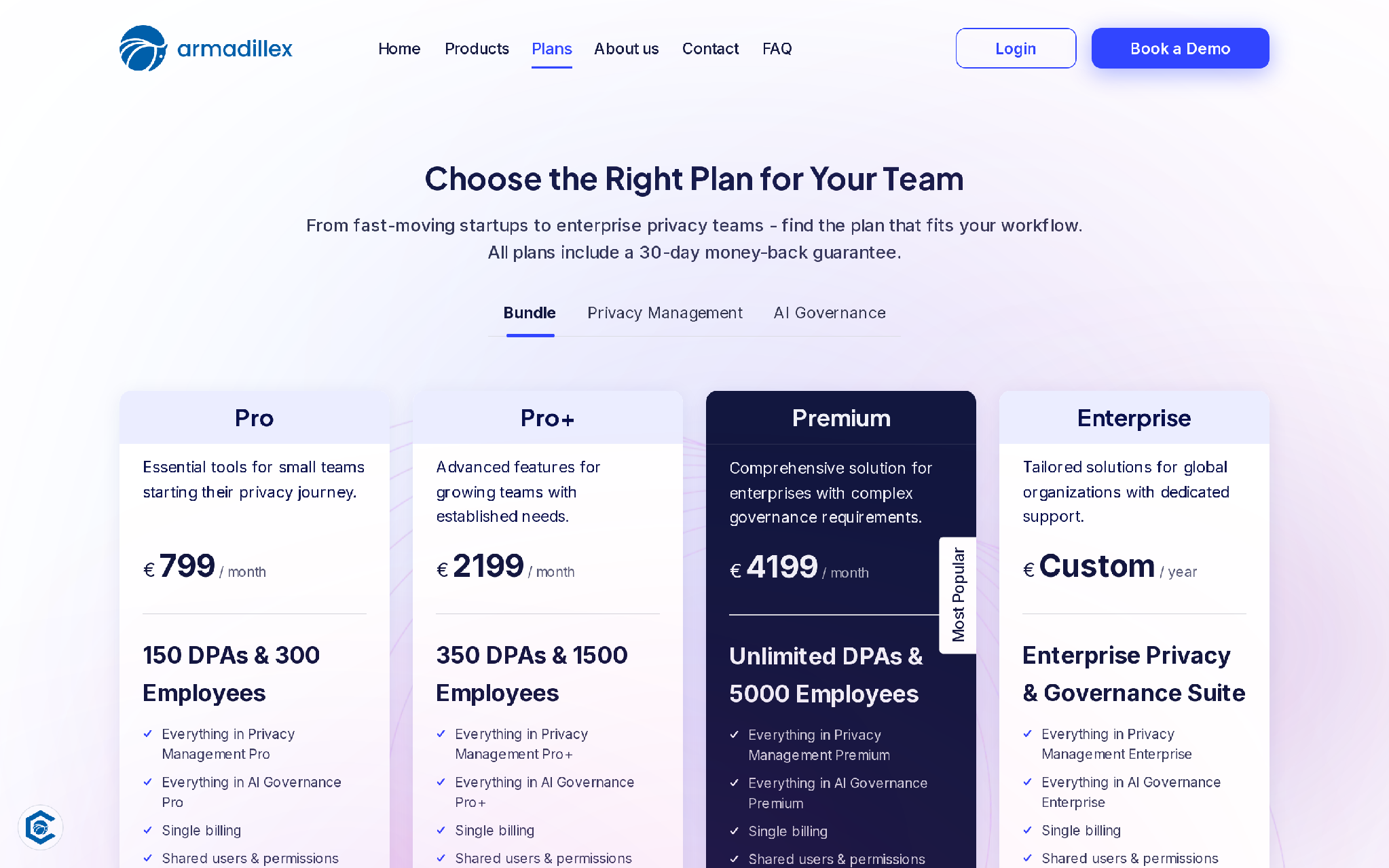
Armadillex includes ROPA within a broader privacy management and AI governance platform. It suits a privacy office that wants one inventory for several laws, assessment workflows, AI records, and risk decisions. Indian teams should test whether local notice and consent fields work without heavy configuration. During the sales demo, load one real processing activity with its owner and prior approval, then check how much field mapping the team must configure before review can start.
Features
- Creates and maintains ROPA records
- Provides a privacy management workspace
- Tracks assessment workflows
- Keeps AI governance records
- Supports risk decisions
- Maintains one inventory across several regulations
- Assigns governance work
- Links privacy and AI programme records
Pricing: Armadillex
Pricing: Plans start at €799 per month. No free plan or trial is published. Broader enterprise scope requires a quote. Buyers should ask the vendor to separate the base plan from added entities, users, regulatory content, AI governance, implementation, integrations, support, and any contract minimum.
Pros
- One inventory can support several regulatory programmes.
- AI governance records sit beside privacy work.
- Assessment workflows connect the inventory with risk decisions.
- The workspace suits a privacy office with cross-border scope.
- Shared governance can reduce duplicate records across legal programmes.
Cons
- The wider platform creates more setup than a focused register.
- DPDPA fit needs validation during procurement.
- Indian notice and consent fields may require configuration.
- A team seeking only ROPA may not use the AI governance scope.
- Multi-law configuration needs clear ownership to avoid conflicting fields.
Armadillex summary
Armadillex can beat Redacto when the buyer needs one global privacy and AI governance layer. An India-first team with consent and vendor workflows at the centre will get a closer fit from Redacto.
How to choose ROPA software for an Indian company
Start with the trigger that makes your register stale, because a code change and a missed owner review call for different controls. When engineering creates the gap, test Privado AI or another discovery-led product and follow one changed data field from detection through approval. A small team with known activities can start with DPDPOne or RoPA Pilot, while a team with overdue reviews needs assignment history and escalation evidence before it needs another discovery scan.
During a demo, change the purpose on one activity, send it back to the owner, and export the approved version after the second review so you can see whether the record preserves the full chain instead of replacing the earlier answer. Where the product creates a new version automatically, compare the old purpose with the new one, inspect the reviewer identity, and confirm that the approval time survives the export without a separate audit-log request.
A processor change gives you another test, because the register should identify the affected activity, route it to the accountable owner, and retain the decision even after the vendor record changes again. Once the owner approves the update, ask a colleague who did not attend the demo to reconstruct the event, name the source of the change, and explain why the final purpose was accepted.
For an Indian enterprise the legal model needs special care. The Digital Personal Data Protection Act, 2023 does not prescribe a ROPA format. Treat the register as an operating record for purpose, consent, safeguards, and ownership under the Act. Do not copy GDPR Article 30 fields and call the result DPDPA compliance.
Use one real activity in every demo. Customer onboarding is a useful test because it touches notice, consent, processors, and retention. Ask the vendor to show the source system and purpose. Then change one field and inspect the approval trail.
Export the changed processing activity before you choose a product. The file should show its owner, stated purpose, prior value, approval identity, and approval timestamp, so a second reviewer can reconstruct the change without opening the tool. Your DPO or legal team still owns the conclusion.
Build the first evidence trail this Monday
Pick one activity that changed last quarter. Trace its purpose and data fields to every system and vendor. Then compare that reality with the current ROPA entry.
Write down each mismatch. Assign an owner and a review date. If the exercise takes days or nobody can prove approval then run the same activity through two shortlisted tools. The better product is the one that exposes the missing handoff and preserves the decision.