7 Best DSAR Management Software and Automation Tools (2026)
Compare seven DSAR management software and automation tools on intake, identity, fulfilment, ticketing, audit trails and price, including DPDP rights.

A request lands in a shared inbox. The data sits in a CRM, a support tool, a billing system and a vendor you do not control. Identity is informal, the clock is a calendar reminder, and nobody can show what was done.
If you are a CISO, DPO or counsel buying DSAR management software, including the automation that finds the data, checks identity, fulfils the request and keeps the evidence file, I wrote this for those gaps. Under the Digital Personal Data Protection Rules, 2025 (G.S.R. 846(E), 13 November 2025), Rule 14(3) requires every Data Fiduciary and Consent Manager to run a grievance redressal system that responds "within a reasonable period not exceeding ninety days," and to put in place "appropriate technical and organisational measures" so that period is real.
I'll compare the modules on those jobs, so you can see which one can close a real request in your systems and leave a file you can defend.
TL;DR
- For Indian teams that want DSAR management and automation on one record, with a visible clock and a path when a system has no API, start with Redacto.
- If you already run a global request module, stay inside OneTrust or Securiti and test identity, legal hold, fulfilment and the exportable file, in the tenant you pay for.
- DataGrail is the first call when most of the personal data lives in SaaS and you want request automation with in-platform collaboration.
- TrustArc is the first call when you need jurisdiction-aware deadlines, an audit trail, and tasks that land in Jira or ServiceNow.
- Ketch is the first call when you need requests routed across many connected systems, including historical data, and you want a published plan grid.
- IQWorks is worth a look when the gap is launching a discovery scan from the request itself, with the person's identifiers already filled in.
- If you already want an India-native rights specialist, the one with a public plan is Consiva: access, correction, erasure, grievance and nomination, with a public plan. Basic is ₹0 for now as a limited-time offer, down from ₹2,499, and Pro is ₹5,999 a month plus taxes.
- If nomination and grievance are non-negotiable under DPDP, shortlist Consiva first, then confirm the same two jobs in a demo of Privy, OneConsent or DPDP.ai. I'd ask to see both in those demos before counting on them.
Comparison table
Each entry links the official product or price URL it rests on. Where grievance, nomination or a no-API path still has to be proven, the table says "Ask in demo."
| Tool | Best for | Core DSAR jobs | Identity check | Ticketing / collaboration | No-API path | Public price |
|---|---|---|---|---|---|---|
| Redacto | Indian teams that want DSAR management and grievance on the same programme record, with a visible clock | Access, correction, erasure, grievance; discovery and a drafted response, with owner approval | Yes, before fulfilment | Internal routing, reminders and DPO escalation when the internal clock runs short | Yes: a tracked task on the same clock | Quote-based |
| OneTrust (DSR Automation) | Organisations already on OneTrust that need intake, identity, legal hold and a secure response portal | Intake, identity, discovery, deletion, redaction, legal hold, secure response | Yes | Ask in demo for Jira or ServiceNow; work stays in the module | Ask in demo | Quote-based |
| DataGrail (Request Manager) | SaaS-heavy teams that want access, deletion and opt-out automation with in-platform collaboration | Access, deletion, opt-out; branded forms and Smart Verification | Yes (Smart Verification, using data you already hold) | In-platform project management with internal teams and vendors | Ask in demo | Quote-based |
| TrustArc (Individual Rights Manager) | Teams that need jurisdiction-aware deadlines, an audit trail, and tasks in the queues they already watch | Access, deletion, correction, portability, restriction, objection, opt-out | Yes | Yes: Jira, ServiceNow, Salesforce and Gmail, with status flowing back | Ask in demo | Quote-based |
| Ketch (DSR Automation) | Teams that need requests routed across many connected systems, including historical data | Intake, AuthenticatedID, discovery, routing, deletion, opt-out, redaction | Yes (AuthenticatedID, strength set by jurisdiction and request type) | Routing by region, type, system and owner; Rights Queue for status | Ask in demo | Plus from $499 a month, billed annually, with Rights Workflows as an add-on; Pro is custom and includes DSR automation. Free and Starter do not include it |
| Securiti (DSR Automation) | Global privacy-ops teams that want request fulfilment tied to a discovery graph | Intake, identity, fulfilment, encrypted response, audit records | Yes | Task collaboration without sending personal data over email | Task collaboration, yes; no-API path: Ask in demo | Quote-based |
| IQWorks (ComplyIQ + DiscoverIQ) | Teams that want the request queue and the discovery scan joined, with identifiers already filled in | Intake, email OTP, deadline flags, a pre-filled DiscoverIQ scan, correspondence with processors | Yes (email one-time code; CAPTCHA on the public form) | Email to processors from the request record; not a Jira or ServiceNow connector I would count on without a demo | The scan only covers sources DiscoverIQ has already indexed; Ask in demo for anything outside that footprint | Quote-based |
How we chose these tools
I scored what a DSAR programme actually has to run, not what a vendor usually leads with in a product overview.
A request has to arrive through a means you have published. Identity has to be verified before fulfilment, or you will disclose or erase the wrong person's data. Each request needs a named owner and a clock someone can see. The software has to find the person's data across the systems you actually run, or raise a tracked task when a connector does not exist. Erasure has to pause when another law requires you to keep the data. Redaction has to strip other people's information before an access pack goes out. The file you keep has to be exportable, with an audit trail of who did what and when. Ticketing into Jira or ServiceNow is a real requirement for some teams, and I scored it where the vendor shows it. Price should be public, or honestly quote-based. Reviews should be dated within 12 months, or I say plainly that none exist.
The best DSAR processing platform, on that scorecard, is the one that can close a real request in your systems and leave a file you can defend. DSAR workflow software that only logs a ticket and leaves fulfilment to email is not enough once volume grows.
Consent, data mapping, RoPA and DPIA often sit in the same suite. They are useful neighbours, and they are not the reason to pick a DSAR module. Programme-level software is covered in data privacy management platforms and in DPDPA compliance tools. DPIA work sits in how to do a privacy risk assessment. Discovery as a discipline sits in our data discovery guide. A banner that ships without breaking the site is a CMP job, not a DSAR one. How a banner, Consent Governance and a DPDP Consent Manager differ is in CMP vs Consent Governance vs a DPDP Consent Manager.
For Indian Fiduciaries I also scored grievance, nomination and a no-API fallback, because those jobs sit in DPDP even when a vendor only sells DSAR automation. The Rule 14 clock applies from about 13 May 2027. GDPR still has a statutory response period: one month, with a possible two-month extension for complex cases. A "45-day" figure is not the GDPR default, and it is not a DPDP deadline for access or erasure.
No tools were tested in a lab. Nothing here is a paid placement, and no vendor reviewed the draft. Where a demo still has to prove grievance, nomination or a no-API path, the table says "Ask in demo."
What DPDP requires when you run a DSAR programme
If you are buying DSAR management software for India, the statute uses different words, and a few of the jobs are easy to miss.
Section 11 gives a Data Principal the right to a summary of the personal data being processed, the processing activities undertaken, and the identities of other Data Fiduciaries and Data Processors with whom that data has been shared, plus a description of what was shared. Section 12 covers correction, completion, updating and erasure. On a correction request, the Fiduciary must correct inaccurate or misleading data, complete incomplete data, and update it. On an erasure request, the data must be erased unless retention is necessary for the specified purpose or for compliance with any law in force. Section 13 gives a right to readily available means of grievance redressal, and requires the Fiduciary or Consent Manager to respond within the period prescribed; the Data Principal must exhaust that path before approaching the Board. Section 14 is the right to nominate another individual who, in the event of death or incapacity, can exercise those rights.
There is no data-portability right in the Act. The word does not appear in sections 11 to 14. A portability right was discussed in earlier draft legislation; it is not in the statute that was passed. An intake form that offers "portability" as a DPDP request type creates an expectation the Act does not support. Section 11 is a right to a summary of what you hold and what you do with it, which is a different job from a machine-readable export of the records themselves.
The clocks are easy to mix up, and I would not let a vendor mix them for you. For grievances, Rule 14(3) sets "a reasonable period not exceeding ninety days." That is a ceiling on the period you publish, not a default you can assume. For access, correction, erasure and nomination, the Act and the Rules do not set a response deadline. A 30-day service target can still be good practice. It is not a DPDP figure, and it should be labelled as a service target.

Rule 14(1) also requires you to publish the means of making a request and the identifiers you will use to recognise the person. A queue that only works when a connector is already in place still leaves branch, paper and older cores untouched. Erasure as a process sits in our guide to handling a DPDP erasure request.
The 7 best DSAR management and automation software tools
1. Redacto
Full disclosure: we build Redacto, so I won't score it beside the others.
Three customers, in their own words:
Surya N, Director, Product Management, TimePay: "As a product team, we had one worry: would privacy compliance hurt the onboarding journey? It didn't. Redacto's consent flows fit into our app with very little engineering effort, and we change notices from the console instead of shipping a new build. Our users get a clear choice at every step, and we get a consent record we can stand behind."
Prem Kumar, Data Protection Officer, Pine Labs Group: "Privacy across a group of businesses is hard because every team has its own systems and its own idea of what personal data it holds. Redacto gave us one view of where personal data is collected, why we collect it and where it goes. When a customer request or an audit question comes in, I answer it with evidence, not a round of emails."
Saif, Head, Infosec Compliance & Privacy, Razorpay: "Our vendor security and privacy reviews used to live in spreadsheets and long email threads. With Redacto, every assessment, every piece of evidence and every follow-up sits in one place. When a customer sends us a security questionnaire, we answer it from that same record. We focus on the vendors that actually carry risk, and the paperwork no longer runs the week."
These are our customers speaking, so weigh them that way and ask for a reference call.
By our own count we've done 40+ successful implementations.
Features
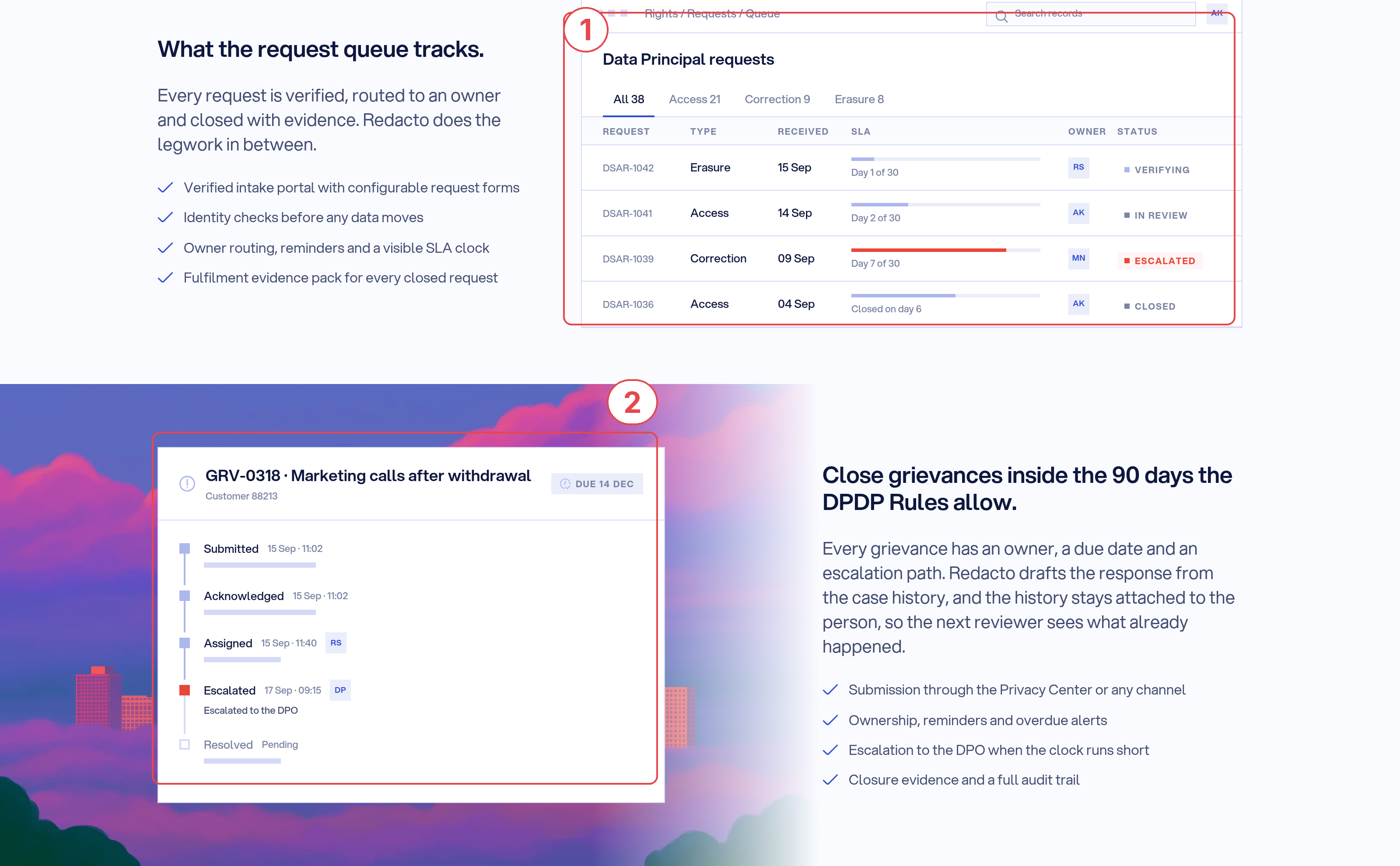
Redacto DSAR and Grievance Management puts access, correction, erasure and grievance requests in one queue.
A request lands through a verified intake portal. Identity is verified before any data moves. The request is routed to an owner, with reminders and a visible SLA clock. Redacto finds the person's data across connected systems and drafts a response; an owner has to approve what goes back. On closure, an evidence pack is kept.
Grievances are given an owner and a due date inside the ninety days Rule 14(3) allows. When the internal clock runs short, the case escalates to the DPO. The history stays attached to the person, so the next reviewer sees what already happened.
If a system has no API, the request becomes a tracked task on the same clock, and it only closes once the owner's evidence is on file. That fallback is the item I would not drop from a trial. A queue that ends when the last connector runs out still leaves branch, paper and older cores untouched.
I'd ask to see nomination, and any configurable ninety-day setting, in a demo before counting on them.
Pricing
Quote-based.
Reviews
There isn't a public review base yet.
Clients
The three customers quoted above are the public references I am using. Ask for a reference call in the same rights-and-grievance motion you are buying, not only a consent or vendor-review motion.
Summary
Pick Redacto if you want DSAR management and grievance on a record that can also hold consent, with a visible clock, owner approval before a response goes out, and a tracked task when a system has no API. It is a weaker fit if you only need a website banner, if you need a public price and a self-serve plan, or if becoming a Board-registered Consent Manager is the job you actually have.
The limits are real. There is no public price and no self-serve plan. There is no public review corpus. The DSAR name on the product can confuse a DPDP-only buyer. Confirm nomination, legal hold and the exact clock you will publish, in a trial, before you treat those as done.
2. OneTrust
Features
OneTrust Data Subject Request Automation is a global DSAR automation module. It does intake, identity verification, discovery, deletion, redaction, legal hold checks, and a secure customer portal for the response. Those are real operational jobs. Legal hold is one I would not drop from a bake-off, because you will have records you are not free to erase. Redaction before an access pack goes out is the other, because the file will otherwise contain other people's data.
If you already pay for OneTrust, the question is not whether the brand can do "requests." It is whether the tenant you have can run identity, legal hold, a secure response, and, for Indian work, a grievance under section 13, a nominee under section 14, a Rule 14 clock, and a request on a system with no connector. I'd ask to see those paths in a trial, against your own systems, before counting on them. A longer comparison of the wider suite sits in our OneTrust alternatives post.
Intake can sit with OneTrust's banner and Trust Center, which is useful if the person already manages preferences there. It does not, by itself, make this a DPDP grievance product.

Pricing
Quote-based. OneTrust pricing has no public self-serve price for this module. Our OneTrust pricing note is the place for the wider packaging conversation.
Reviews
There is no separate G2 corpus for Data Subject Request Automation. Comments sit on the platform-wide OneTrust Privacy Automation profile, which was 4.3 out of 5 from 155 reviews on 12 November 2026. Users on G2 like having request handling in the same platform as the rest of their privacy work, and complain about a long setup, a steep learning curve and a high price (G2, Jan 2026). A 29 July 2025 review that also talks about request handling is older than 12 months, so it is not the current picture.
Clients
Ask for a reference customer for the rights module. The Forrester line OneTrust quotes is a vendor-cited study, not a customer I have verified.
Summary
Pick OneTrust if you already run the platform and the module can show, in your tenant, identity checks, legal hold, redaction, a secure response, and the DPDP jobs a global DSR module may not cover. It is a weaker fit if you are starting from scratch in India, if you need a public price, or if grievance and nomination are the reason you are buying. Do not treat a DSR label as coverage of sections 13 and 14.
3. DataGrail
Features
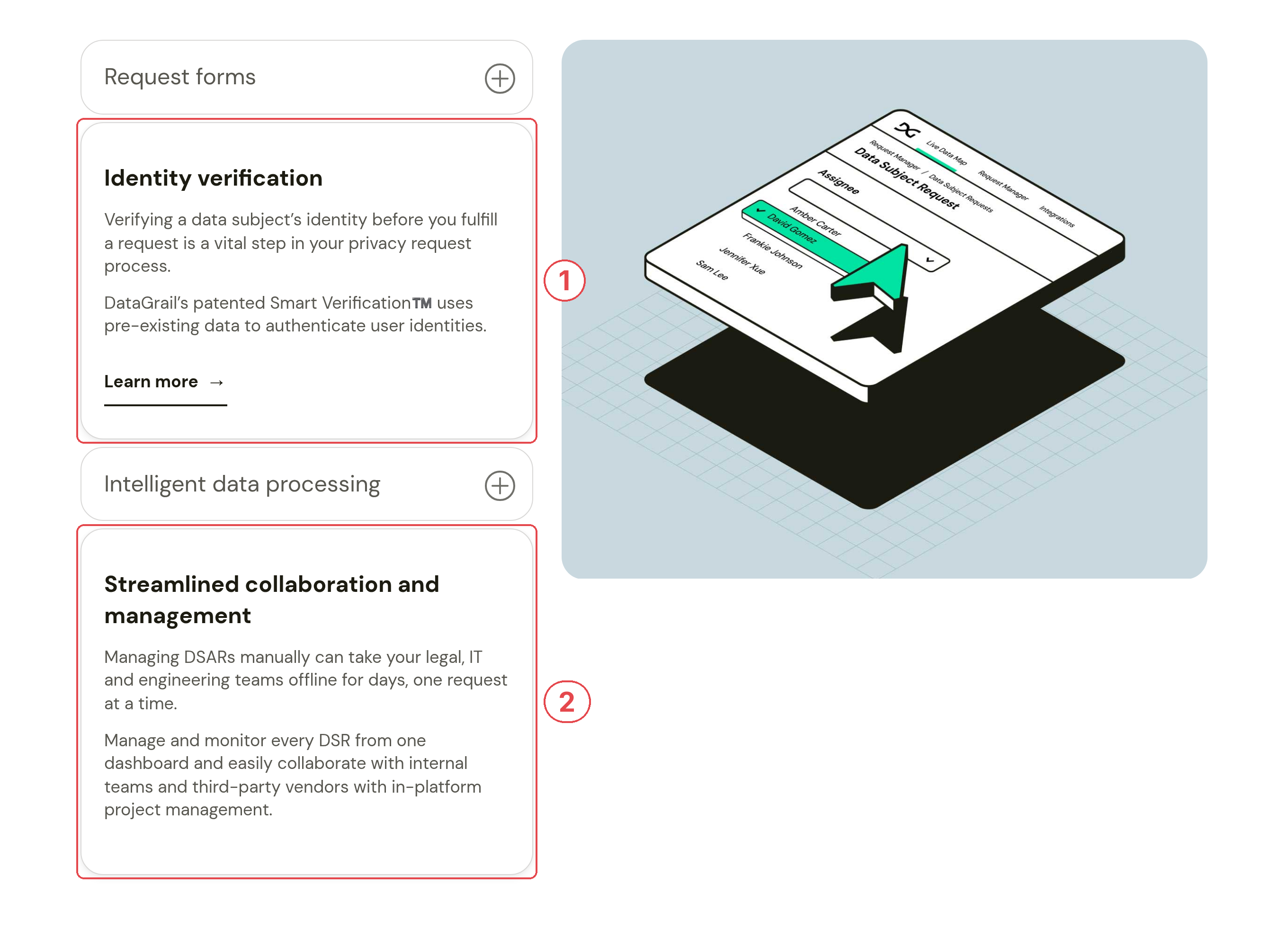
DataGrail Request Manager is built for access, deletion and opt-out requests across a SaaS-heavy stack. A branded form on your site funnels requests into one dashboard. Identity is verified with Smart Verification, which uses data you already hold, before fulfilment starts. The module then runs the request across connected internal and third-party systems, and gives legal, IT and vendor owners a place to collaborate without taking the work back to a shared inbox.
That collaboration layer is the reason I kept DataGrail on this list. A mid-market privacy team can run the queue from one screen if the connectors you actually use are in the catalogue. DataGrail talks about a very large connector catalogue; I'd still test the systems you run, including the awkward payment and franchise tools, in a trial. I'd also ask to see a no-API fallback, legal hold, redaction, and any DPDP grievance or nomination path before counting on them. Access, deletion and opt-out are the jobs I would start with.
Pricing
Quote-based. There's no public self-serve price for Request Manager.
Reviews
Comments sit on the platform-wide DataGrail profile, which was 4.7 out of 5 from 208 reviews on 12 November 2026. Users on G2 like DSAR automation, discovery and responsive support, and complain that data subject requests cannot be processed in bulk and that a request error is easy to miss until someone checks the queue by hand (G2, Mar 2026). An April 2026 review also mentions API connector errors that delayed the first connections by a few weeks.
Clients
Ask for a reference customer for Request Manager in a SaaS stack close to yours. The brand names DataGrail uses in its own profile are not customers I have verified for this module.
Summary
Pick DataGrail if most of the personal data lives in SaaS, you want access, deletion and opt-out automation with in-platform collaboration, and you can prove the connectors in a trial. Look elsewhere when you need a public price, a no-API path already shown as a tracked task, or a DPDP grievance and nomination path you have already seen in your own tenant.
4. TrustArc
Features
TrustArc Individual Rights Manager is a DSR automation module for intake, identity checks, routing, fulfilment and an audit trail. Intake forms can sit on web, mobile and app surfaces, and can adapt by jurisdiction and language. Once a request is in, TrustArc routes it, creates tasks for system owners, and tracks a due date that depends on the person's residence and the request type. The activity history is built to be handed to an auditor.
The ticketing connection is the item I would take to a demo first. TrustArc can land tasks in Jira, ServiceNow, Salesforce and Gmail, and can take status back into the case, so fulfilment happens in the queues your teams already watch. That is a real requirement for how the request moves, and it is one I would not assume from a generic "connectors" line.
The module also supports portability, restriction and objection, which matter under GDPR and some US state laws. There is no portability right in DPDP, so I would not buy this module for a portability checkbox in India. I'd ask to see grievance, nomination, legal hold and a no-API fallback in a demo before counting on them for DPDP work.

Pricing
Quote-based. I did not treat a third-party "from" figure as TrustArc's public plan.
Reviews
There is no separate G2 corpus for Individual Rights Manager. Comments sit on the platform-wide TrustArc profile, which was 4.2 out of 5 from 348 reviews on 12 November 2026. Users on G2 like a central place to run a privacy programme, and complain about a complex setup and menus that take extra training (G2, Oct 2026). A large share of the recent comments are about consent banners and assessments, so I would still ask for a reference who has run rights requests in this module.
Clients
Ask for a reference customer for Individual Rights Manager, ideally one that already uses the Jira or ServiceNow path.
Summary
Pick TrustArc if you need jurisdiction-aware deadlines, a defensible audit trail, and DSAR tasks that land in Jira or ServiceNow. It is a weaker fit if you are buying a narrow request tool, if you need a public price, or if the DPDP jobs (grievance, nomination, a no-API fallback) are the reason you are shopping. Confirm those paths, and the rights module itself, in a trial.
5. Ketch
Features
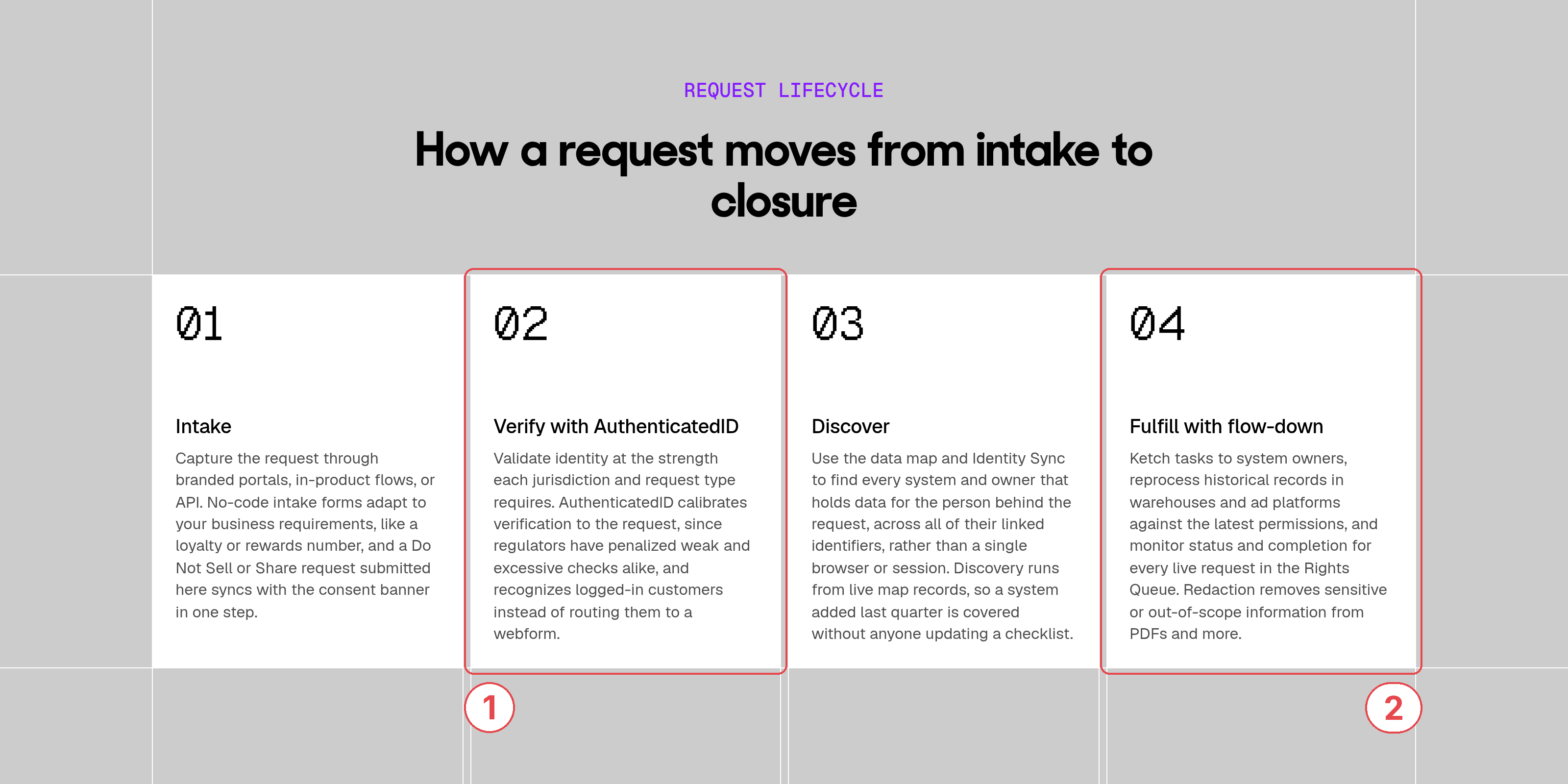
Ketch DSR Automation takes a request from a branded form, an in-product flow or an API, verifies the person with AuthenticatedID, and routes the work by region, type, system and owner, using the data map. Identity Sync is meant to join the different identifiers that belong to the same person, which matters when someone appears under an email in one system and an account ID in another. Deletion and opt-out can be applied to historical data, including records collected before the request arrives. Redaction can strip sensitive or out-of-scope information before a file is released. Progress sits in a Rights Queue.
A no-code request-flow builder is part of the module on the plans that include DSR automation. I'd still ask to see a no-API fallback, legal hold, and any DPDP grievance or nomination path in a demo. Routing, historical-data flow-down and identifier matching are the jobs I would start with. A wider look at the suite sits in our Ketch alternatives post.
Pricing
Ketch publishes a plan grid. Free at $0 and Starter at $150 a month are consent plans; they do not include DSR automation. Plus starts at $499 a month, billed annually, and offers Rights Workflows as an add-on. Pro is custom and includes DSR automation, data mapping and risk assessments. DSR automation is sold separately from consent management, so a banner contract is not a rights contract. I'd lock the add-on or Pro scope in writing before you treat DSR as included.
Reviews
Comments sit on the platform-wide Ketch profile, which was 4.6 out of 5 from 225 reviews on 13 November 2026. Most recent comments are about consent banners. Users on G2 like a straightforward setup and responsive support. A 30 October 2026 review by a verified mid-market user praises the easy setup and the help during rollout, scores Ketch 3.5 out of 5, and asks in its headline for clearer pricing (G2, 30 Oct 2026).
Clients
Ask for a reference customer for DSR automation, in addition to any banner reference. The RealReal and Renaissance quotes Ketch publishes are consent or programme comments, not rights-module references I have verified.
Summary
Pick Ketch if you need DSAR automation routed across many connected systems, including historical data, and you want a published plan grid you can take to finance. Look elsewhere when Free or Starter pricing is what you were shown, when you need a no-API path already demonstrated, or when grievance and nomination are the reason you are buying. Confirm the Rights Workflows add-on, or Pro, in the quote.
6. Securiti
Features
Securiti Data Subject Request Automation ties request fulfilment to a People Data Graph: intake forms, identity verification, pre-built fulfilment paths, and an encrypted portal for the response. Records are kept in one place for reviews and audits. A workbench gives a single view of open requests, with reports and an audit log. It also offers a large pre-built connector catalogue across hybrid, multi-cloud and SaaS systems.
In operational terms, that is a strong discovery-led fulfilment story for access, correction and erasure, if the graph actually covers the systems you run. I'd ask to see grievance, a Rule 14 clock, nomination, legal hold, and a no-API fallback in a demo before counting on them. Teams can collaborate on tasks without sending personal data over email, which may help when a request has to be worked by hand. That is still not the same as a tracked task that cannot close without evidence. A wider look at the suite sits in our Securiti AI alternatives post.

Pricing
Quote-based. There's no public price.
Reviews
Comments sit on the platform-wide Securiti profile, which was 4.6 out of 5 from 116 reviews on 12 November 2026, not on a standalone rights module. Users on G2 like automated request fulfilment tied to discovery across many systems, and complain about a heavy initial setup and enterprise-level pricing (G2, Aug 2026).
Clients
Ask for a reference customer for the rights module.
Summary
Pick Securiti if you already use it for discovery and want request fulfilment on the same graph, and you can prove in a trial that your systems, grievance and nomination are covered. Choose another tool when the requirement is an India-native rights specialist, a public price, or a Rule 14 grievance path you have already seen in a trial. The connector count helps only for the systems those connectors actually reach.
7. IQWorks
Features
IQWorks DSR Automation splits the work the way many privacy teams already split it. ComplyIQ owns the request: a branded public form, email verification with a one-time code, CAPTCHA on the form, a single queue with owner, age and deadline flags, and correspondence with the person and with processors, kept on the record. DiscoverIQ owns the search across databases, SaaS apps, file shares and endpoints.
The useful join is the hand-off. From the request, you can open a DiscoverIQ scan that is already filled with the requester's name and email. Someone still has to start that scan and review the matches; it is a guided hand-off, not a request that closes itself. The scan only covers sources DiscoverIQ has already indexed. That honesty is why I kept IQWorks on this list, and it is also the limit I would test. I'd ask to see legal hold, redaction, a no-API fallback outside the indexed footprint, and any DPDP grievance or nomination path in a demo before counting on them.
A 30-day clock on the queue can be a useful service target. It is not a DPDP statutory deadline for access or erasure, and I would not treat a vendor's "DPDP 30-day" line as one.

Pricing
Quote-based. There's no public price.
Reviews
There isn't a public review base for IQWorks that I would treat as a rights-module corpus.
Clients
Ask for a reference customer for the ComplyIQ and DiscoverIQ hand-off, in a stack close to yours.
Summary
Pick IQWorks if the gap in your process is joining the request queue to a discovery scan, with the person's identifiers already filled in, and you can accept that an operator still runs and reviews that scan. Look elsewhere when you need unattended fulfilment across a large connector catalogue, a public price, an independent review base, or a DPDP grievance and nomination path you have already seen in a demo.
India-native Data Principal rights tools
If you are buying primarily for DPDP rights, including grievance and nomination, these India-native tools are worth a look alongside the DSAR modules above. They are a separate shortlist, not part of the seven-tool comparison table.
Privy by IDfy
Features
Privy Data Principal Rights Management is a named module in Privy's India-built suite. It gives a Data Principal a multilingual portal, in 22 Indian languages, to raise and track requests for access, erasure, renewal or grievance. Request status is shown as accepted, pending or resolved, and the module keeps an immutable proof of what was done.
Grievances and data requests can be routed to agents or processors, with SLAs, reminders and closure tracking. The module also includes built-in chat with the Data Principal, and automatic updates when a grievance is resolved, when consent changes, or when a breach affects the person. DPRM is connected to consent, data discovery and incident management, so a request can be matched against historical consent logs, and processor purge actions can be watched.
I'd ask to see a nominee request from intake to closure in a demo before counting on nomination. Access, erasure and grievance are the jobs I would start with.

Pricing
Quote-based. There's no public price.
Reviews
There isn't a Privy-specific review corpus on G2. IDfy's KYC product reviews are not a substitute.
Clients
Ask for a reference customer for the rights module.
Summary
Choose Privy for an India-native suite with a named rights module, a 22-language portal, and grievance sitting next to access and erasure. Look elsewhere when a public price, an independent review base, or a no-API path spelled out as a tracked manual task is a requirement. Confirm nomination and DPO escalation in a demo.
Consentin
Features
Consentin runs a Privacy Rights Centre that logs access, correction and erasure requests, assigns them to a team, and tracks SLAs. A dedicated rights URL was not available on 12 November 2026, so this is the URL I used. A Data Principal can raise a request from a Privacy Centre on your site, or from a Consentin account, with email OTP on the sample form. Response records are kept so you can show what was done if the Board asks.
I'd ask to see grievance under section 13, nomination under section 14, and a no-API fallback in a demo before counting on them. The suite around the rights job is broader: notices, withdrawal, retention and deletion, assessments and breach. That is useful context, and it is also a reason to keep this entry scoped to the rights job. I would not take a vendor's "mandated timeline" line as a substitute for Rule 14. For access and erasure, remember, the Rules do not set a statutory deadline.

Pricing
Quote-based for the paid suite. Consentin's pricing offers a Starter Pack of 3,000 consent collects a month at ₹0, forever, and paid packs billed as a flat annual or quarterly fee on consent volume. That public price is for consent collects, not a rights-request meter. Ask what a rights-only or suite contract actually costs.
Reviews
There isn't a public review base for Consentin.
Clients
Consentin is built by Leegality, which works with 100+ banks. Ask for a reference customer for the rights module.
Summary
Pick Consentin if you already want notices and artefacts in the same India-built suite, and the Privacy Rights Centre can show access, correction and erasure on an SLA you can audit. It is a weaker fit if nomination and grievance are the reason you are buying. I'd ask to see both in a demo before counting on them, along with the path for a system that has no connector.
Consiva
Features
Consiva Data Principal Rights Management is an India-native rights product, and it is the most complete DPDP right-set in this India-native group. Intake, identity checks, routing, fulfilment and a case file cover access, correction, erasure, grievance and nomination. Like the official text, Consiva does not invent a portability right.
Identity is verified by OTP, with the strength set by request type, before a case is assigned to a named owner. Two clocks are tracked separately: a service timer you choose for access, correction, erasure and nomination, and a published grievance period for section 13, capped at ninety days by Rule 14(3). Cases escalate before either clock runs out. A closed file includes the request, the verification, the systems searched, the action taken, any refusal with its statutory basis, and the response.
On erasure, a refusal that relies on a retention duty is recorded as a reasoned entry, which is the right shape for section 12(3). Where a system has no connector, a manual search is assigned to a named owner and recorded as a manual step the owner reported, not as a verified connector result. That honesty is rare, and I would still want to see that manual step in a demo.

Pricing
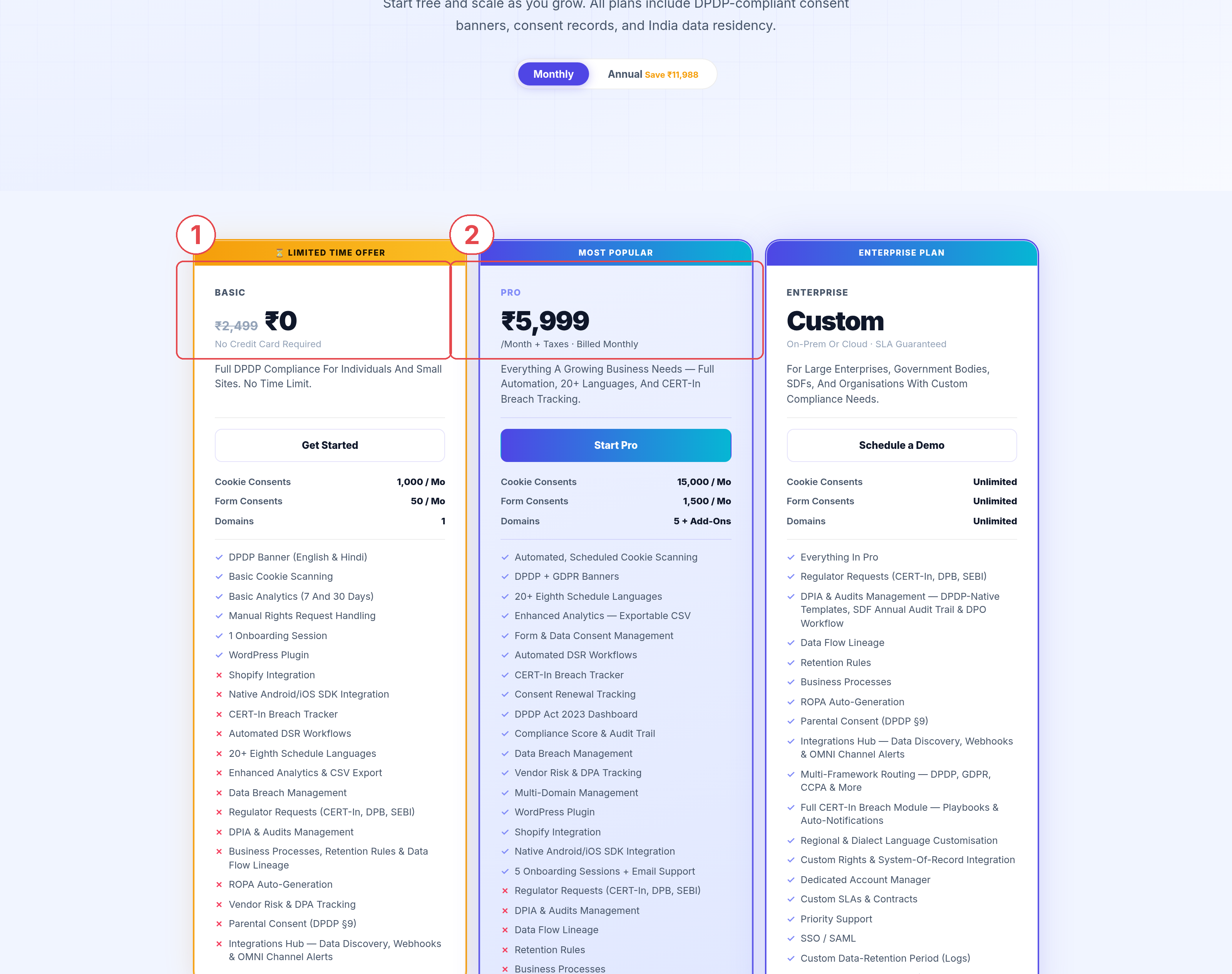
Public, and still live on 13 November 2026. Consiva keeps rights requests unmetered on every plan, including Free, and never charges by volume. Pricing is a Basic plan at ₹0 (no credit card), a Pro plan at ₹5,999 a month plus taxes, and Enterprise on request. That ₹0 is a limited-time offer, down from ₹2,499, so I'd lock the price in writing before you sign, even though Consiva still calls its Free plan permanent. The ₹0 plan includes manual rights-request handling; automated rights handling sits on Pro. I would weigh the two together: unlimited volume, including on the free plan, with automation as a paid step.
Reviews
There isn't a public review base for Consiva.
Clients
Ask for a reference customer for the rights module. The healthcare scenario Consiva uses is a sample, not a named customer.
Summary
Pick Consiva if you want an India-native specialist that covers nomination and grievance, separates the Rule 14 clock from a service timer, and has a public plan, including a ₹0 Basic option, for now a limited-time offer down from ₹2,499, with unmetered rights volume. Look elsewhere if a large global connector catalogue, an independent review base, or a rights module already sitting inside a suite you pay for is the requirement. Confirm, in a trial, that the manual path and the two clocks actually run that way.
OneConsent
Features
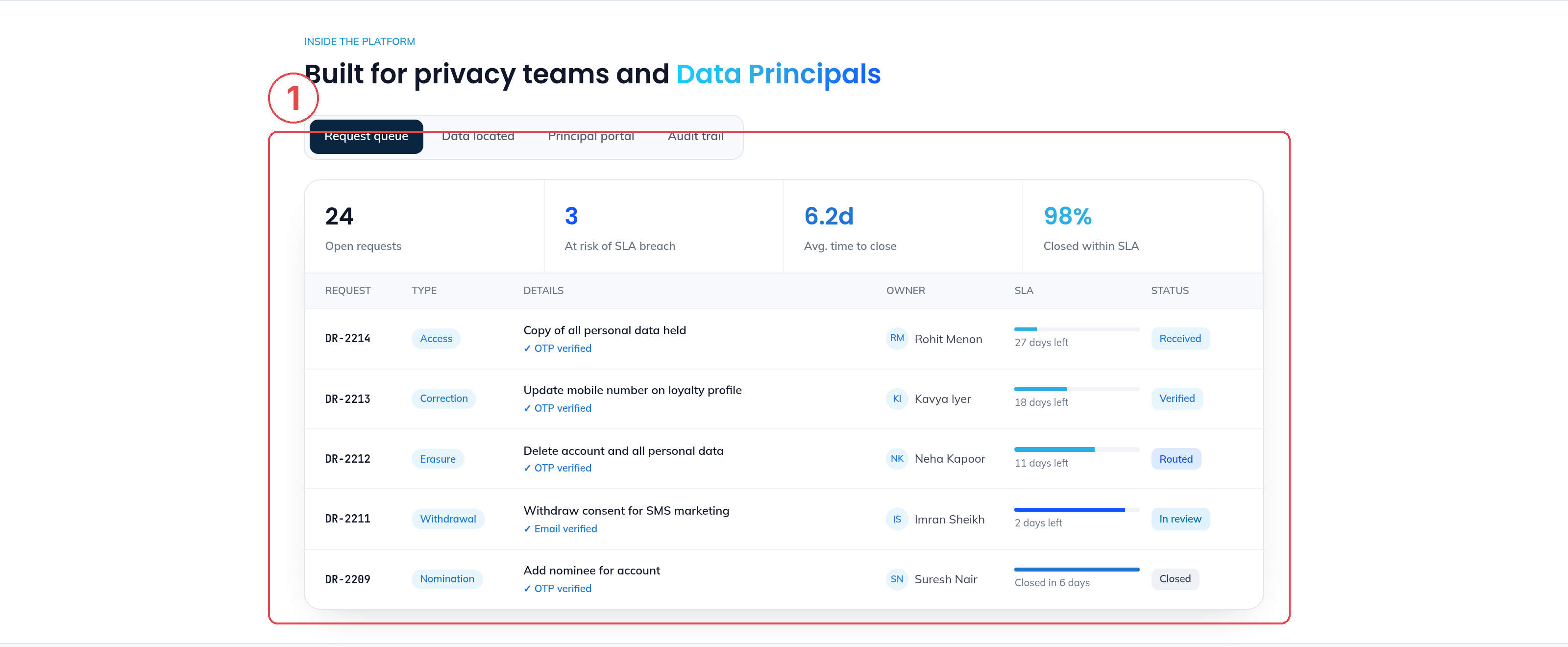
OneConsent Data Principal rights is a dedicated rights surface. It runs a single queue for access, correction, erasure, withdrawal and nomination, with identity checks (OTP in the sample queue), owner assignment, a live SLA clock, and an exportable audit trail. Requests can arrive from a portal, email, app or API. Each request is matched against a data-discovery inventory, so the team sees where the person's data lives before anyone starts searching.
Nomination appears in the sample queue as a closed request. I'd ask to see grievance under section 13, a Rule 14 clock, DPO escalation, legal hold, and a no-API fallback in a demo before counting on them.
Pricing
Quote-based. There's no public price.
Reviews
There isn't a public review base for OneConsent.
Clients
Ask for a reference customer for the rights module.
Summary
Choose OneConsent for an India-native rights queue that already shows nomination, identity checks and a discovery-linked fulfilment path. Hold off if a public price, a review corpus, or a grievance path you have already seen in a demo is required. The discovery link is the reason to take a trial seriously; the missing Rule 14 jobs are the reason not to sign from the brochure.
DPDP.ai
Features
DPDP.ai's Data Principal Rights Management Platform offers a self-service portal for access, correction, erasure and nomination, with multilingual support, status tracking and notifications. Identity is verified before personal data is processed, and the verification is kept on the request history. A single queue handles requests and grievances, with an SLA clock, routing, reminders and chat. Approved erasure can be pushed to connected applications, databases, vendors and processors, with evidence of what was completed. An audit trail records each action, actor and time.

Pricing
Quote-based. There's no public price.
Reviews
There isn't a public review base for DPDP.ai.
Clients
Ask for a reference customer for the rights module.
Summary
Choose DPDP.ai for an India-native platform that covers nomination and grievance, identity checks, an SLA clock and connected-system erasure, if you are willing to prove those jobs in a trial. Pass on it when the requirement is a public price, an independent review, or a no-API path set out as a tracked manual task. Ignore speed and volume slogans until you have run one real request to closure.
How to choose, by situation
We need end-to-end DSAR automation, not only a ticket
Start with the module that can find the data, check identity, fulfil or refuse with a reason, and leave a file you can export. OneTrust and Securiti are the first calls if you already pay for the platform. DataGrail is the first call if the stack is mostly SaaS. Ketch is the first call if the work is routing across many systems, including historical data. IQWorks is the first call if the gap is launching a discovery scan from the request itself. In every case, break a connector in the trial and watch how a failed fulfilment is surfaced.
We already pay for OneTrust
Keep the module if a trial on your own systems shows identity checks, fulfilment, legal hold or a reasoned refusal, redaction, a secure response, and a file you can export. Then decide whether you still have a gap. If those core DSAR jobs cannot be shown, you are paying for a label. A wider view of the suite sits in OneTrust alternatives.
Our personal data mostly lives in SaaS
DataGrail is the starting point, because Request Manager is built for access, deletion and opt-out across a large SaaS catalogue, with in-platform collaboration. Put Ketch next to it if identifier matching and historical-data flow-down matter more than the SaaS collaboration layer. In the trial, use the systems you actually run, including the awkward ones, and watch what happens when a request hits an error.
We need tasks to land in Jira or ServiceNow
TrustArc is the first call, because Individual Rights Manager can open tasks in Jira, ServiceNow, Salesforce and Gmail and take status back into the case. Ask to see that round trip with your own project queues, not a slide. If you already live in OneTrust or Securiti, ask for the same ticketing path in the tenant you pay for before you add a second tool.
We are a small privacy team handling rising volume
You need intake that is not a shared inbox, a clock you can see, and as much fulfilment as your connectors will honestly support. DataGrail and Ketch are built for a small team that has to move requests without a large operations bench. Redacto is the starting point if you also need a tracked fallback when a system has no API, and you want the request on the same programme record as consent. A "45-day" deadline is not the GDPR default (one month, with a possible two-month extension) and it is not a DPDP figure for access or erasure. Set the clock you will actually publish, and test it.
Many of our systems have no API
Treat the fallback as a scored item, not a footnote. Redacto raises a tracked task on the same clock and will not close the request without evidence. If a vendor can only show connectors, assume the request stops at the last system you already hooked up. Branch, paper and older cores are usually where that failure appears.
We need grievance and nomination, not only access
Start with Consiva, which covers both jobs and separates the Rule 14 grievance period from a service timer. Then put Privy, OneConsent and DPDP.ai in a demo and ask to see a nominee request and a grievance, from intake to an exportable file. If you already pay for OneTrust or Securiti, do not assume the module you have covers sections 13 and 14; ask for the same two paths in your tenant. Redacto is strong on grievance and the DPO path; I'd ask to see nomination in a demo before counting on it.
We want an India-native specialist with a published plan
Consiva is the one product in the India-native group with a public price: a ₹0 Basic plan, for now a limited-time offer down from ₹2,499, Pro at ₹5,999 a month plus taxes, and unmetered rights volume on every plan, including Free, on its pricing. Consentin's Starter Pack is 3,000 consent collects a month at ₹0, but that is not a rights price. The seven tools in the main table are quote-based, except Ketch, which publishes a plan grid with DSR automation on Pro or as a Plus add-on. If a public DPDP rights plan matters, start with Consiva and put one suite vendor next to it so you can compare what you actually get for the quote.
Final thoughts
The expensive failure is still a shared inbox. A request arrives, identity is informal, the clock is a calendar reminder, and the first serious document you produce is a reconstruction after something has already gone wrong. Buy the queue, the identity check, the fulfilment path in the systems you actually run, the clock you will actually publish, and the file you can export.
If you already pay for a global DSAR module, test the jobs it does not advertise: legal hold, redaction, ticketing, and the request that lands on a system with no API. If you want DSAR management and automation on one programme record, with a visible clock and a tracked fallback, start with Redacto.
If you want an India-native specialist with a public plan, Consiva is the one with a public price as I write this. Sections 11 to 14 are not a single "request type." Access is a summary. Erasure has a lawful-retention exception. Grievance has a period that must not exceed ninety days. Nomination is a separate right, for death or incapacity. If a product only automates access and deletion, it is only doing part of the statute.